
Round Bottom Flask, Narrow Neck

Product Code : LSK-LF-10428
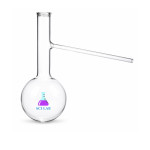
The Round Bottom Flask, Narrow Neck is a boiling flask in borosilicate glass 3.3 with a 166 mm round body and a 50 mm narrow neck finished with a beaded rim. It stands 260 mm high overall. The round body spreads heat and stress evenly, so it suits boiling, steam generation and holding batches of liquid in the laboratory.
Specifications of the Narrow Neck Round Bottom Flask
| Specification | Value |
|---|---|
| Material | Borosilicate glass 3.3 |
| Shape | Round bottom |
| Neck | Narrow, 50 mm diameter, with beaded rim |
| Body diameter | 166 mm (about 6.5 in) |
| Height | 260 mm overall (about 10.2 in) |
| Manufacturer | Science Lab Supplies, Saha, Ambala, India |
Boiling and Steam Work with the Narrow Neck Round Flask
A round flask holds water or solution well for long boiling runs. It is clamped at the neck and supported under the body, and heated slowly through a gauze or in a bath so the thick curve of glass warms evenly.
- Steam generator for steam distillation: fill the flask about half with water, fit a stopper carrying a long safety tube and a steam outlet, and heat over a Bunsen Burner, 150 mm.
- Gentle direct heating: rest the flask on a Wire Gauze (Metal Mesh) for Heating so the flame does not touch one spot of the glass.
- Supporting the weight: hold the neck in the clamp of a Ring Stand Set, Rectangular Base, with Burette Clamp and Rings and set a ring under the body.
Precautions: never heat the flask empty, raise the heat gradually, and check the glass for star cracks or deep scratches before each use.
Frequently Asked Questions
What does the rim on the neck do?
The rim thickens the lip so it resists chipping when stoppers go in and out. It also gives clamp jaws and tubing a firm edge to hold, and keeps a foil or cloth cover in place.
Can a borosilicate round flask be sterilised in an autoclave?
Borosilicate glass of this kind takes steam sterilisation. Leave any stopper or cover loose so pressure can equalise, and let the flask cool slowly in the autoclave instead of moving it straight onto a cold bench.
Which chemicals does borosilicate glass resist?
It stands up to water, most acids, salt solutions and organic solvents. Hydrofluoric acid attacks it quickly, and hot concentrated phosphoric acid or strong hot alkalis slowly etch it, so do not boil those in the flask for long periods.
How is a narrow-neck round flask cleaned inside?
Rinse it soon after use so residue does not dry on. For stubborn soil, fill it with warm detergent solution and soak it fully under water with no air trapped inside. Then scrub through the neck with a bottle brush, rinse with tap water and finish with distilled water.
How can you tell the flask is really clean?
Pour distilled water through it. On clean glass the water drains as an even, unbroken film. Droplets or dry patches mean grease is left on the wall, and the flask needs washing again.
How should the flask be dried after washing?
Let it drain upside down on a rack, or dry it in a drying oven when it is needed quickly. Do not wipe the inside with paper, which leaves fibres on the glass.
Related Round Bottom and Boiling Flasks
- Round Bottom Flask, Wide Neck: 105 mm diameter, 168 mm height, beaded rim on a 50 mm neck.
- Round Bottom Flask, 500 ml, Long Neck: 500 ml spherical body with a long neck.
- Round-bottom Flask: round body with a 14/29 ground joint neck.
- Borosilicate Flat Bottom Flask: flat base that stands on the bench without a support ring.
- Laboratory Glassware Washing Brush, 200 x 35 mm: medium nylon bristles on twisted stainless-steel wire.
Find more boiling and reaction flasks under Laboratory Flasks, or beakers and general glass under Lab Glassware.
Nigeria, Kenya, Ghana, Ethiopia, Tanzania and Uganda are within reach for these narrow neck round flasks, which Science Lab Supplies exports with its Importer-Exporter Code. Ask for a quotation by giving the quantity on the contact page or through the enquiry cart.
Last updated: 26 November 2026

.jpg)


.jpg)