
Dissolution Vessel, Flask D, 1000 mL, Borosilicate Glass, Without Side Cut
Product Code : LSK-LF-10430
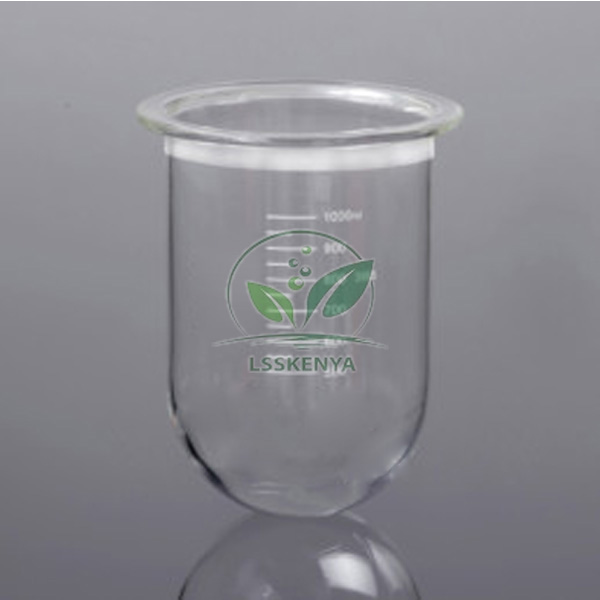
The Dissolution Vessel, Flask D, 1000 mL, is used in dissolution testing to measure how a medicine in a tablet or capsule dissolves in a test medium. It is made of clear, heat-resistant, low-expansion borosilicate glass, with a cylindrical wall, a smooth hemispherical bottom, graduations at 50 ml intervals and a rim without a side cut.
Specifications of the Flask-D Dissolution Vessel
| Specification | Value |
|---|---|
| Material | Clear, heat-resistant, low-expansion borosilicate glass |
| Capacity | 1000 ml nominal |
| Shape | Cylindrical wall with a smooth hemispherical bottom |
| Internal diameter | About 100-105 mm |
| Height | About 160-185 mm |
| Graduation | Marked at 50 ml intervals |
| Rim | Without side cut |
| Use | Dissolution testing of tablets and capsules |
| Manufacturer | Science Lab Supplies, Saha, Ambala, India |
Running a Dissolution Test in the Flask-D Vessel
The vessel sits in the water bath of a dissolution tester and holds the test medium at the set temperature. A paddle or basket turns at a fixed speed while samples are drawn at set times and analysed for dissolved drug.
- Release profile of a tablet (B.Pharm. practical): degas and warm the medium, fill the vessel, drop in the tablet and draw each sample from the same point with a Volumetric (One-Mark) Pipette, 5 ml.
- Disintegration and dissolution compared: test the same batch in Beakers, Tablet Disintegration on the disintegration machine, then in this vessel, and relate break-up time to release.
- Floating capsules: wrap the capsule in a sinker so it stays at the bottom of the vessel during the run.
Common errors: bubbles from medium that was not degassed, a vessel that is off-centre under the paddle, and evaporation from an uncovered vessel during a long run.
Frequently Asked Questions
What should be checked before ordering dissolution flasks?
Check the vessel against the bath and holder plate of the tester in use: first the rim or flange and its locating fit, then the body size and the glass colour. This clear vessel holds 1000 ml, has no side cut and measures about 100-105 mm inside and about 160-185 mm high; these body sizes are separate from the flange seating dimensions.
Can vessels from different testers be mixed in one bath?
It is better not to. Small differences in diameter and rim shape change how a vessel centres and stands upright under the paddle, and that can shift results between positions. Keep a matched set for each tester.
Is glass or plastic better for dissolution vessels?
Glass vessels resist most media, pass heat evenly from the bath and show scratches or chips clearly. Plastic vessels resist breakage but scratch more easily and warm up differently. This vessel is borosilicate glass.
Why must the medium be degassed before the test?
Dissolved air comes out as bubbles on the tablet and the vessel wall. Bubbles cover part of the tablet surface and disturb the flow around it, so the drug may dissolve more slowly and results vary from vessel to vessel.
What causes a cone of powder under the paddle?
Coning happens when the vessel is off-centre or the paddle speed is wrong, leaving a still zone at the bottom where powder piles up. Check centring and verticality, and run at the speed the method gives.
Related Dissolution and Volumetric Items
- Amber Dissolution Vessel, Flask E, 1000 ml, Without Side Cut: amber borosilicate vessel, 1000 ml, 131 mm diameter, 173 mm high.
- Water bath, 7 L: stainless steel bath from 3 °C above ambient to 100 °C.
- Laboratory Thermometers: alcohol-filled glass thermometers reading −10 to 100 °C.
- Volumetric Flask with Stopper (One-Mark), 50-500 ml: one-mark glass flasks in 50 ml, 100 ml and 500 ml.
Other specialised flasks are in Laboratory Flasks, and beakers for tablet testing in Glassware Beaker.
Pharmacy colleges and quality laboratories in Ghana, Ethiopia, Tanzania, Uganda, the UAE and Saudi Arabia can import Flask-D vessels from Science Lab Supplies under its Importer-Exporter Code. To have a quotation drawn up, state the number of vessels on the contact page or in the enquiry cart.
Last updated: 26 November 2026

.jpg)

.jpg)


