
Flask Erlenmeyer with Screw Cap
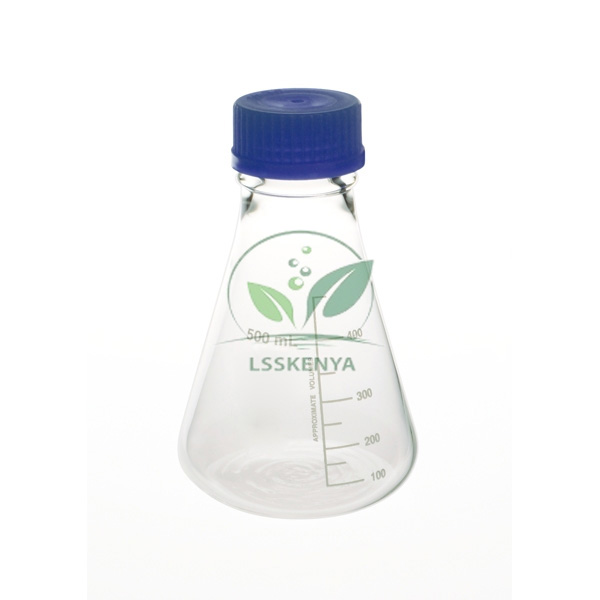
Product Code : LSK-LF-10417
The Flask Erlenmeyer with Screw Cap is a conical flask in heat-resistant borosilicate glass, closed by a polyethylene screw cap with a PTFE liner. The cap is autoclavable, so media, buffers and reagents can be sterilised, closed and stored in the same flask. Five capacities from 50 ml to 1000 ml are offered on two thread sizes.
Specifications of the Screw Cap Erlenmeyer Flask
| Specification | Value |
|---|---|
| Flask | Erlenmeyer (conical) shape, borosilicate glass, heat resistant |
| Cap | Polyethylene screw cap, autoclavable |
| Cap liner | PTFE |
| Capacities and body diameters | 50 ml (51 mm), 100 ml (64 mm), 250 ml (85 mm), 500 ml (105 mm), 1000 ml (131 mm) |
| Thread size | 25 on the 50 ml and 100 ml flasks; 32 on the 250 ml, 500 ml and 1000 ml flasks |
| Supplied by | Science Lab Supplies, Ambala, India |
Sterilising and Storing Media in the Screw Cap Flask
The cap screws onto the threaded neck in place of a cotton plug or foil. The PTFE liner faces the contents, so the polyethylene shell stays clear of the liquid. A closed flask can be shaken, carried and stored without spills or evaporation.
- Nutrient broth or agar: fill the flask no more than half full, unscrew the cap about a quarter turn and sterilise in an Autoclave Analogue Top Loading. Tighten the cap only after the load has cooled.
- Pouring plates: melt and cool the sterile agar, flame the neck briefly and pour into a Glass Petri Dish with Cover, 100 mm.
- Buffers and stock solutions: make up, label and keep the closed flask on the shelf for the next practical.
Precaution: never heat or autoclave the flask with the cap screwed down tight. Trapped steam and air build pressure that can crack the glass or force the cap off.
Frequently Asked Questions
Can the flask and its cap go into the autoclave together?
Yes. The borosilicate flask takes steam sterilisation, and the polyethylene cap is autoclavable. Put the cap on loosely before the cycle, so steam can reach the inside and pressure can escape.
What does the PTFE liner inside the cap do?
It is the surface that touches the liquid and the rim of the neck. PTFE resists almost all laboratory chemicals and does not swell in solvents, so the seal stays tight and the contents do not pick up anything from the plastic cap.
What is a screw cap conical flask used for?
It holds liquids that must stay closed for some time: culture media, broths, buffers, standards and samples. The conical shape still allows swirling, and the cap replaces cotton plugs, foil or rubber stoppers.
Why must the cap be left loose during sterilisation?
Air and steam inside a sealed flask expand when heated. With the cap tight, pressure builds and can push the cap off, break the glass or stop steam reaching the medium, so the contents may not be sterile.
When should the cap be tightened after the cycle?
Wait until the flask has cooled and the pressure inside has settled, then tighten it promptly with clean hands. Touch only the outside of the cap, because each extra handling step is a chance for contamination.
How are the cap threads kept clean?
Medium that dries in the threads is hard to remove and can harbour microbes. Wipe drips off the neck before closing, wash the cap and liner separately in warm detergent and rinse well before the next use.
Related Flasks and Media Glassware
- Glass Reagent Bottle With Screw Cap: 250 ml borosilicate 3.3 bottle with a polypropylene screw cap and drip-free pouring ring.
- Baffled Culture Flask: four equidistant baffles give steady agitation on an orbital shaker.
- Conical Flask (Erlenmeyer) with Stopper, 25-500 ml: ground glass fixed stopper and a reinforced beaded rim.
- Borosilicate Conical Flask: clear glass with a flat base and a narrow neck.
- Autoclave Bags: strong, pliable bags that resist leaks and punctures.
More flasks for culture and storage are listed under Laboratory Flasks, and stoppers, bottles and dishes under Lab Glassware.
Screw cap flasks can leave India under the Importer-Exporter Code held by Science Lab Supplies, bound for Bangladesh, Zambia, Rwanda, South Africa, Qatar or Sri Lanka. Name the capacities and quantities on the contact page, or collect them in the enquiry cart and ask for a quotation.
Last updated: 20 November 2026
.jpg)


