
Human Skeleton Chart
Product Code : SCL-BLE-11766
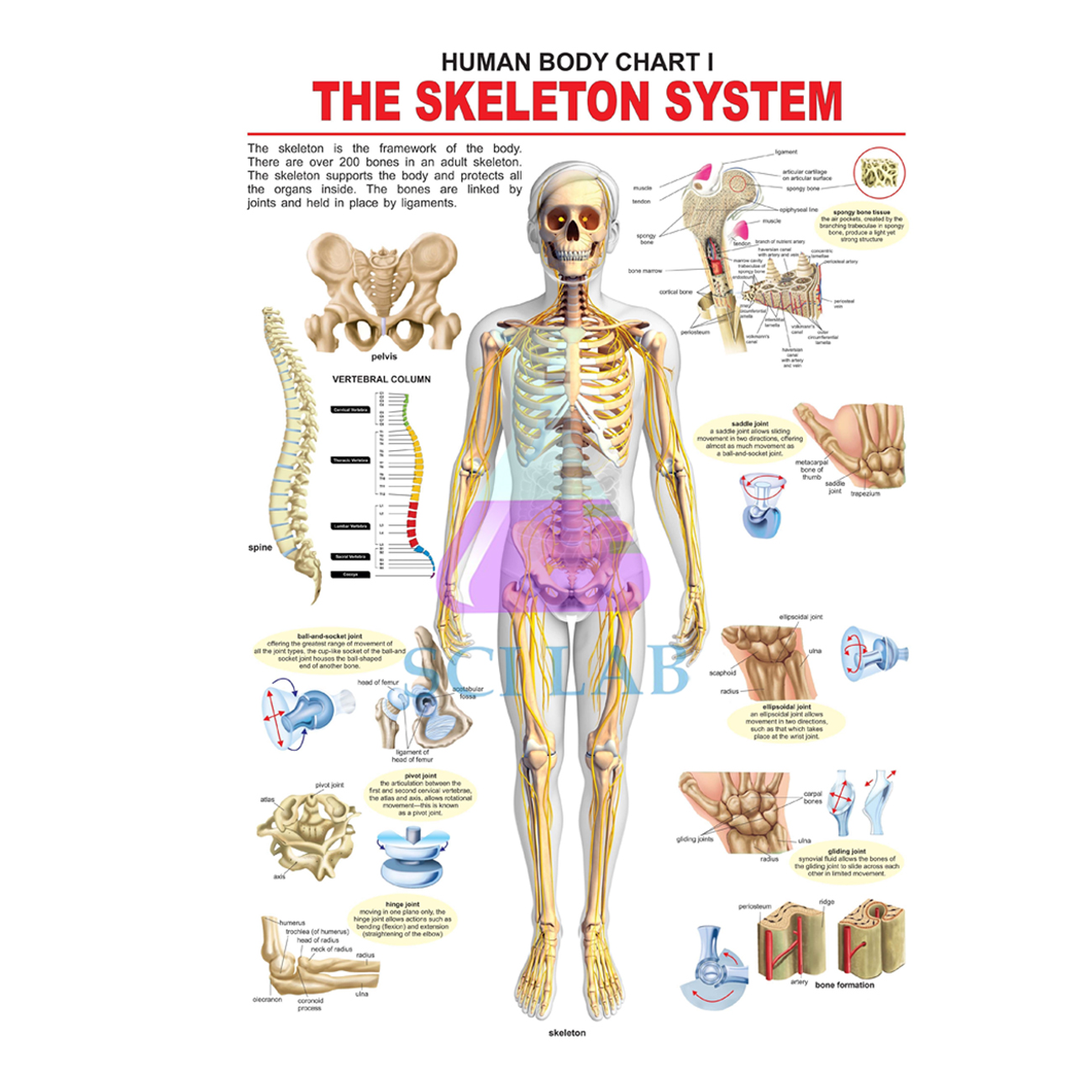
The Human Skeleton Chart is a laminated wall chart, 70 x 100 cm, showing the skeleton from the front and the back with an inset of the hand and foot. English labels name the skull, spine, ribs, pelvis and the major arm and leg bones. It is fitted with rods and a top cord for hanging in a laboratory or classroom.
Specifications of the Skeleton Chart
| Specification | Value |
|---|---|
| Subject | Human skeleton |
| Views | Front and back, with a hand and foot inset |
| Bones labelled | Skull, spine, ribs, pelvis, major arm and leg bones |
| Labels | English |
| Finish | Laminated |
| Size | 70 x 100 cm (700 x 1000 mm) |
| Mounting | Wall mounted, with rods and a top hanging cord |
| Use | Laboratory and classroom |
| Supplied by | Science Lab Supplies, Ambala, India |
Bone Identification Lessons with the Skeleton Chart
The chart is the fixed reference on the wall. Students find a bone on the chart first, then locate the same bone on a model and feel for it on their own arm, leg or spine.
- Axial and appendicular skeleton (Class 11): sort the skull, spine, ribs and sternum from the girdles and limbs, then check the grouping on the Human Skeleton Model 45 cm.
- Bone shapes: pick out long, flat, irregular and sesamoid bones on the main views and the short bones on the hand and foot inset, then hold the matching loose bones of a Disarticulated Human Skeleton Model.
- Joint survey: mark the ball-and-socket joints at the shoulder and hip, the hinge joints at the elbow and knee, and the fixed joints between the bones of the skull.
Common errors: mixing up the radius and ulna, or the tibia and fibula. In the standard anatomical position the radius lies on the thumb side of the forearm, and the tibia is the thicker bone on the big-toe side of the leg.
Frequently Asked Questions
Should a skeleton chart for nursing or physiotherapy courses carry Latin bone names?
Often, yes. School biology uses English names such as collarbone and hip bone, while anatomy courses also expect the Latin terms, such as clavicula and os coxae. This chart is labelled in English, which suits school classes; for anatomy courses, tutors add the Latin terms during the lesson.
Which buyers besides schools use a full-body skeleton chart?
Nursing, physiotherapy and paramedical colleges use one when teaching fractures, joint wear and posture. First-aid and sports-coaching courses use it to show where common injuries happen. A laminated surface suits rooms where the chart is pointed at and wiped often.
Which bones belong to the axial skeleton and which to the appendicular?
The axial skeleton is the central axis: skull, ear ossicles, hyoid, vertebral column, ribs and sternum, 80 bones in all. The appendicular skeleton is the shoulder and hip girdles with the arms and legs, 126 bones.
Which are the longest and the smallest bones in the body?
The femur in the thigh is the longest and strongest bone. The smallest is the stapes, one of the three ear ossicles, about 3 mm long. The ossicles sit deep inside the skull, in the middle ear.
How are bones grouped by their shape?
Long bones, such as the femur and humerus, are longer than they are wide. Short bones are the cube-like carpals and tarsals. Flat bones, such as the sternum, ribs and scapula, protect organs or anchor muscles. Vertebrae are irregular bones, and the kneecap is a sesamoid bone set inside a tendon.
Related Skeleton Models and Anatomy Charts
- Human Skeleton Model, Life Size PVC: 170 cm PVC skeleton with removable arms and legs and a movable jaw.
- Medium Human Skeleton Model, Painted: 85 cm PVC skeleton painted to show the main arteries and peripheral nerves.
- Human Muscles Chart: laminated, wall-mounted chart in the same 70 x 100 cm size.
- Human Jaw and Teeth Model: enlarged PVC jaw with the adult permanent teeth, each removable and keyed to its socket.
- Comparison of Limbs in Vertebrates: scaled PVC replicas of five homologous forelimbs on one board, with an English key.
For three-dimensional bones to set beside this chart, open Skeleton, Bones and Joints Model; the remaining wall charts of the series are listed in Charts & Portraits.
The skeleton chart is open to export orders from Malaysia, Peru, Egypt, Iraq, Nigeria and Kenya, which Science Lab Supplies can handle with its Importer-Exporter Code. To have the chart quoted, give the number of copies on the contact page or add it to the enquiry cart.
Last updated: 19 November 2026






.jpg)