
Conditioned Reflexes Chart
Product Code : SCL-BLE-11751
The Conditioned Reflexes Chart is a laminated 70 x 100 cm wall chart on how a conditioned reflex forms by association: a neutral signal, paired again and again with a stimulus that already sets off a reflex, comes to set off the response by itself. Panels labelled in English show the stimulus, the association and the conditioned response, with before, during and after captions.
Specifications of the Conditioned Reflexes Chart
| Specification | Value |
|---|---|
| Subject | Formation of conditioned reflexes |
| Panels | Stimulus, association and conditioned response, with separate before, during and after captions |
| Labels | English |
| Size | 70 x 100 cm |
| Finish | Laminated |
| Mounting | Wall mounted: top and bottom rods with a top hanging cord |
| Supplied by | Science Lab Supplies, Ambala, India |
Teaching Reflexes and Learning with the Chart
The chart hangs at the front while the class works through inborn and learned reflexes. The classic case is Pavlov's work with dogs, where a sound came to trigger salivation once it had been paired with food.
- Inborn reflexes (Class 10, control and coordination): trace the path of a simple reflex through the grey and white matter of a Human Spinal Cord Model, then contrast it with a learned reflex that needs the brain.
- Brain and learning: point to the cerebral hemispheres on a Human Brain Model, 4 Parts. Conditioned reflexes depend on the brain, while a simple reflex can be completed in the spinal cord.
- Psychology and physiology classes: read the chart's before, during and after captions in turn, and match each panel to the unconditioned stimulus, neutral stimulus, conditioned stimulus and conditioned response.
- Viva practice: students explain extinction and spontaneous recovery in their own words.
Common errors: calling the bell a conditioned stimulus before training has started, and treating every reflex as learned.
Frequently Asked Questions
Is the conditioned reflex taught in biology, in psychology or in both?
In both. Biology covers it under reflex action and the nervous system, and human physiology under conditioned reflexes. Psychology teaches it as classical conditioning, often through Pavlov's study with dogs, so distributors can offer the chart to both departments.
Is this chart about the reflexes of newborn babies?
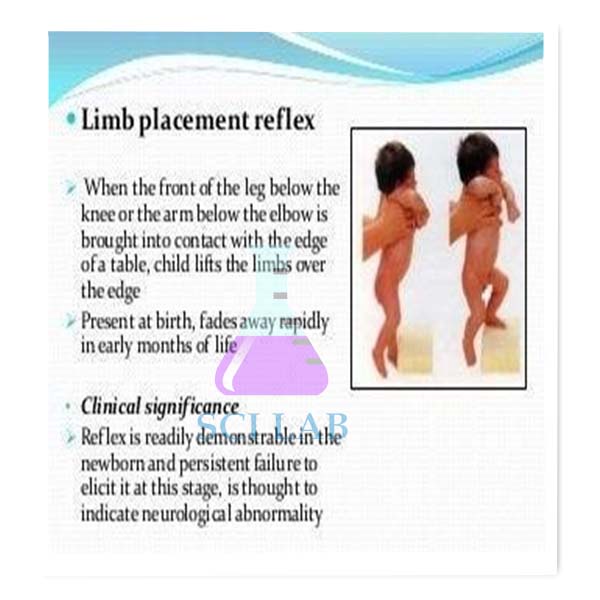
No. It deals with conditioned reflexes, which are learned by association during life. Newborn reflexes, such as grasping, rooting and the Moro startle, are inborn, fade as the child grows and are taught in child development and nursing courses with charts of their own.
What changes for the bell between before and after conditioning?
Before training the bell is a neutral stimulus and causes no salivation. After repeated pairing with food it becomes a conditioned stimulus, and the salivation it now causes on its own is the conditioned response.
What happens if the bell keeps ringing with no food?
The conditioned response weakens and stops: this is extinction. After a rest the response may briefly return when the bell sounds again, which is called spontaneous recovery. It shows the link was held back, not erased.
Is a conditioned reflex the same as a simple reflex like the knee jerk?
No. A simple reflex is inborn, the same in every member of a species, and can run through the spinal cord alone. A conditioned reflex is learned during life, needs the brain, and fades if it is not reinforced.
Related Nervous System Teaching Aids
- Human Nervous System Chart: laminated, wall-mounted chart, 70 x 100 cm, for laboratory and classroom use.
- Neuron Model: medullated nerve fibre with axon, myelin sheath and nodes of Ranvier, 2500 times larger than life.
- Human Nervous System Model: central and peripheral nervous system, coloured and numbered with a key card.
- Human Brain Stem Model: about 3 times life size, with the bases of the 12 pairs of cranial nerves shown in yellow.
- Sympathetic Nervous System Model: board-mounted PVC model of the autonomic nervous system, including the sympathetic part, with 53 positions.
The chart is filed with other printed teaching charts in Charts & Portraits; reflex and nerve models sit in the Biology Lab Equipment range.
Science Lab Supplies is registered with an Importer-Exporter Code. A conditioned-reflex chart can therefore be sent to colleges and schools in Ethiopia, Tanzania, Uganda, the UAE, Saudi Arabia and Oman. For a quotation, write through the contact page or place the chart in the enquiry cart.
Last updated: 19 November 2026
.jpg)
.jpg)
.jpg)
.jpg)