Flask Heating Mantle, 500 ml
Product Code : SCL-CL-11913
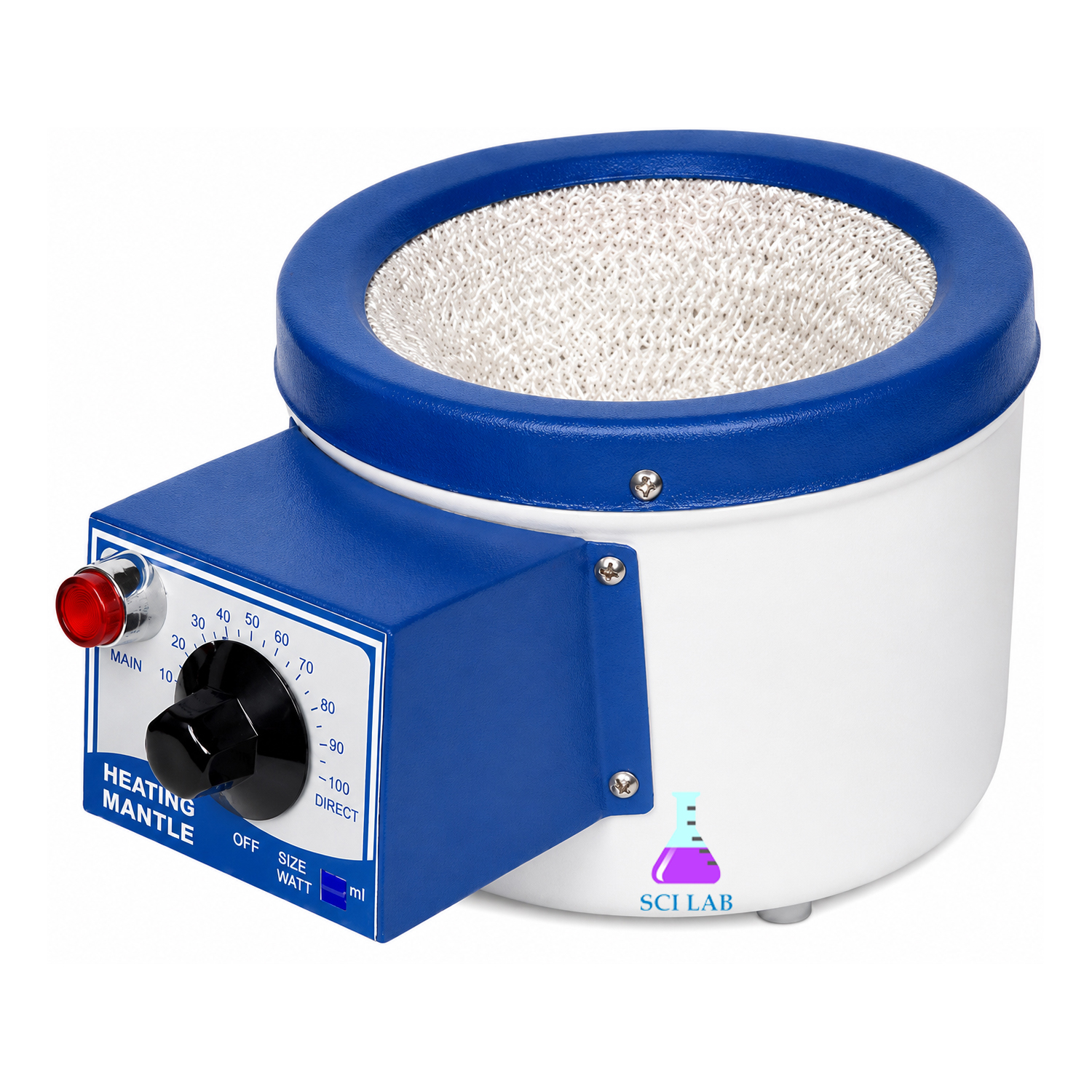
The Flask Heating Mantle is a single-place heating mantle for a 500 ml flask. A woven glass-yarn basket with built-in resistance wiring wraps around the flask, and the insulated body with energy regulator control gives even, flame-free heating without the hot spots of an open burner.
Specifications of the Flask Heating Mantle
| Specification | Value |
|---|---|
| Type | Single place, for one 500 ml flask |
| Heating basket | Flexible woven glass-yarn basket with integrated resistance wiring |
| Body | Cylindrical insulated body, white coated, with a blue rim that holds the basket |
| Insulation | Integrated glass-yarn insulation |
| Heat control | Energy regulator |
| Supplied by | Science Lab Supplies, Ambala, India |
Heating Flasks with the Heating Mantle
The flask sits in the basket so its lower half touches the heated fabric. Clamp the flask neck to a stand so it cannot tip, then turn the regulator up in steps rather than straight to full.
- Simple distillation (Class 11–12): heat the mixture in a Distillation Flask on the heater, condense the vapour and collect the distillate in a clean receiver.
- Reflux of an organic preparation: boil the mixture gently under an upright condenser so the vapour runs back into the flask. Keep the top of the condenser open to the air.
- Hot solutions for recrystallisation: dissolve the solid near boiling and follow the temperature with a Thermometer (with no Mercury), with the flask held by a Ring Stand Set.
Precautions: never heat an empty flask, add anti-bumping granules to the cold liquid, never close the apparatus, and lower or remove the heater before taking the set apart.
Frequently Asked Questions
Why use a heating mantle instead of a Bunsen burner for flammable liquids?
There is no open flame, so vapour from solvents such as ethanol is far less likely to catch fire. The fabric basket also spreads the heat around the flask, which cuts the risk of cracking from hot spots.
Why do I still need anti-bumping granules?
Even heating does not stop bumping. A liquid can overheat and then boil violently. Add two or three granules to the cold liquid before switching on, never to a liquid that is already hot.
What should I do if no distillate comes over at the start?
Raise the regulator one step at a time and wait a few minutes between changes. The mantle takes time to warm up, and turning it to full at once can make the liquid boil over into the condenser.
Can the heater be left running while I do other work?
No. Stay with the apparatus while it is switched on, keep solvent bottles and paper away from it, and switch off at the supply as soon as the run ends.
Can I use a flask with a small crack or star mark?
No. Check the flask before every run. A cracked flask can split when heated and spill hot liquid into the basket and onto the heating wires.
Why must the flask fit the mantle?
The basket is shaped for one 500 ml flask. A smaller flask leaves an air gap, so the heating wires run hotter than the glass and heat it unevenly. A larger flask cannot sit down in the basket and is poorly supported.
Related Distillation and Heating Apparatus
- Distillation Apparatus, Ground-Joint Set: borosilicate glass set with round-bottom flask, still head, adapter, condenser and fractionating column.
- Distillation Flask with Side Arm, 250 ml: 250 ml borosilicate glass pot with a narrow mouth and a 175 mm side pipe.
- Hot Plate With Stirrer: bench heater with a ceramic glass surface, magnetic stirrer and temperature control up to 450 °C.
- Round Bottom Flask, Narrow Neck: borosilicate glass with a 166 mm base diameter, narrow neck with rim and 260 mm height.
- Glass Funnel with Angled Stem, 90 / 150 mm: clear glass funnel in 90 mm and 150 mm sizes with an angled stem tip.
More bench heating apparatus and glassware is listed in the Chemistry Lab range, part of School Lab Equipments.
Science Lab Supplies holds an Importer-Exporter Code and can ship this heater to buyers in Bangladesh, Zambia, Rwanda, South Africa, Qatar and Sri Lanka. Heating mantle quotations are sent in reply to a contact page message or an enquiry cart list.
Last updated: 15 November 2026
.jpg)