
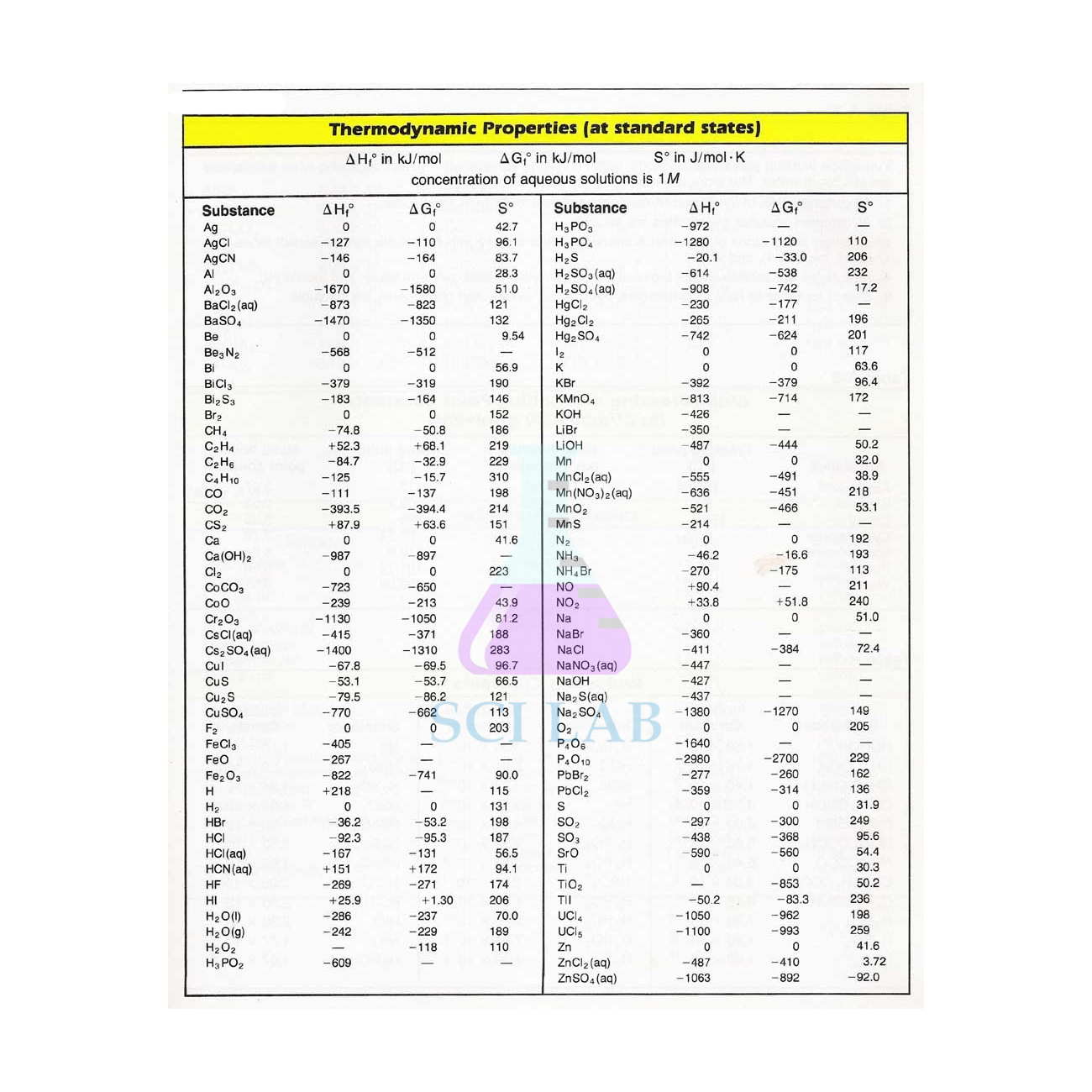
Thermodynamic Data for Some Substances
Product Code : SCL-CL-11597
Thermodynamic Data for Some Substances is a laminated wall chart, 70 cm x 100 cm, giving a class a shared reference for thermochemistry. Students use such data to work out enthalpy, entropy and free-energy changes for reactions.
Specifications of the Thermodynamic Data Chart
| Specification | Value |
|---|---|
| Format | Laminated wall chart |
| Size | 70 cm x 100 cm |
| Mounting | Wall mounted |
| Use | Classrooms and laboratory |
| Supplied by | Science Lab Supplies, Ambala, India |
Thermochemistry Practicals with the Data Chart
After a heat measurement, students compare their value with one calculated from the chart and explain the gap.
- Enthalpy of neutralisation: react an acid and an alkali in a Calorimeter and record the rise on a Laboratory Thermometer.
- Hess cycle: measure two reactions that can be combined, and compare the result with a value worked out from formation enthalpies.
- Feasibility: use enthalpy and entropy values to find the temperature at which a reaction becomes feasible.
Common errors: heat loss to the room, which makes measured values smaller than the data predict, and mixing joules with kilojoules.
Frequently Asked Questions
Why is the enthalpy of formation of oxygen gas zero?
By definition, an element in its standard state has a standard enthalpy of formation of zero. Oxygen gas, graphite and solid iron are reference points from which compounds are measured.
How is a reaction enthalpy worked out from the table?
Multiply each formation enthalpy by its coefficient in the equation. Add the values for the products, add those for the reactants, and subtract the reactant total from the product total.
Why must entropy values be handled with care in free-energy sums?
Entropy is usually listed in J/(K mol) and enthalpy in kJ/mol. Convert one of them before using the free-energy equation, and always use the temperature in kelvin.
Why do elements have entropy values that are not zero?
Tables list absolute standard entropies, not entropy changes. Every substance above absolute zero has some entropy, so entropy of reaction must be found as products minus reactants.
What happens to the enthalpy if a reaction is reversed or doubled?
Reversing the equation changes the sign of the enthalpy change. Doubling every coefficient doubles the value, and the result is then no longer a formation enthalpy.
Related Physical Chemistry Charts and Heat Apparatus
- Elementary Reactions and Rate Equation: laminated wall chart, 70 cm x 100 cm.
- Reduction Potential: 70 cm x 100 cm chart.
- The Relationships of The Mole: wall-mounted laminated chart, 70 cm x 100 cm.
- Aggregate States of Water: 70 cm x 100 cm chart for classroom and lab.
- Alcohol Lamp: round glass spirit lamp, 150 ml, with PVC cap.
For more thermochemistry items, visit the Chemistry Lab category or the main School Lab Equipments page.
We export with an Importer-Exporter Code to Ethiopia, Tanzania, Uganda, the UAE, Saudi Arabia and Oman. Quotations are available on request from the contact page or the enquiry cart.
Last updated: 14 November 2026




.jpg)
