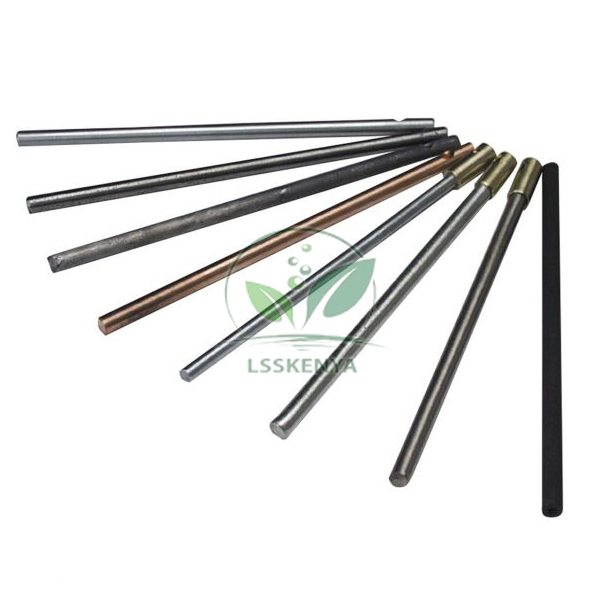
Round Electrodes, 6-7 mm
Product Code : LSK-CL-10273
Round Electrodes, 6-7 mm are rod electrodes 6 to 7 mm in diameter. They are sized to fit the electrode holder, the electrode connector and rubber stoppers with a hole, so they can be set up quickly for electrolysis and simple cell experiments in the school lab.
Specifications of the Round Electrodes
| Specification | Value |
|---|---|
| Shape | Round rod |
| Diameter | 6 to 7 mm |
| Fits | Electrode holder, electrode connector, rubber stoppers with a hole |
| Supplied by | Science Lab Supplies, Ambala, India |
Electrolysis and Cell Work with Round Electrodes
Push each rod through a holed stopper or clamp it in a holder, then connect it with a lead to the power supply or meter. Keep the two electrodes apart in the solution so they cannot touch.
- Electrode mounting: fit the rods into the Electrode Connector, which takes round electrodes up to 7.5 mm and has a socket for 4 mm plugs.
- Electrolysis of a salt solution: seat each rod in one of the Rubber Stoppers of Various Diameters with Holes and watch for gas or metal at each electrode.
- Testing the products: collect any gas over each electrode in a small inverted test tube and test it with a lighted or glowing splint.
Clean the rods after each run, since deposits from one solution change the next result.
Frequently Asked Questions
Will these electrodes fit the electrode connector?
Yes. The connector takes round electrodes up to 7.5 mm across, and these rods are 6 to 7 mm in diameter.
What is an inert electrode?
An inert electrode carries the current but does not react, so the products come only from the ions in the solution. A reactive electrode can dissolve or take part, which changes what forms at it.
Which electrode is the anode and which is the cathode?
The cathode is the electrode joined to the negative terminal of the supply, and positive ions move to it. The anode is joined to the positive terminal, and negative ions move to it.
Why must the electrodes not touch?
If they touch, the current passes straight from one to the other. This is a short circuit, so no electrolysis takes place and the supply may overheat.
How are the gases at the electrodes identified?
Collect each gas in a small test tube held over the electrode. Hydrogen gives a squeaky pop with a lighted splint, oxygen relights a glowing splint, and chlorine bleaches damp blue litmus paper after turning it red.
How should the electrodes be cleaned?
Rinse them in water after use. Rub off metal deposits with fine abrasive paper, then rinse and dry before storing.
Related Electrodes and Electrolysis Apparatus
- Electrode Rod: 100 x 10 mm rods with terminal in aluminium, carbon, copper, iron or zinc.
- Electrode Plate: 100 x 45 mm plates with socket terminal in aluminium, carbon, copper, lead or zinc.
- Electrode Rod Platinum: rod in a glass tube with terminal, ending in platinum leaf.
- Electrolysis Cells: 75 x 25 mm glass cylinder with a 2-hole stopper and two carbon electrodes.
- Apparatus for the Electrolysis of Salts: U-tube 15 mm across with 60 mm graphite electrodes.
See more electrochemistry items in the Chemistry Lab range or browse School Lab Equipments.
Science Lab Supplies holds an Importer-Exporter Code and can ship to buyers in Iraq, Nigeria, Kenya, Ghana, Ethiopia and Tanzania. To ask for a quotation, use the contact page or the enquiry cart.
Last updated: 15 November 2026


.jpg)