Electrode Connector
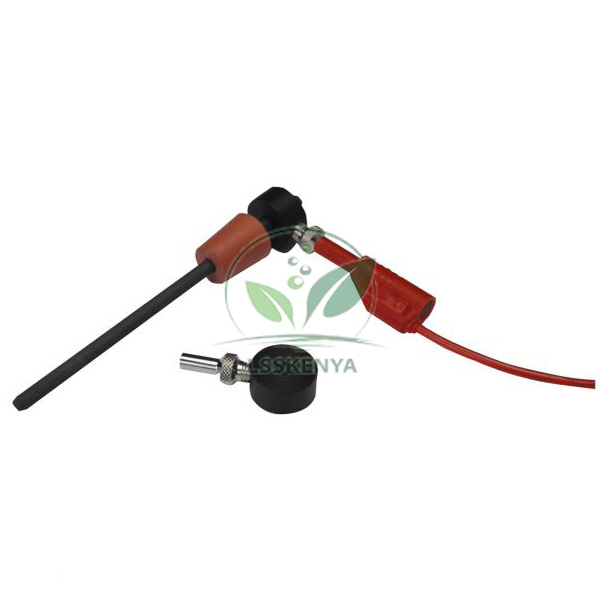
Product Code : LSK-CL-10264
The Electrode Connector holds a round electrode and joins it to the circuit. It takes round electrodes up to 7.5 mm in diameter, and its contact screw carries a socket for 4 mm safety plugs. The body is acid-resistant plastic, 25 mm across with a 12 mm bore.
Specifications of the Electrode Connector
| Specification | Value |
|---|---|
| Electrode size | Round electrodes up to 7.5 mm diameter |
| Connection | Contact screw with a socket for 4 mm safety jacks |
| Material | Acid-resistant plastic |
| Dimensions | Outer diameter 25 mm, inner diameter 12 mm |
| Supplied by | Science Lab Supplies, Ambala, India |
Wiring Electrodes for Electrochemistry Practicals
Slide the electrode through the connector, tighten the contact screw and plug a 4 mm lead into its socket. The electrode is then held firmly and wired without loose clips.
- Electrolysis of solutions: fit two Round Electrodes in connectors, dip them in the solution and connect a DC supply.
- Simple cells: compare pairs of metal Electrode Rod electrodes, wired through their own terminals, in an electrolyte and read the voltage.
- Conductivity tests: compare tap water, acid and salt solutions, wired with Connecting Cables with Plugs.
Frequently Asked Questions
Which electrodes fit the connector?
Round electrodes up to 7.5 mm in diameter, such as carbon or metal rods. Flat plate electrodes need a different holder.
What leads plug into the connector?
Standard 4 mm plugs, including shrouded safety plugs. The socket is in the contact screw, so the lead connects directly to the electrode.
Why is the connector made of acid-resistant plastic?
It sits close to acids, salt solutions and electrolysis products that would corrode bare metal. The plastic body also insulates the electrode from the hand.
Why do readings drift or jump during an experiment?
Usually from a loose contact. Tighten the contact screw onto the electrode, push the plug fully home, and clean the electrode surface with fine sandpaper before the run.
Which lead goes to which electrode?
Join the lead from the positive terminal of the supply to the connector on the electrode meant to be the anode, and the negative lead to the cathode. Using red for positive and black for negative makes the circuit easy to check.
Can an electrode be moved while the power is on?
No. Switch off the supply first, then loosen the contact screw and reposition the electrode. Moving it while the circuit is live risks bringing the electrodes together and causing a short circuit.
Related Electrodes and Electrolysis Parts
- Electrode Plate: 100 x 45 mm plate with socket terminal, in aluminium, carbon, copper, lead or zinc.
- Electrode Rod Carbon Voltameter: 100 x 10 mm carbon rod in a glass tube with terminal.
- Electrolysis Cells: glass cylinder with two carbon electrodes and crocodile clip contacts.
- Electrolysis Kit: insulated stainless steel electrodes and rubber gaskets for the test tubes.
- Salt Bridge: inverted U-tube closed by sintered discs, arms 13 mm in diameter.
Browse the Chemistry Lab range or all School Lab Equipments.
Science Lab Supplies holds an Importer-Exporter Code and can ship to buyers in Zambia, Rwanda, South Africa, Qatar, Sri Lanka and Vietnam. To ask for a quotation, use the contact page or the enquiry cart.
Last updated: 15 November 2026