Atomic Orbital Model Py
Product Code : SCL-CL-11537
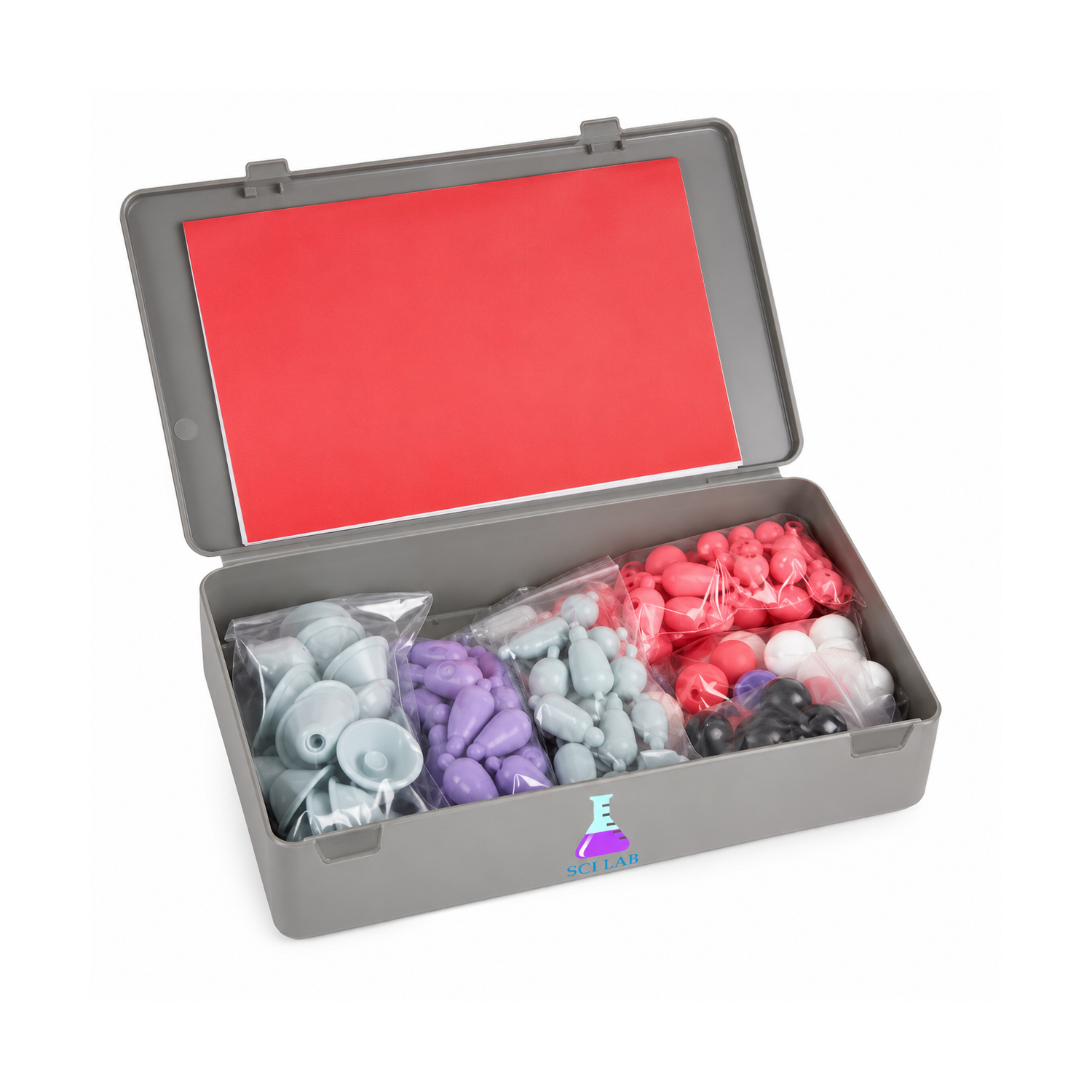
Atomic Orbital Model Py (SKU SCL-CL-11537) is an assemble-it-yourself model of the py orbital, the p orbital whose two lobes point along the y-axis. It comes as durable plastic parts and links, with metal elements, that students or teachers put together and then stand on a grey transparent base. Class 11 and B.Sc. chemistry departments, tender contractors and distributors can obtain it on quotation from Science Lab Supplies, which supplies the model from Ambala, India.
Specifications
The py model's parts, colour scheme and base are listed one per row in the table. In short, it is made from plastic with metal elements, includes durable plastic parts and links for assembly, is colour-coded to national standards for quick identification, and comes with grey transparent bases so the finished model can be displayed.
| Specification | Value |
|---|---|
| SKU | SCL-CL-11537 |
| Orbital shown | py (p orbital along the y-axis) |
| Material | Plastic |
| Metal parts | Metal elements |
| Parts | Durable plastic parts |
| Links | Plastic links for assembling the model |
| Colour coding | To national standards, for ease of identification |
| Base | Grey transparent |
| Base use | Display |
| Supplied by | Science Lab Supplies, Ambala, India |
Applications and Experiments for the Atomic Orbital Model Py
Because the py model is assembled from parts, building it becomes a short activity in itself: students place the lobes on either side of the centre along the y-axis and see where the node lies. It serves NCERT Class 11 atomic structure and bonding lessons and orbital theory in B.Sc. chemistry.
- Class 11 chemistry: identifying px, py and pz by the axis each orbital follows, and relating p orbitals to the p-block of the Periodic Table of Chemical Elements.
- Class 11 bonding: sideways overlap of p orbitals to form pi bonds, compared with the Carbon-Carbon Molecular Model.
- B.Sc. chemistry: orbital orientation, nodal planes and hybridisation groundwork.
Standard Scope of Supply
Each set contains the plastic parts and links, with metal elements, needed to assemble the py orbital model, plus the grey transparent display base. Partner px and pz models are separate items and can be quoted together with it so that all three axes are covered.
Packing, MOQ and Lead Time
Order one model for demonstration or enough for student groups to build their own. Science Lab Supplies prepares a quotation giving the packing, delivery time and price for that quantity, and you can ask for the Atomic Orbital Model Py price in India together with the other orbital models.
As a registered exporter with an Importer-Exporter Code, Science Lab Supplies can ship to buyers in the Philippines, Nepal, Bangladesh, Zambia, Rwanda and South Africa. Mention how many groups will assemble the model when you write via the contact page or submit the enquiry cart; institutional tenders go through the lab tender page.
Frequently Asked Questions
Does the py model need assembling?
Yes. It includes durable plastic parts and links for assembling the model, which turns building the orbital into part of the lesson rather than a ready-made display.
How does py differ from px and pz?
All three p orbitals share the same dumbbell shape. The py orbital is the one aligned with the y-axis; px and pz lie along the x- and z-axes.
Who supplies this orbital model?
Buyers get the py model through Science Lab Supplies, a supplier based in Ambala, India. The company does not claim to make it, and it quotes schools, colleges, contractors and distributors directly.
Can the model be displayed after the lesson?
Yes. It comes with a grey transparent base intended for display, so the assembled model can stay on a shelf or desk.
Related Orbital and Atomic Structure Models
The py model is most useful with its two sibling p-orbital models, models of the quantum-mechanical atom and of orbitals in action, a hybridisation model and charts on electron shells and electronegativity. Together they support a complete Class 11 atomic structure unit.
- Atomic Orbital Model Px — x-axis p orbital, colour-coded and mounted on a grey transparent base.
- Atomic Orbital Model Pz — z-axis p orbital assembled from plastic parts, with a plastic storage box.
- Schrodinger Atomic Model — three-dimensional view of an atom with nodal planes marked.
- Dynamic Model for Atomic Orbital Demonstration — orbital demonstration unit of 250 x 320 x 40 mm with its own 8 V DC power supply.
- Orbital Model of Sp3 Hybridization — plastic model with metal elements for organic, inorganic and stereochemistry.
- Distribution of Electrons in Electronic Layers — 70 x 100 cm laminated chart for wall mounting.
- Electronegativity — wall-mounted laminated chart, 70 x 100 cm.
See the full Chemistry Lab range, the Physics Lab range, or all school lab equipment.
Last updated: 9 October 2026