Hand Vacuum Pump with Pressure Gauge
Product Code : LSK-CL-10082
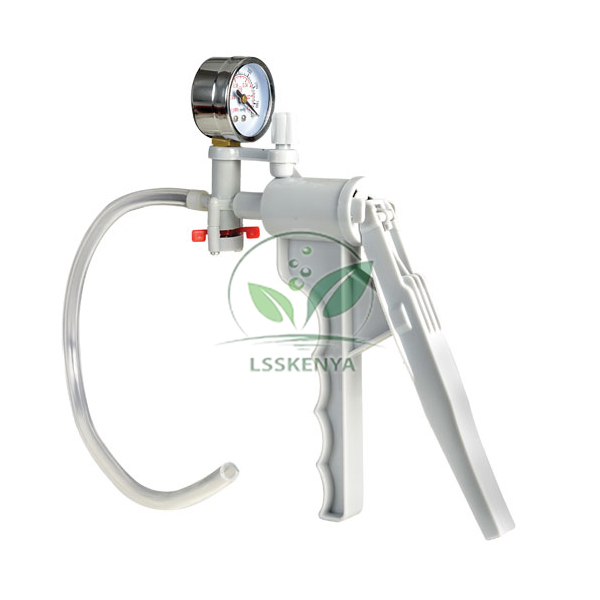
The Hand Vacuum Pump with Pressure Gauge removes air at 15 ml per stroke and can displace up to 725 ml of air. Its gauge reads in both centimetres and inches of mercury, and a valve releases the vacuum without disconnecting the pump. It suits small-scale vacuum work at the student bench.
Specifications of the Hand Vacuum Pump
| Specification | Value |
|---|---|
| Pumping rate | 15 ml of air per stroke |
| Air displacement | Up to 725 ml |
| Gauge | Pressure gauge reading in cm and inches of mercury |
| Release | Valve releases the vacuum without disconnecting the pump |
| Supplied by | Science Lab Supplies, Ambala, India |
Reduced-Pressure Experiments with the Hand Pump
Connect the pump to the apparatus with short, thick-walled tubing. Squeeze steadily and watch the gauge; stop when the reading stops rising. Open the release valve slowly at the end of each run.
- Air pressure: evacuate the Magdeburg Hemispheres and let students try to pull them apart, then open the valve and show how easily they separate.
- Small-scale filtration: pull a filtrate through a Buchner Funnel where no tap is available for a water pump.
- Boiling at reduced pressure: pump air from a small sealed vessel holding warm water and watch it boil without heating.
- Leak testing: pump a closed set-up down, stop and watch whether the gauge reading holds.
Wear eye protection whenever glassware is under vacuum.
Frequently Asked Questions
What do the two scales on the gauge mean?
Both show how far the pressure is below atmospheric pressure, one in centimetres of mercury and one in inches of mercury. One inch equals 2.54 cm, so students can convert readings between the scales.
What is the release valve for?
It lets air back in slowly while the pump stays connected. A slow release avoids liquids splashing or being drawn into the tubing, and lets students repeat a run straight away.
Why does each stroke seem to do less as I keep pumping?
Each stroke removes 15 ml of the gas that is left, and that gas gets thinner as the pressure falls. So the gauge rises quickly at first and then more slowly.
How do the gauge readings convert to kPa?
One centimetre of mercury is about 1.33 kPa and one inch of mercury about 3.39 kPa. A reading of 50 cm of mercury below atmosphere is therefore about 67 kPa below, leaving roughly 35 kPa in the vessel at sea level.
Which practicals does the pump cover?
Air-pressure demonstrations such as the Magdeburg hemispheres, boiling at reduced pressure, small filtrations where no water tap is free, and leak tests on sealed apparatus. The gauge readings also give students numbers to record and convert between units.
Related Vacuum Apparatus
- Hand Vacuum Pump: draws 15 cm³ per stroke to a maximum vacuum of 50 mmHg and gives up to 2 atm pressure.
- Bell Jars: baseplate with tap, glass bell jar and a battery-operated bell for vacuum demonstrations.
- School Vacuum-Pump Set: vacuum chamber 4.75 x 4.75 in at the top for boiling, fountain and pressure demonstrations.
- Vacuum Pressure Pump: quiet general-purpose pump, about 50 litres per minute, ultimate vacuum 5 Pa.
- Water Filter Pump (Aspirator), Brass: extruded brass pump that creates a vacuum as tap water flows through it.
Vacuum and air-pressure apparatus is spread over the Chemistry Lab pages and the wider School Lab Equipments section.
Importers in the UAE, Saudi Arabia, Oman, the Philippines, Nepal and Bangladesh can source the hand vacuum pump directly from Science Lab Supplies, an Indian exporter with an Importer-Exporter Code. For quantities and a quotation on the hand pump, the contact page is the quickest route; the enquiry cart suits mixed orders.
Last updated: 15 November 2026