
Colorimeter Photo Digital
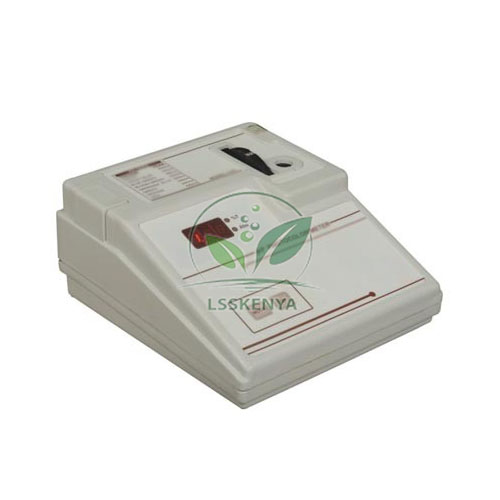
Product Code : LSK-CL-10051
The Colorimeter Photo Digital finds the concentration of a known substance in a coloured solution by comparing it with a standard. It works with test tubes, selects one of 8 filters from a rotating disc, covers 400 to 700 nm and reads transmission or absorbance with auto zeroing.
Specifications of the Photo Colorimeter
| Specification | Value |
|---|---|
| Sample holder | Test tubes only |
| Filters | Rotating disc with 8 filters |
| Wavelength range | 400 to 700 nm |
| Measurement modes | Transmission 0-100%, Absorbance 0-1.99 |
| Zeroing | Auto zeroing facility |
| Light control | Automatic shutter stops light reaching the sensor |
| Controls | Soft touch membrane keys |
| Supplied by | Science Lab Supplies, Ambala, India |
Colorimetry Practicals with the Photo Colorimeter
A coloured complex is formed with a suitable reagent. A tube of blank solution sets the zero, then standards and samples are read with the filter that matches the colour being measured.
- Calibration graph: make a series of standards with a Measuring Cylinder 10ml and pipette, transfer them with a Pipette Filler Bulb, and plot absorbance against concentration.
- Unknown concentration: read the sample tube and find its concentration from the straight-line part of the graph.
- Choosing the filter: read one standard through each of the 8 filters and pick the one that gives the highest absorbance.
- Rate of reaction: follow a colour change over time, for example a fading dye, by reading absorbance at fixed intervals.
Common errors: scratched or wet Test Tubes, fingerprints in the light path, and forgetting to re-zero with the blank when the filter is changed.
Frequently Asked Questions
Which filter should be used for a coloured solution?
Use the filter of the complementary colour, the colour the solution absorbs most. A blue copper solution absorbs orange-red light, so a red or orange filter gives the strongest reading.
Why must the colorimeter be zeroed again when the filter is changed?
Each filter passes a different band of light, and the light source, sensor and blank all respond differently in each band. Zeroing on the blank with the new filter in place resets the 100% transmission point, so readings through that filter start from the right baseline.
Why does the colorimeter work only from 400 to 700 nm?
Its filters cover the visible spectrum, which is all that coloured solutions need. Substances that are colourless and absorb only in the ultraviolet need a UV spectrophotometer with a suitable lamp and quartz cells, or a reagent that turns them into a coloured complex first.
What law does a colorimeter rely on?
The Beer-Lambert law. For a fixed path length, absorbance is proportional to concentration, so the calibration graph of standards is a straight line through the origin within the working range.
How is a colorimeter different from a spectrophotometer?
A colorimeter uses a set of fixed colour filters and works in the visible range. A spectrophotometer selects a narrow band of wavelengths and can scan, so it suits more exact work.
Which sample tubes should be used with this colorimeter?
It takes samples in test tubes only. Keep a set of clear, unscratched tubes of the same glass and wall thickness for the blank and every sample, hold them near the top, and wipe off fingerprints before each reading, since marks scatter light and raise the absorbance.
Related Analytical Instruments and Labware
- Visible Spectrophotometer: monochromatic beam over 330 to 1000 nm, bandwidth 10 nm.
- Bench Digital Ph Meter: pH 0.00 to 14.00 and ORP with temperature compensation.
- Glass Beaker, Low Form, 100 ml: graduated low-form glass beaker.
- Wash Bottle, LDPE, 500 ml, Pack of 6: 500 mL squeeze bottle for rinsing labware with distilled water.
- Laboratory Deioniser: mixed bed cartridge that gives purified water directly from tap water.
Analytical instruments for teaching labs are listed in the Chemistry Lab range and across School Lab Equipments.
Science Lab Supplies holds an Importer-Exporter Code and ships to laboratories in Peru, Egypt, Iraq, Nigeria, Kenya and Ghana. For a quotation, please use the contact page or the enquiry cart.
Last updated: 15 November 2026

.jpg)



.jpg)