
Circuit Switch
Product Code : SCL-CL-11869
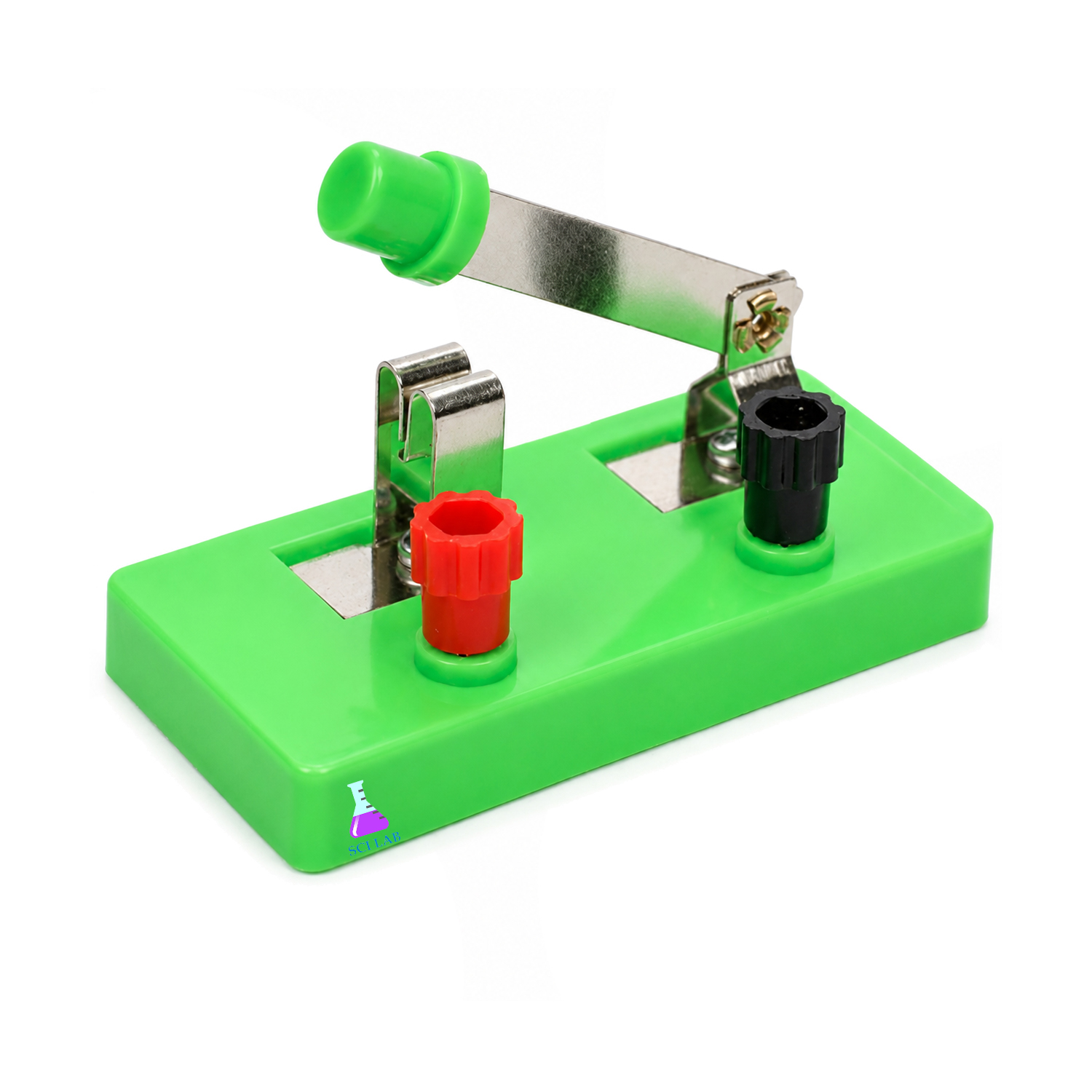
Circuit Switch (SKU SCL-CL-11869) is a mechanical knife switch that opens or closes an electrical circuit by hand: current flows when the metal lever is down and stops when it is lifted. Red and black binding posts take the connecting wires. It suits Class 6–12 electricity practicals and basic ITI wiring exercises, and Science Lab Supplies can deliver it from Ambala, India to schools, colleges, training institutes, distributors and tender contractors.
Specifications
Every feature of the knife-lever Circuit Switch has its own row in the table that follows. In short, the switch is purely mechanical, with a metal knife lever that students can see making and breaking contact, and colour-coded red and black binding posts that grip the wires firmly for series and parallel circuit work.
| Specification | Value |
|---|---|
| SKU | SCL-CL-11869 |
| Type | Mechanical |
| Operation | Manual; opens or closes an electrical circuit |
| Lever | Metal knife lever |
| Terminals | Red and black binding posts |
| Circuit use | Basic series and parallel circuits |
| Supplied by | Science Lab Supplies, Ambala, India |
Applications and Experiments for the Circuit Switch
Because the contact is visible, the knife switch shows students exactly what "open" and "closed" mean in a circuit. It fits the electricity chapters of NCERT Class 6–10 science, Class 12 physics practicals where the supply must be cut between readings, and basic ITI wiring work on manual switching.
- Class 6: open and closed circuits with a cell and bulb, wired to the posts with Cables with Clips.
- Class 10: switching series and parallel bulb circuits, such as those built with the Apparatus for Studying Circuits for Series and Parallel Connections.
- Class 12 physics: breaking the circuit between readings on an Ohms Law Apparatus or a bench circuit so resistors do not heat.
- ITI electrician trade: introducing manual switching of a load.
Standard Scope of Supply
The Circuit Switch is supplied as a single unit with its metal knife lever and red and black binding posts. Connecting leads, bulbs and power sources are separate catalogue items; name the ones you want and they will be added to the same quotation as the switch.
Packing, MOQ and Lead Time
Whether you need one switch or one for every student group, Science Lab Supplies quotes that exact number and states the packing, delivery time and price. As a laboratory equipment supplier in India, it can put leads, bulbs and other bench items on the same quotation for one delivery.
Science Lab Supplies holds an Importer-Exporter Code and can ship to buyers in Bangladesh, Zambia, Rwanda, South Africa, Qatar and Sri Lanka. If you would like switches priced, write to the team through the contact page or place them in the enquiry cart; buyers preparing a tender will find the steps on the lab tender page.
Frequently Asked Questions
How does the Circuit Switch work?
Pressing the metal knife lever into its contact closes the circuit and lets current flow; lifting it opens the circuit and stops the current. Students can see the gap, which makes the idea easy to grasp.
How are wires connected to the switch?
Through the red and black binding posts. Loosen the post, insert the lead or bare wire, and tighten it again for a firm contact that will not slip during the experiment.
Who supplies the Circuit Switch?
This switch is quoted and sent by Science Lab Supplies, located in Ambala, India. Schools, colleges, training institutes, distributors and tender contractors can ask for a single piece or enough for a whole class.
Is it suitable for series and parallel circuit experiments?
Yes. The switch is intended for building and demonstrating basic series and parallel circuits in classroom electricity work, helping students follow current flow, open circuits and closed circuits by hand.
Related Switches, Keys and Circuit Items
A switch controls a circuit only once it has a source, a load and leads, and some practicals call for a key or a different switch type. These items from the Chemistry Lab, Physics Lab and Electrical and Electronics ranges can be listed on the same enquiry to equip every student group.
- Knife Switch — single-pole, single-throw switch with brass poles and blades on a plastic base.
- Brass One Way Plug Key — makes or breaks a circuit by inserting or removing a conductive plug.
- Tapping Key Physics Lab — momentary contact switch for brief, controlled current pulses.
- Double-Pole Switch — rated 24 V, 2 A, in a snap-in panel-mount housing.
- Light Bulb — 9 V, 0.2 A lamp on a stand, supplied with two spares.
- Power Supply Unit/ Block for DC — DC source with a thermal circuit breaker against overload or short circuit.
- Cables with Plug — 50 cm plug leads for sockets and binding posts.
Browse the full Chemistry Lab range, the Electrical and Electronics range, or all school lab equipment.
Last updated: 9 October 2026



.jpg)