U-Tube Manometer
Product Code : SCL-CL-12361
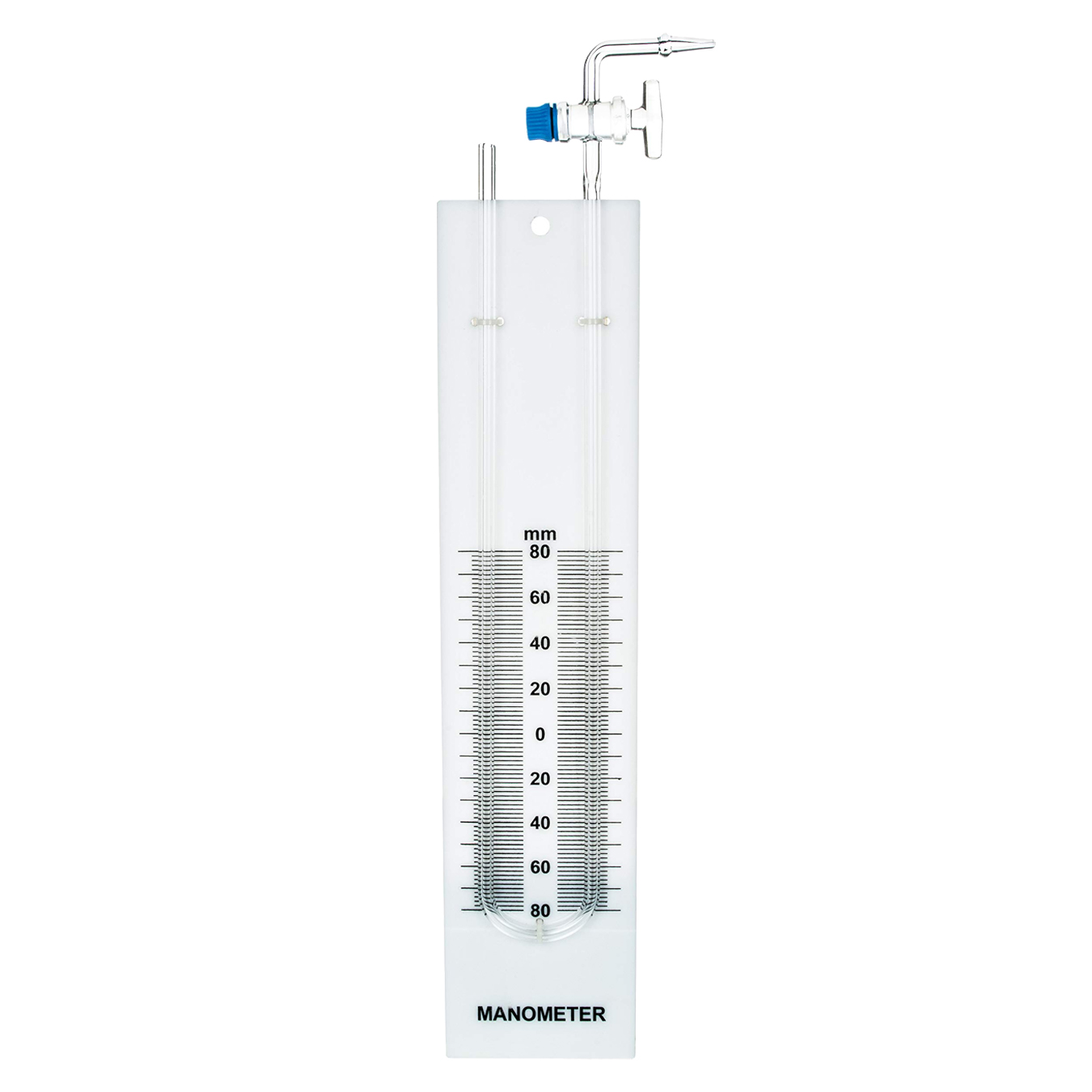
The U-Tube Manometer measures small gas pressure differences as the vertical gap between two coloured water levels. A clear glass U-tube of 5 mm nominal bore, with a built-in reservoir and a glass stopcock, sits on a white plastic back panel of 400 × 80 mm with a centred 80–0–80 mm scale in 2 mm divisions. Its rated span is ±80 mm of water, about ±0.785 kPa.
Specifications of the U-Tube Manometer
| Specification | Value |
|---|---|
| Tube | Clear glass U-tube, 5 mm nominal bore, with built-in reservoir |
| Valve | Built-in glass stopcock |
| Back panel | White plastic, 400 × 80 mm |
| Scale | 80–0–80 mm in 2 mm divisions, centred on zero; the marks read liquid-column displacement in mm |
| Rated span | ±80 mm water differential (about ±0.785 kPa) |
| Indicating liquid | Coloured water |
| Reading | Vertical difference between the two menisci |
| Manufacturer | Science Lab Supplies, Saha, Ambala, India |
Pressure Experiments with the U-Tube Manometer
Fill with coloured water until both levels sit on zero, then join one limb to the gas or vessel with rubber tubing. Read both levels and take the difference. The pressure difference equals liquid density × g × h, where h is the full vertical distance between the two liquid surfaces, not the rise or fall in one limb.
- Breath pressure: blow very gently into one limb through clean tubing and read the height difference before it passes the 80 mm span.
- Heated air: connect a stoppered flask of air, warm it by only a degree or two in a Water bath, 7 L, check the change with a Glass Thermometer and watch the levels move.
- Liquid density: refill with a less dense coloured liquid and compare the height change for the same gentle breath.
Raise the pressure slowly so liquid is not pushed out of the open limb, blow gently and never suck on the tubing. Never connect it to a vacuum line or a strong pressure supply, and avoid bending or knocking the glass, which can break.
Frequently Asked Questions
What liquid should be used in the manometer?
Coloured water is the indicating liquid for this manometer, and its ±80 mm span is rated in millimetres of water. A less dense liquid such as ethanol gives a bigger height change for the same pressure, but each reading must then be converted with that liquid’s density.
How do I set the zero before a reading?
With both limbs open to the air, add liquid until both levels sit on the zero line. Only then connect the tubing, because once one side is joined the levels no longer show room pressure.
How is the pressure worked out from the reading?
Take the height difference between the two levels in metres and multiply by the liquid density and g. For water, a 10 mm difference is close to 100 Pa above or below room pressure. The rated span of this manometer is ±80 mm of water, about ±0.785 kPa.
Why does the liquid go down on the side I blow into?
The extra pressure pushes the liquid away on that side and up the other limb. The levels stop moving when the extra column of liquid balances the pressure you apply.
What are the common reading mistakes?
Reading only one limb and doubling it, viewing the meniscus at an angle, and not checking the zero. Read both menisci at eye level against the 2 mm marks and take the vertical gap between them.
What else is needed before the manometer can be used?
Coloured water to fill it, a length of rubber tubing to join one limb to the gas source, and a way to hold the panel upright, such as a wall fixing or a stand clamp. A small funnel with a balloon stretched over it gives a simple pressure source for class demonstrations.
Related Manometers and Pressure Gauges
- U-Tube Manometer on Stand, Wall Hanging Type: small manometer on a wooden base with a 15 cm scale.
- Simple Glass Manometer: 2 mm bore tube on a 140 × 70 mm acrylic base.
- Aneroid Barometer, 960-1060 hPa: dial barometer also scaled 720–795 mmHg.
- Metal Barometer, 57 mm Dial: 90 mm base with a 57 mm dial field.
Listed under Properties of Matter with other pressure apparatus; the wider Physics Lab Equipment section covers the rest of the physics range.
Science Lab Supplies can arrange export of laboratory instruments to Peru, Egypt, Iraq, Nigeria, Kenya and Ghana with its Importer-Exporter Code. For a quotation, write in through the contact page or use the enquiry cart.
Last updated: 20 November 2026