
Manometer Cylinder with Piston Temperature Meter
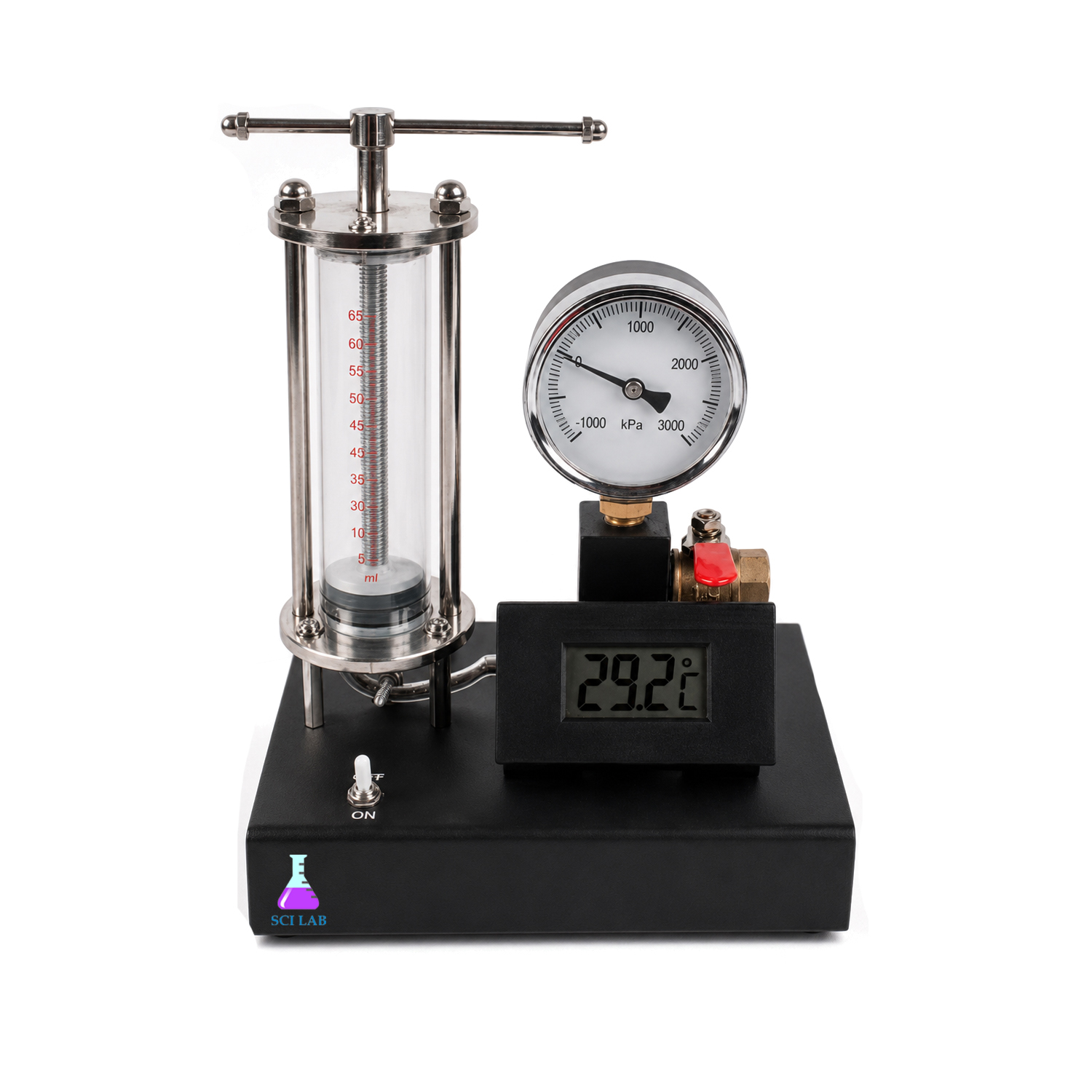
Product Code : SCL-CL-11877
This Boyle's law apparatus traps air in a graduated cylinder and changes its volume with a screw-type plunger. A manometer scaled in pascals shows the pressure, and a digital thermometer checks that the temperature stays steady while students take readings.
Specifications of the Manometer Cylinder
| Specification | Value |
|---|---|
| Cylinder | Graduated cylinder holding a trapped air sample |
| Plunger | Screw type, compresses or expands the air |
| Pressure reading | Manometer/pressure gauge, scale in Pa |
| Gauge accuracy | 5% |
| Thermometer | Digital, monitors ambient temperature |
| Supplied by | Science Lab Supplies, Ambala, India |
Boyle's Law Practicals with the Manometer Cylinder
Turn the screw a little, wait for the gauge to settle, then read the volume on the cylinder and the pressure on the gauge. Work in steps, first compressing and then expanding the air.
- Pressure and volume (Class 9–11): take six to eight pairs of readings and work out p × V for each one.
- Graph work: plot p against 1/V. A straight line through the origin confirms Boyle's law. Compare with the mass-loaded syringe of the Boyle's Law Apparatus.
- Reading pressure two ways: show how a pressure difference becomes a liquid height difference on the U-Tube Manometer on Stand Table Model, then compare with the dial reading in pascals.
Common errors: turning the screw quickly, which warms the air; reading the scale at an angle; and leaving out the air in the gauge connection.
Frequently Asked Questions
Why wait after each turn of the screw before reading?
Squeezing the air does work on it and warms it a little, so the pressure first reads high. A short wait lets the air return to room temperature, which Boyle's law assumes.
Why plot pressure against 1/V and not against V?
Pressure against volume gives a curve, which is hard to judge by eye. If pV is constant, pressure against 1/V is a straight line through the origin, easy to check with a ruler.
What is the digital thermometer for?
Boyle's law holds only at constant temperature. The thermometer shows whether the room, or warm hands on the cylinder, changed the temperature during the run, so you know whether the readings can be compared.
Why is my pV value not exactly constant?
Some spread is normal with a gauge of 5% accuracy. Other causes are air in the gauge connection not counted in the volume, a slow leak at the plunger, and readings taken before the temperature settled.
How can I predict the pressure at a new volume?
Use p1V1 = p2V2. Halving the volume of trapped air should double its pressure, as long as the temperature and the amount of air stay the same.
Related Gas-Law Apparatus
- Boyle's Law Apparatus, Pressure Type: Boyle's law unit 80 cm high, supplied with a hand pump.
- Boyle's Law Apparatus, Advanced with Oil: oil chamber with Bourdon gauge and a glass tube scaled 0 to 65 cm³.
- Bourdon Gauge: dual dial reading 0 to 50 lb/in² and 0 to 3.5 kg/cm² on a cast metal base.
- Charles's Law Apparatus, U-Tube: glass U-tube of 10 mm diameter with a beaker reservoir.
- Kinetic Theory Apparatus: motor-driven piston agitates metal spheres to model gas molecules.
- Room Thermometer: spirit-filled glass thermometer on a plastic backing, reading −30 to +50 °C.
See the Properties of Matter range for more gas-law work, or the Physics Lab Equipment listings.
Science Lab Supplies is registered with an Importer-Exporter Code and can supply buyers in Peru, Egypt, Iraq, Nigeria, Kenya and Ghana. Quotations are given through the contact page or the enquiry cart.
Last updated: 14 November 2026
