Kinetic Theory Model
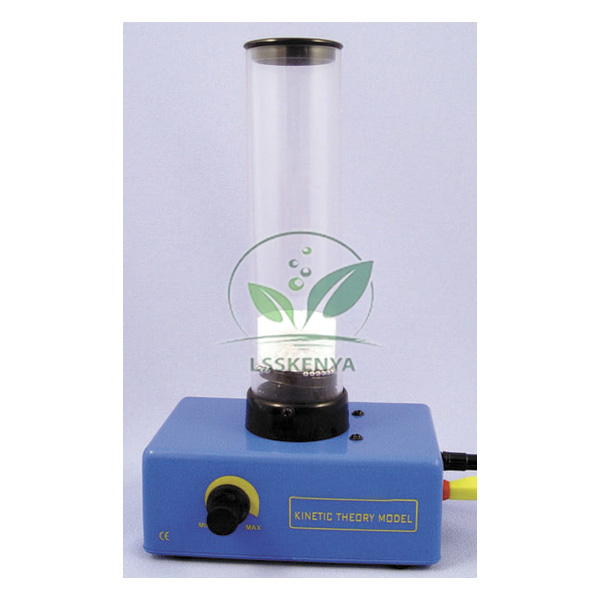
Product Code : LSK-CL-10253
Kinetic Theory Model (SKU LSK-CL-10253) gives a visual analogue of molecular motion in a gas: tiny metal spheres are thrown upwards inside a wide acrylic tube by a vibrating piston, and their random movement stands in for gas molecules. Teachers use it in physics and chemistry lessons on states of matter and the kinetic theory of gases. Schools and colleges can source the model through Science Lab Supplies, which handles quotations and dispatch from Ambala, India.
Specifications
Every specification of the motor-driven particle model appears in the table. In short, a piston in a wide acrylic tube is vibrated by a low-voltage electric motor housed in the supporting box; the motor has a speed control and needs a 6 V DC supply able to deliver 2.5 A.
| Specification | Value |
|---|---|
| SKU | LSK-CL-10253 |
| Tube | Wide acrylic tube |
| Particles | Tiny metal spheres simulating gas molecules |
| Drive | Piston vibrated by a low-voltage electric motor |
| Motor housing | Box supporting the tube |
| Speed control | Provided on the motor |
| Effect of speed | Higher speeds give more extensive movement of the spheres |
| Motion shown | Random in both direction and extent |
| Supply voltage | 6 V DC |
| Supply current | Capable of 2.5 A |
| Presentation | Side illumination and a black background recommended for larger groups |
| Supplied by | Science Lab Supplies, Ambala, India |
Applications and Experiments for the Kinetic Theory Model
The model lets a class see that particle motion is random in both direction and extent, and that supplying more energy, by turning up the motor speed, makes the particles move further and faster. It is an intuitive bridge from temperature to the average kinetic energy of molecules in a gas.
- Class 9 science: particles of matter are constantly moving, and move faster when heated; a Thermometer (with no Mercury) reading from -10 to 120°C can anchor the temperature idea.
- Class 11 physics: kinetic theory of gases and the link between temperature and molecular speed.
- Chemistry lessons on gas behaviour, diffusion and gas pressure from molecular collisions.
Run the motor from a DC source such as the Power Supply Unit/ Block for DC, which gives a regulated 0–9 V at 2.5 A. For larger groups, light the tube from the side against a black background so the spheres stand out.
Standard Scope of Supply
The Kinetic Theory Model is supplied as a single unit as described above, with the acrylic tube, piston, metal spheres and motor box with speed control. The 6 V DC supply it needs is a separate item and can be added to the quotation, as can connecting leads.
Packing, MOQ and Lead Time
Quotations cover anything from one demonstration model to units for several science rooms. Each one sets out the packing, delivery time and price for your quantity, and a matching power supply or other school laboratory equipment can be priced on the same sheet.
As a registered exporter, Science Lab Supplies can use its Importer-Exporter Code to ship to buyers in Kenya, Ghana, Ethiopia, Tanzania, Uganda and the UAE. A quote for the model can be requested on the contact page or by adding it to the enquiry cart; procurement officers handling tenders will find the lab tender page useful.
Frequently Asked Questions
What power supply does the Kinetic Theory Model need?
The motor runs on 6 V DC and the supply must be able to provide 2.5 A. A suitable low-voltage DC unit can be quoted with the model if your lab does not have one.
Can the speed of the particles be changed?
Yes. The motor has a speed control, and higher speeds give more extensive movement of the spheres, which models the effect of raising the temperature of a gas.
Who supplies this kinetic theory apparatus?
You can order it from Science Lab Supplies, which runs quotations and dispatch from Ambala, India. A single model for a teacher's bench or several for a group of schools are both quoted.
How do I make the spheres visible to a whole class?
Light the tube from the side and place a black background behind it. The metal spheres then show up clearly, even for students sitting at the back of the room.
Related Particle-Model and Gas-Law Apparatus
Pair the model with these items to cover the particle theory of matter from several angles: Brownian motion, a second kinetic theory apparatus, changes of state, atomic structure and the gas laws. Any of them can be quoted together with the model for a states-of-matter unit.
- Smoke Cell — box with condensing lens and a 12 V, 3 W festoon bulb, with flanges for standard microscopes and a smoke generator.
- Kinetic Theory Apparatus — 1/8 inch spheres agitated on a rubber diaphragm by a DC-motor piston, with 4 mm socket terminals.
- Aggregate States of Water — laminated 70 x 100 cm wall chart.
- Atom Activity Model — transparent plastic model for overhead projection, covering atomic numbers, bonding and electron layers.
- Apparatus Charle's Law — glass U-tube of 10 mm diameter with a scale; 20 ml of mercury required.
- Apparatus Boyles Law Pressure Type — 80 cm high unit supplied with a hand pump.
- Charles Law Apparatus (Combined) — Jolly's air bulb and glass mercury reservoir on a wooden stand with a 0–100 cm scale.
Browse the full Chemistry Lab range, the Properties of Matter range for gas-law apparatus, or all school lab equipment.
Last updated: 9 October 2026



.jpg)