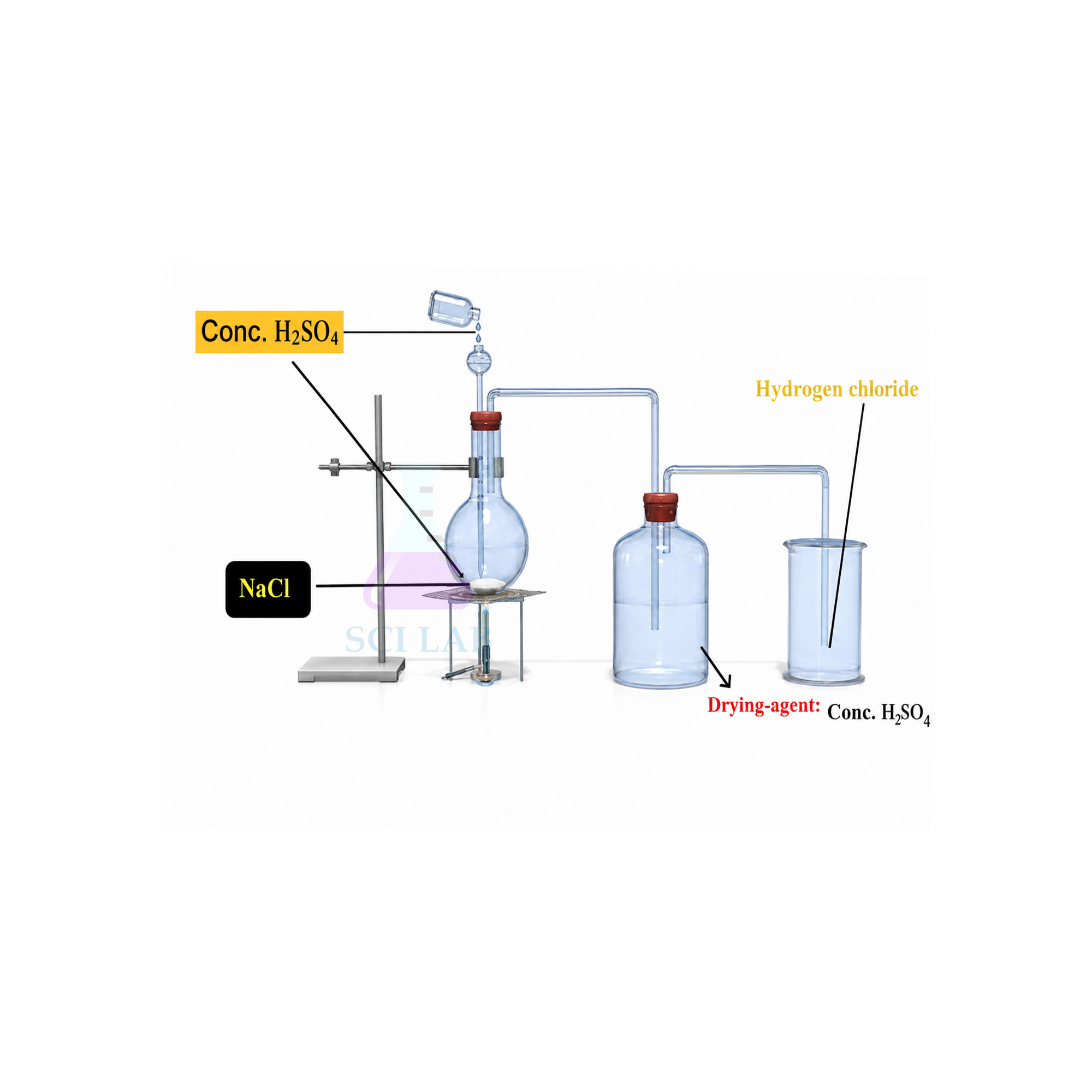
Apparatus for Preparing Chlorine and Hydrogen Chloride
Product Code : SCL-CL-11452
This apparatus is a glass set for preparing chlorine or hydrogen chloride gas in the school laboratory. It has a 250 ml glass flask, a safety tube with two bulbs, a gas delivery tube, a 250 ml bottle for drying the gas and a container for collecting it.
Specifications of the Chlorine and Hydrogen Chloride Apparatus
| Specification | Value |
|---|---|
| Reaction flask | Glass, 250 ml |
| Safety tube | With two bulbs |
| Delivery | Gas delivery tube |
| Drying bottle | 250 ml |
| Collection | Container for collecting gases |
| Supplied by | Science Lab Supplies, Ambala, India |
Preparing Chlorine and Hydrogen Chloride
The solid goes into the flask and acid is added through the safety tube, whose bulbs hold liquid as a seal. The gas passes through the drying bottle, charged with concentrated sulfuric acid, and then into the collecting container.
- Hydrogen chloride: warm sodium chloride with concentrated sulfuric acid, heating gently over a Tripod Stand and Wire Gauze.
- Chlorine: add concentrated hydrochloric acid to potassium permanganate (no heating) or to manganese dioxide (gentle heating), then wash the gas through water before drying it.
- Collection and tests: both gases are denser than air, so lead them to the bottom of the dry container. Test chlorine with damp litmus and hydrogen chloride with ammonia.
Safety: both gases are toxic and corrosive. Prepare them only in a fume cupboard, in small amounts, with eye protection.
Frequently Asked Questions
Why is hydrogen chloride not collected over water?
Hydrogen chloride is very soluble in water, so it would dissolve instead of collecting. It is denser than air, so it is collected by downward delivery into a dry container.
Which drying agent is used for chlorine and hydrogen chloride?
Concentrated sulfuric acid is used for both. Basic drying agents such as quicklime or soda lime are not used, because they react with acidic gases like these.
Why is chlorine washed through water before it is dried?
Chlorine made from hydrochloric acid carries some hydrogen chloride gas. Water dissolves the hydrogen chloride very easily while most of the chlorine passes on, so the gas is cleaner before drying.
What is the safety tube with two bulbs for?
Acid is added through it without opening the flask. Liquid held in the bulbs forms a seal so gas cannot escape, and if pressure builds the liquid is pushed up the tube.
How are the two gases identified?
Chlorine is pale yellow-green and bleaches damp blue litmus paper. Hydrogen chloride turns damp blue litmus red and gives dense white fumes with ammonia on a glass rod.
Related Gas Preparation Glassware
- Safety Funnel Tube with Bulb, 350 mm: 350 mm long with a 40 mm upper diameter.
- Drying Column: 250 ml drying column for gases with an emery (ground) nozzle.
- Distillation Flask with Side Arm, 250 ml: 250 ml borosilicate pot with a 175 mm side pipe.
- Kipp's Apparatus, 250 ml: makes gases such as carbon dioxide and hydrogen from an acid and a solid without heating.
- Deflagrating Spoon: 35 cm long with a 75 mm cap, for lowering chemicals into a gas jar.
Browse the Chemistry Lab section for more preparation apparatus, or the full School Lab Equipments catalogue.
Science Lab Supplies is registered with an Importer-Exporter Code and can export to schools and colleges in Zambia, Rwanda, South Africa, Qatar, Sri Lanka and Vietnam. Quotations can be requested from the contact page or through the enquiry cart.
Last updated: 14 November 2026