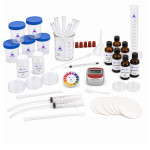
Wilmott's Bubbler
-Photoroom (1).png)
Product Code : SCL-LG-11976
Wilmott's Bubbler shows oxygen release by an aquatic plant during photosynthesis as a stream of bubbles. Bubbles are counted over equal time periods, so students can compare the rate of photosynthesis when light, carbon dioxide or temperature is changed one at a time.
Specifications of Wilmott's Bubbler
| Specification | Value |
|---|---|
| Principle | Counting gas bubbles released by an aquatic plant during photosynthesis |
| Specimen | Suitable aquatic plant, obtained separately |
| Measures | Comparative rate of photosynthesis as bubbles per unit time |
| Operation | No electrical supply needed |
| Contents | One Wilmott's Bubbler apparatus |
| Supplied by | Science Lab Supplies, Ambala, India |
Photosynthesis Practicals with Wilmott's Bubbler
A fresh shoot of an aquatic plant is fitted cut end up in the water-filled apparatus, and gas from the cut stem rises as a line of bubbles. After a short settling time, bubbles are counted for a fixed period with a Digital Stopwatch.
- Light intensity (Class 10 and 11): set a lamp at four distances from the plant and count bubbles per minute at each one.
- Carbon dioxide: add sodium hydrogencarbonate solution in steps and record how the bubble rate rises and then levels off.
- Temperature: stand the apparatus in water at set temperatures, checked with a Glass Thermometer, and compare the counts.
Precautions: keep lamps and cables well away from the water, use a heat screen or fixed lamp distance so the water does not warm up, and handle the glassware with care.
Frequently Asked Questions
What must a buyer arrange besides the bubbler for a class practical?
The aquatic plant is obtained separately, usually fresh Elodea or Hydrilla from a local pond or aquarium source. A lamp, a metre rule, a timer, sodium hydrogencarbonate and a thermometer complete a typical practical.
Which class levels is Wilmott's Bubbler suited to?
It suits secondary biology, where students compare bubble rates under different light, and pre-university or first-year college courses, where the same counts are used to show limiting factors and Blackman's law.
Why is sodium hydrogencarbonate added to the water?
It releases dissolved carbon dioxide, the raw material for photosynthesis. With too little carbon dioxide the bubble rate stays low whatever the light, so adding it in steps shows carbon dioxide acting as a limiting factor.
How can the gas in the bubbles be shown to be oxygen?
Collect the gas over several hours in a small inverted test tube filled with water. A glowing splint pushed into the tube relights, showing the gas is rich in oxygen, although it also holds some nitrogen and carbon dioxide.
Why is the plant left for a few minutes before counting starts?
After any change in light or temperature, the rate takes a few minutes to settle at its new level. Counting too early mixes the old and new rates and makes the results uneven.
Related Photosynthesis and Respiration Apparatus
- Apparatus for Photosynthesis: calibrated capillary tube and plastic syringes on a 190 x 150 mm panel.
- Kit for Experiments on Photosynthesis: photosynthesis cell with a CO2 sensor and a platinum temperature sensor.
- Photosynthesis Kit: floating leaf disk assay with sodium bicarbonate, syringes and metric rulers.
- Kuhne's Fermentation Tube: closed arm that collects carbon dioxide from yeast fermentation.
- Respirometer with Stand: two corked tubes, three-way taps and a graduated manometer on a stand.
Wilmott's Bubbler is filed with the potometers, respirometers and fermentation tubes in Biology Lab Equipment; beakers, test tubes and other general glass vessels are in Lab Glassware.
Schools in Oman, the Philippines, Nepal, Bangladesh, Zambia and Rwanda can receive the bubbler by export, since Science Lab Supplies holds an Importer-Exporter Code. A quotation can be requested from the contact page or by adding the bubbler to the enquiry cart.
Last updated: 16 November 2026