Vacuum Pressure Pump
Product Code : LSK-CL-10083
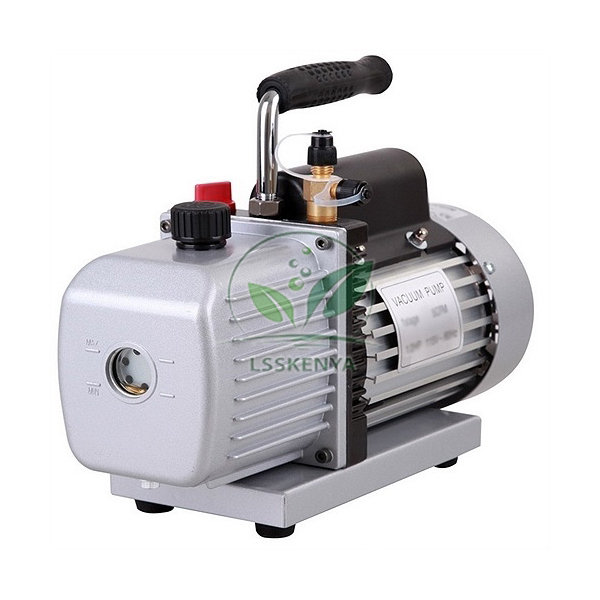
The Vacuum Pressure Pump is a general-purpose, quiet-running pump for evacuating laboratory apparatus. It moves about 50 litres of gas per minute and reaches an ultimate vacuum of 5 Pa, low enough for bell jar demonstrations, vacuum filtration and reduced-pressure work.
Specifications of the Vacuum Pressure Pump
| Specification | Value |
|---|---|
| Type | General purpose, quiet running |
| Pumping rate | About 50 litres per minute (3 m³/h) |
| Ultimate vacuum | 5 Pa (0.05 mbar) |
| Use | Pumping gases from laboratory apparatus |
| Supplied by | Science Lab Supplies, Ambala, India |
Using the Vacuum Pump in the Lab
Stand the pump on a firm bench and connect it with thick-walled vacuum tubing. Put an empty trap flask between the apparatus and the pump inlet so no liquid or vapour reaches the pump.
- Vacuum demonstrations: evacuate the Bell Jars set and let the class hear the electric bell fade as the air is removed.
- Boiling and freezing: place a cup of warm water under the jar; it boils at room temperature, and with longer pumping the cooling can freeze it.
- Faster filtration: run the Equipment for Vacuum Filtration set from the pump where tap pressure is too low for a water pump.
Precautions: wear eye protection near any evacuated glassware and let air back in slowly.
Frequently Asked Questions
What does an ultimate vacuum of 5 Pa mean?
It is the lowest pressure the pump reaches with its inlet closed. Atmospheric pressure is about 101,000 Pa, so 5 Pa leaves roughly one twenty-thousandth of the original air.
What does a pumping rate of 50 litres per minute tell me?
It is the volume of gas the pump moves each minute at its inlet. A small bell jar is pumped down quickly, but the real speed falls as the pressure inside gets lower.
Why should an evacuated bell jar be screened?
Outside air presses hard on the glass once the jar is pumped down. A scratched or chipped jar can implode and throw fragments, so check the glass before each run and keep a clear plastic safety screen between the jar and the class.
Should liquids or vapours be drawn into the pump?
Keep them out. Use a trap flask between the apparatus and the pump, and avoid pulling acid or solvent vapours through it, which can damage the pump and shorten its life.
Why does the electric bell go quiet as the jar is pumped?
Sound needs a material such as air to carry its vibrations. As the pump removes air, fewer molecules pass the vibrations to the glass, so the ringing fades while the hammer can still be seen moving.
Is the pump quiet enough to run during a lesson?
It is a quiet-running pump, so it can stay on the front bench while the class listens for the bell fading in the jar. Stand it on a firm, level surface; a bench that vibrates adds noise of its own.
Related Vacuum and Air Pressure Apparatus
- Hand Vacuum Pump with Pressure Gauge: 15 ml per stroke, gauge in cm and inches of mercury, with a release valve.
- Portable Diaphragm Type Vacuum Pump cum Air Compressor: oil-free double-stage diaphragm pump for low vacuum and low pressure.
- Air Pump (Vacuum Pump with Aluminium Plate): single steel barrel on a wooden base with an aluminium plate and stopcock.
- Magdeburg Hemispheres: metal hemispheres held together by air pressure once the air is pumped out.
- School Vacuum-Pump Set: educational vacuum chamber and pump set for boiling and pressure demonstrations.
Bell jars, filter sets and other items to run with the pump are listed under Chemistry Lab within School Lab Equipments.
Overseas orders for the vacuum pump from Saudi Arabia, Oman, the Philippines, Nepal, Bangladesh and Zambia are taken by Science Lab Supplies under its Importer-Exporter Code. The vacuum pump can be added to the enquiry cart for a combined quotation, or asked about on its own through the contact page.
Last updated: 15 November 2026