
Static and Dynamic Balancing Apparatus
Product Code : LSK-TOMLE-10617
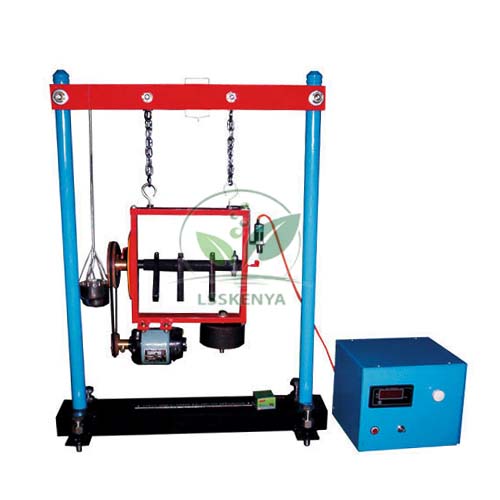
Static and Dynamic Balancing Apparatus (SKU LSK-TOMLE-10617) lets students balance a rotating shaft carrying four eccentric blocks, first statically and then while it spins. It is a standard dynamics-of-machinery practical for B.Tech mechanical students and diploma courses. Science Lab Supplies manufactures the apparatus on its own shop floor at Plot 448, HSIIDC Industrial Area, Saha, Ambala, India, and deals directly with colleges, polytechnics, contractors and distributors.
Specifications
Shaft, blocks, scales and drive of the balancing apparatus are each listed separately in the table. In short, a stainless-steel shaft in a chain-suspended rectangular frame carries four eccentric stainless-steel blocks, positioned on angular and longitudinal scales and spun by a variable-speed FHP motor on a painted structure.
| Specification | Value |
|---|---|
| SKU | LSK-TOMLE-10617 |
| Shaft | Stainless steel |
| Frame | Rectangular, with the shaft fixed in it |
| Suspension | Chains, for dynamic balancing |
| Balancing blocks | 4 nos, stainless steel |
| Block masses | Different-sized eccentric masses for varying unbalance |
| Block mounting | Clamping arrangement on the shaft |
| Static weighing | Cord and container system |
| Weighing unit | Number of steel balls |
| Angular scale | Sets the angular position of each block |
| Longitudinal scale | Sets the axial position of each block |
| Drive motor | FHP motor, variable speed |
| Speed control | Speed controller |
| Electricity | 0.5 kW, 220 V, single phase |
| Structure | Painted |
| Experiments | Static and dynamic balancing of a single rotating mass system; effect of unbalance |
| Manufacturer | Science Lab Supplies, Saha, Ambala, Haryana |
| Country of origin | India |
Applications and Experiments for the Balancing Apparatus
Students find the relative out-of-balance of each block by counting steel balls in the container, draw a moment polygon to fix the blocks' angular and axial positions, and then run the shaft to confirm it spins smoothly. Running with blocks out of position shows the effect of unbalance.
- B.Tech/B.E. mechanical, Dynamics of Machinery: static and dynamic balancing of rotating masses, a topic taught alongside governors on the Motorised Governor Apparatus.
- Diploma mechanical engineering: observing vibration caused by unbalance.
- Graphical practice: force and couple (moment) polygons for balancing.
- Foundation work on rotational dynamics beforehand with the Air-Bearing Rotational System in the physics lab.
Tighten every block clamp before starting the motor, raise speed slowly and keep hands clear of the rotating shaft.
Standard Scope of Supply
Each apparatus comprises the stainless-steel shaft in its chain-suspended frame, four eccentric balancing blocks with clamps, the cord and container system for static weighing, angular and longitudinal scales, and the FHP motor with speed controller, all on the painted structure.
Packing, MOQ and Lead Time
Institutes looking for a TVET lab equipment supplier can ask for one apparatus or a full theory of machines lab. Each quotation gives packing, delivery time and price for the quantity, and the gyroscope, governor and gear-train units from the same range can be added.
As a registered exporter with an Importer-Exporter Code, Science Lab Supplies can ship to buyers in Rwanda, South Africa, Qatar, Sri Lanka, Vietnam and Malaysia. Write to the factory team via the contact page, park the apparatus in the enquiry cart while you assemble a lab list, or turn to the lab tender page for tender purchases.
Frequently Asked Questions
How is static balance measured on this apparatus?
Each block is clamped on the shaft in turn and its out-of-balance is measured with the cord and container system, counting the steel balls needed to balance it.
What power supply does it need?
The apparatus needs 0.5 kW at 220 V, single phase, to run the variable-speed FHP motor and its speed controller. Connect it to an earthed supply and keep the cable clear of the shaft.
Is Science Lab Supplies the manufacturer or a trader?
Science Lab Supplies is the manufacturer. Its Saha, Ambala works in India builds this balancing apparatus, so colleges and contractors get technical answers and quotations from the people who make it.
Why is the frame hung on chains?
Chain suspension lets the frame move freely, so any remaining dynamic unbalance shows up clearly as vibration when the motor spins the shaft at increasing speed.
Related Machine Dynamics and Rotational Apparatus
Balancing is taught with other rotating-machinery and inertia experiments. These items from the Theory of Machine Lab Equipments, Applied Mechanics and Material Testing ranges cover gyroscopic couple, Coriolis acceleration, gear and belt drives, flywheels and fatigue, and can share one quotation.
- Motorised Gyroscope Apparatus — 250 mm rotor free about three axes, loaded with 0.2, 0.5 and 1 kg weights.
- Cariollis Component of Acceleration — two 300 mm rotating tubes driven by a 0.5 HP swinging-field DC motor.
- Epicyclic Gear Train Holding Torque Apparatus — rope brakes measure output and holding torque on a planetary train.
- Slip and Creep Measurement Apparatus — fabric, canvas and rubber flat belts run on equal-diameter pulleys.
- Fly Wheel — machined and balanced cast-iron wheel on ball bearings, in 15, 20 and 25 cm sizes.
- Inertia Table — aluminium disc of about 6 in with three masses, hung on a steel wire.
- Rotating Fatigue Machine — motor-driven rotating cantilever specimen on a variable-speed drive.
Browse the full Theory of Machine Lab Equipments range, the Applied Mechanics range for flywheel and inertia apparatus, or all TVET lab equipment.
Last updated: 9 October 2026


