
Slip and Creep Measurement Apparatus
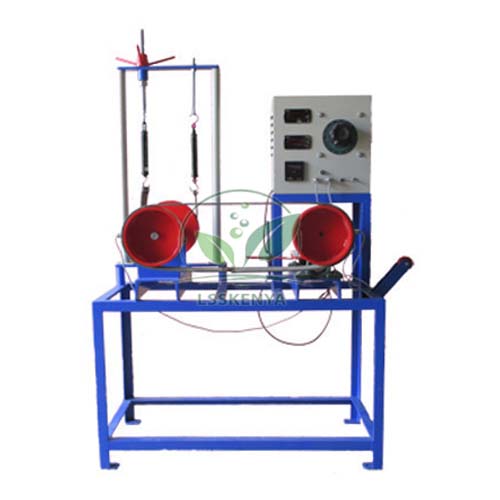
Product Code : LSK-TOMLE-10623
Slip and Creep Measurement Apparatus (SKU LSK-TOMLE-10623) is a flat-belt drive test rig for measuring belt slip, locating the creep zone and finding the friction coefficient between pulley and belt. Fabric, canvas and rubber belts can be compared under controlled tension and brake load. It serves Theory of Machines and machine design labs. The rig is manufactured by Science Lab Supplies in Saha, Ambala, India, and colleges, polytechnics and contractors order it from the factory itself.
Specifications
Motor, pulleys, belts and instruments of the slip and creep rig are split into single rows below. In short, a 1 HP, 1500 rpm variable-speed DC motor drives equal-diameter pulleys, a brake drum with spring balance loads the output, the driven pulley slides to set tension, and a two-channel digital RPM indicator reads both speeds.
| Specification | Value |
|---|---|
| SKU | LSK-TOMLE-10623 |
| Motor | DC, 1 HP |
| Motor speed | 1500 rpm, variable |
| Speed control | Dimmerstat |
| Speed controller unit | Provided |
| Driving pulley | On the motor (input) shaft |
| Driven pulley | On the output shaft, equal in diameter to the driving pulley |
| Brake drum | On the output shaft, with spring balance, to measure power output |
| Belt tension | Driven pulley slides on the base with bearing block |
| Belt tightening arrangement | Provided |
| Belts | Flat, fixed length |
| Belt materials | Fabric, canvas and rubber |
| RPM indicator | Two-channel digital, for driving and driven pulleys |
| Stroboscope | Included |
| Power supply | 230 V AC stabilised |
| Space required | 1.5 x 1.5 m |
| Manufacturer | Science Lab Supplies, Saha, Ambala, Haryana |
| Country of origin | India |
Applications and Experiments for the Slip and Creep Measurement Apparatus
At fixed belt tension students increase the brake load, record both pulley speeds and plot (T1 − T2) against percentage slip to find the creep zone. Repeating at other tensions gives the tension characteristic, power transmitted and the point where gross slip begins.
- Percentage slip at fixed tension and slip characteristics.
- Coefficient of friction between pulley material and different belt materials.
- Power transmitted at varied belt tensions; tension characteristics.
- Belt slip speed and the limiting value at constant speed when slip starts.
- B.Tech/B.E. Theory of Machines and diploma power-transmission practicals, following first belt and chain comparisons on the Drive Systems Kit.
- Brake loading: comparing the drum-and-spring-balance method with the band brake on the Turbine Dynamometer.
Standard Scope of Supply
Each apparatus comprises the variable-speed DC motor, equal driving and driven pulleys, the brake drum with spring balance, fabric, canvas and rubber flat belts, the belt tightening arrangement, the speed controller unit, the two-channel digital RPM indicator and a stroboscope.
Packing, MOQ and Lead Time
A quotation can be prepared for one rig or several for a mechanical engineering lab, stating packing, delivery time and price for that quantity. This TVET lab equipment supplier can add gear-train and governor apparatus, or other vocational training equipment, to the same quotation.
As a registered exporter with an Importer-Exporter Code, Science Lab Supplies can ship to buyers in Peru, Egypt, Iraq, Nigeria, Kenya and Ghana. Send the number of rigs you need through the contact page, place this rig in the enquiry cart with your other transmission apparatus, or look at the lab tender page if you are buying by tender.
Frequently Asked Questions
What is the difference between slip and creep in a belt drive?
Creep is the small speed loss caused by the belt stretching and relaxing as it passes from tight to slack side. Slip is gross sliding of the belt over the pulley once the load exceeds what friction can carry.
Which belts come with the Slip and Creep Measurement Apparatus?
Flat belts of fixed length in fabric, canvas and rubber are supplied, so students can compare friction and slip for three materials running on the same pair of pulleys.
Who makes this apparatus?
It is made by Science Lab Supplies at its own plant in Saha, Ambala, India, and the company prices it for colleges and contractors directly, without a reseller.
Why is a stroboscope included?
The stroboscope lets students check pulley speeds visually and observe the belt while it runs, as a cross-check on the two-channel digital RPM readings.
Related Power Transmission and Machine Dynamics Apparatus
Belt drives are one of several power-transmission topics. These items from the Theory of Machine Lab Equipments, Engineering Science and Physics ranges add gear trains, tooth geometry, balancing, friction, pulleys and kinematics, so a transmission lab can be equipped from one quotation.
- Epicyclic Gear Train Holding Torque Apparatus — bearing blocks for input and output shafts, with a digital ammeter and voltmeter on the panel.
- Generation of Involute Gear Tooth Profile — rack-type cutter of module 25 mm traced onto paper for each disc.
- Static and Dynamic Balancing Apparatus — clamped blocks spun by a motor on a chain-hung frame to check dynamic balance.
- Rotational Friction Kit — screw jack, wedge and bearings for efficiency and overhaul tests.
- Pulley Kit — introduces machine efficiency, velocity ratio and work done.
- Cariollis Component of Acceleration — rotameter measures water flow through tubes rotated at various speeds.
- Wooden Machine Pulley Model — three pulleys on a 6 1/2 x 3 1/2 in base, 16 1/4 in tall, for mechanical advantage.
Browse the full Theory of Machine Lab Equipments range, the Engineering Science range for drive, pulley and friction kits, or all TVET lab equipment.
Last updated: 9 October 2026


