Three Types of Bacteria, Colored
Product Code : SCL-BLE-11670
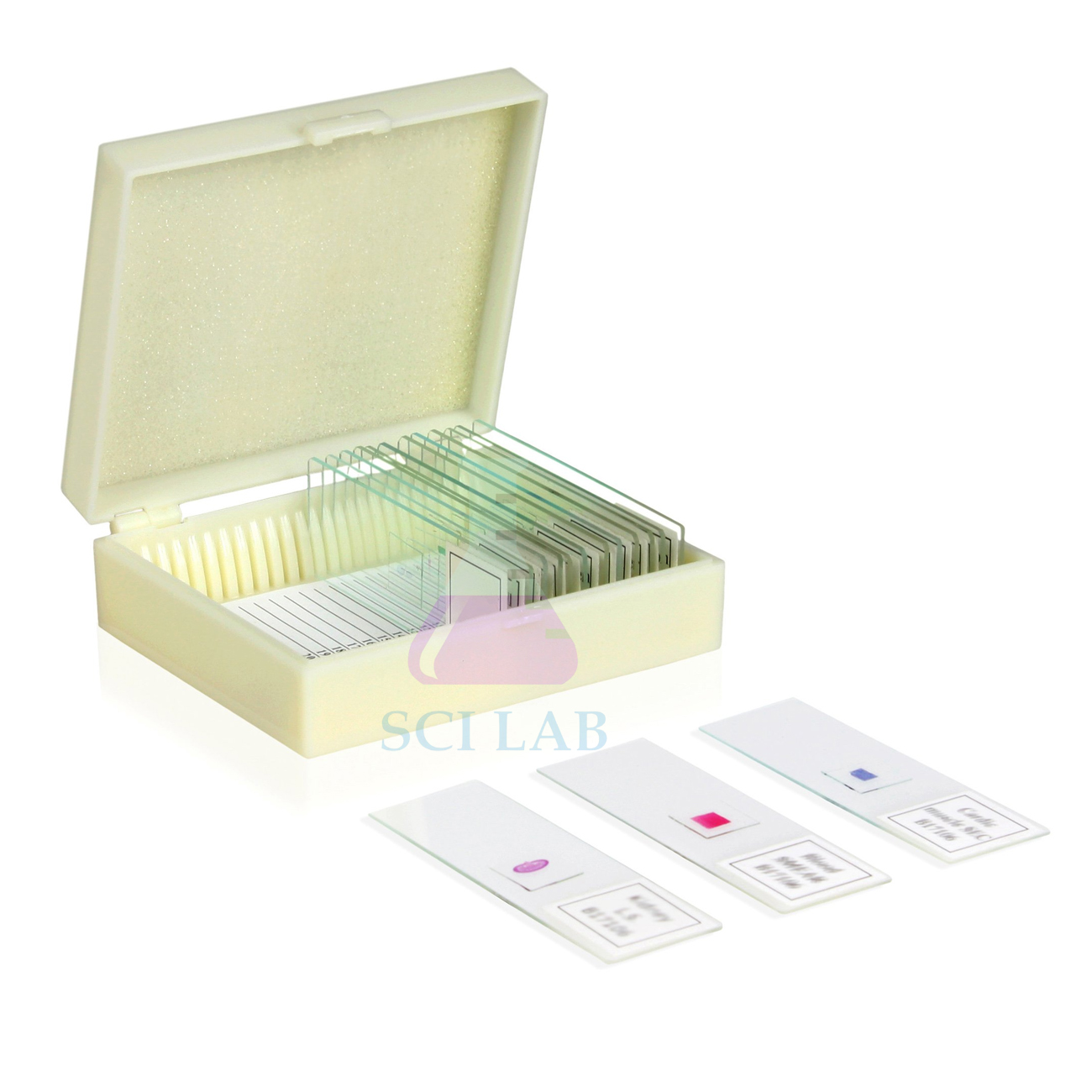
Three Types of Bacteria, Colored is one permanent prepared slide carrying three colour-stained smears: round cocci, rod-shaped bacilli and spiral spirilla. The three types are shape groups, not named species, so students compare the basic bacterial forms side by side. The slide is rectangular borosilicate glass of 25.4 × 76.2 mm and is supplied in a plastic box.
Specifications of the Bacteria Slide
| Specification | Value |
|---|---|
| Smears | 3 bacterial shape types: cocci, bacilli and spirilla |
| Preparation | Colour-stained morphology smears, permanent preparation |
| Quantity | One slide |
| Slide size | 25.4 × 76.2 mm (1 × 3 in) |
| Slide shape | Rectangular |
| Slide glass | Borosilicate |
| Box material | Plastic |
| Supplied by | Science Lab Supplies, Ambala, India |
Viewing Bacterial Shapes at High Power
Bacteria are only a few micrometres long. Find one of the three coloured smears at 10x, focus at 40x, place one drop of immersion oil on the slide and turn straight to the 100x oil objective. Scan several fields of each smear, as the cells may be spread out, then move the stage to the next smear.
- Shape study (Class 8–11): draw cocci, bacilli and spirilla inside circles that stand for the field of view, and write the magnification beside each.
- Oil-immersion practice: the Monocular Research Microscopes unit carries a 100X oil-immersion objective beside its 4X, 10X and 40X lenses.
- Cell size (B.Sc.): calibrate an eyepiece scale with a Micrometric Slide, which has a 1 mm range in 0.01 mm divisions, then measure a rod.
- Own smear: heat-fix a smear of a harmless school culture and stain it with methylene blue from Stains and Reagents for Microscopy, then compare it with the prepared slide.
Common errors: putting oil on the 40x lens and turning back through 40x once oil is on the slide. Others are using the coarse knob at high power and wiping lenses with paper towel instead of lens tissue.
Frequently Asked Questions
Which microscope and accessories should be ordered with the bacteria slide?
Shapes can be picked out at 400x, but clear detail needs a 100x oil-immersion objective, giving 1000x with a 10x eyepiece. Add immersion oil and lens tissue to the order if the microscope does not already have them.
Is the slide meant for shape study or for naming species?
For shape study. In school biology, three types of bacteria means the three basic forms: round cocci, rod-shaped bacilli and spiral bacteria. These are shape groups, not identified species, and this slide has one colour-stained smear of each. Work that names species or compares Gram reactions uses a labelled set of named bacteria instead.
Are the three types mixed in one smear or kept apart?
Kept apart. The slide carries three separate smears, one of cocci, one of bacilli and one of spirilla, so each shape can be found and drawn without the others in the same field. Refocus each time the stage moves to the next smear.
How can stain specks be told apart from bacteria?
Bacteria of one kind are uniform in size and shape and repeat across the field. Stain specks vary in size, have ragged edges and often sit in a different focal plane. Focus slowly up and down to check.
Why must oil touch only the 100x objective?
The 100x lens is sealed and built to look through oil, which bends light much as glass does. Oil on the 40x or 10x lens blurs the image and can seep inside. Turn from 40x straight to 100x.
How is a bacterial smear prepared in a school lab?
Spread a tiny drop of a harmless culture thinly on a clean slide, let it air-dry and pass it quickly through a flame to heat-fix it. Flood it with a simple stain, rinse gently with water and blot dry.
Related Microbiology Slides and Kits
- Bacteria slide Set of 12: twelve glass slides; some samples need a 1000x microscope.
- Fungal Yeast Reproduction Prepared Slide: slide for observing yeast reproduction by budding.
- Ringworm Prepared Microscope Slide: mycology slide of ringworm-related fungal structures.
- Bacterial Amylase Project Pack: enzyme, starch, iodine and buffers for pH and temperature tests.
- Petri Dish Glass With Lid: colourless glass dish, about 90 mm across, for microbiological work.
- Advance Research Microscope: binocular head with 4X, 10X, 40X and 100X oil objectives.
For more microbiology slides see Microscope Slides and Cameras or Biology Lab Equipment; microscopes with oil objectives are in the Microscope range.
Laboratories and distributors in Nepal, Bangladesh, Zambia, Rwanda, South Africa and Qatar can be supplied, since Science Lab Supplies holds an Importer-Exporter Code. Quotation requests for single bacteria slides or class sets go through the contact page or the enquiry cart.
Last updated: 19 November 2026