
RTD Studies in CSTR
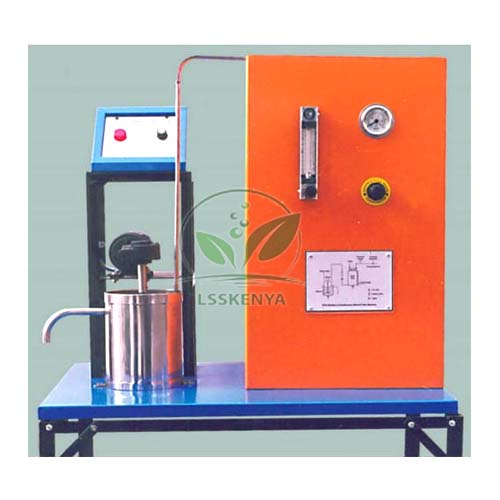
Product Code : LSK-TWL-10799
RTD Studies in CSTR (SKU LSK-TWL-10799) lets students measure the residence time distribution of a continuously stirred tank reactor with a pulse tracer and compare it with ideal back-mixed flow. It is used in chemical reaction engineering practicals for B.Tech/B.E. and diploma students. Science Lab Supplies, a laboratory equipment manufacturer in India, builds it at Plot 448, HSIIDC Industrial Area, Saha, Ambala, and supplies it direct to colleges, tender contractors and distributors.
Specifications
Each specification of this CSTR residence-time rig is set out in the table below. In short, water from one feed tank is circulated by a magnetic drive pump to a stainless steel stirred tank, the flow is set by a needle valve and read on a rotameter, and a syringe doses the tracer pulse.
| Specification | Value |
|---|---|
| SKU | LSK-TWL-10799 |
| Reactor type | Continuously stirred tank reactor (CSTR) |
| Reactor material | Stainless steel |
| Feed tank | One |
| Process fluid | Water |
| Feed circulation | Magnetic drive pump |
| Flow adjustment | Needle valve |
| Flow measurement | Rotameter |
| Tracer dosing | Syringe |
| Method | Stimulus-response, pulse tracer |
| Experiment 1 | Plotting the RTD curve for a CSTR using a pulse tracer |
| Experiment 2 | Determining the dispersion |
| Electricity supply | 1 phase, 220 V AC |
| Power rating | 0.5 kW |
| Utilities required | Water supply and drain |
| Analysis items | Instruments, laboratory glassware and chemicals as per the analysis system adopted (not included) |
| Manufacturer | Science Lab Supplies, Saha, Ambala, Haryana |
| Country of origin | India |
Applications and Experiments for the RTD Studies in CSTR
The set-up shows how real stirred vessels deviate from the ideal mixed-flow model through channelling, recycling or stagnant pockets. Students inject a pulse of tracer, follow the outlet concentration and plot the RTD curve, a standard reaction engineering practical in chemical engineering degree and diploma programmes.
- B.Tech/B.E. chemical engineering: plotting the RTD curve of a CSTR using a pulse tracer.
- Determining the dispersion and comparing the measured curve with ideal mixed flow; an acid or salt tracer can be followed in the samples with a Bench pH Meter or conductivity meter.
- Diploma practicals on the stimulus-response technique for non-ideal reactors, contrasted with the closed system of the Isothermal Batch Reactor.
- Process-plant training: operating the pump, needle valve and rotameter.
Standard Scope of Supply
The set-up is supplied with the feed tank, the stainless steel stirred tank reactor, the magnetic drive pump, the needle valve and rotameter, and a syringe for tracer dosing. Instruments, laboratory glassware and chemicals for analysing the samples are not included, as they follow the analysis system your laboratory uses.
Packing, MOQ and Lead Time
Ask for a quotation for a single unit or a full set of reactor trainers. Every Science Lab Supplies quotation gives the packing, delivery time and price for the quantity you name, and departments buying engineering lab equipment in India can list companion reactor units alongside.
As a registered exporter with an Importer-Exporter Code, Science Lab Supplies can ship to buyers in Peru, Egypt, Iraq, Nigeria, Kenya and Ghana. Use the contact page or the enquiry cart to enquire, and the lab tender page for tender requirements.
Frequently Asked Questions
What experiments can be done on the RTD Studies in CSTR?
The listed experiments are plotting the RTD curve of the CSTR with a pulse tracer and determining the dispersion, which shows how far the tank departs from ideal mixing.
What power supply does the unit need?
It needs a 1 phase, 220 V AC electricity supply rated 0.5 kW, together with a water supply and a drain, so plan a bench near a socket and a sink.
Is Science Lab Supplies the manufacturer or a trader?
Science Lab Supplies is the manufacturer. The unit is made at its own factory in Saha, Ambala, India, and quotations come directly from the factory.
How is this different from the packed bed RTD set-up?
This unit studies a stirred tank, where flow is close to fully mixed; the packed bed version uses a Raschig ring column that approximates plug flow.
Related Reactor Engineering Trainers
Pairing the stirred tank tracer study with these units gives students both ends of the mixing spectrum, from near plug flow in packed and tubular reactors to fully mixed tanks, plus steady-state conversion experiments and a flow-regime demonstration, all available on one quotation.
- RTD Studies in Packed Bed — glass column packed with Raschig rings, with rotameter and tracer injection at the lower end.
- Continuous Stirred Tank Reactor — 2 L stainless steel reactor with stirrer for a second order liquid-phase reaction, fed by compressed air.
- Isothermal Continuous Stirred Tank Reactor — two feed tanks, magnetic drive pump and a constant temperature water bath for runs at various temperatures.
- Plug Flow Reactor (Coiled Tube Type) — helical coil tube reactor where secondary flow adds turbulence.
- Plug Flow Reactor, Straight Tube Type — horizontal straight tube reactor fed from two tanks by compressed air.
- Chemical Reactor Training Equipment — base unit with two variable speed diaphragm pumps and a combined conductivity and temperature measuring unit.
- Reynolds Apparatus — glass tube with bell-mouth entry and dye injection for showing laminar and turbulent flow.
Browse the full Training Workshop Labs range, the Chemistry Lab range for analysis glassware and meters, or all TVET lab equipment.
Last updated: 9 October 2026


.jpg)


