
Human Respiratory System Chart, Laminated, 70 x 100 cm
Product Code : SCL-BLE-11795
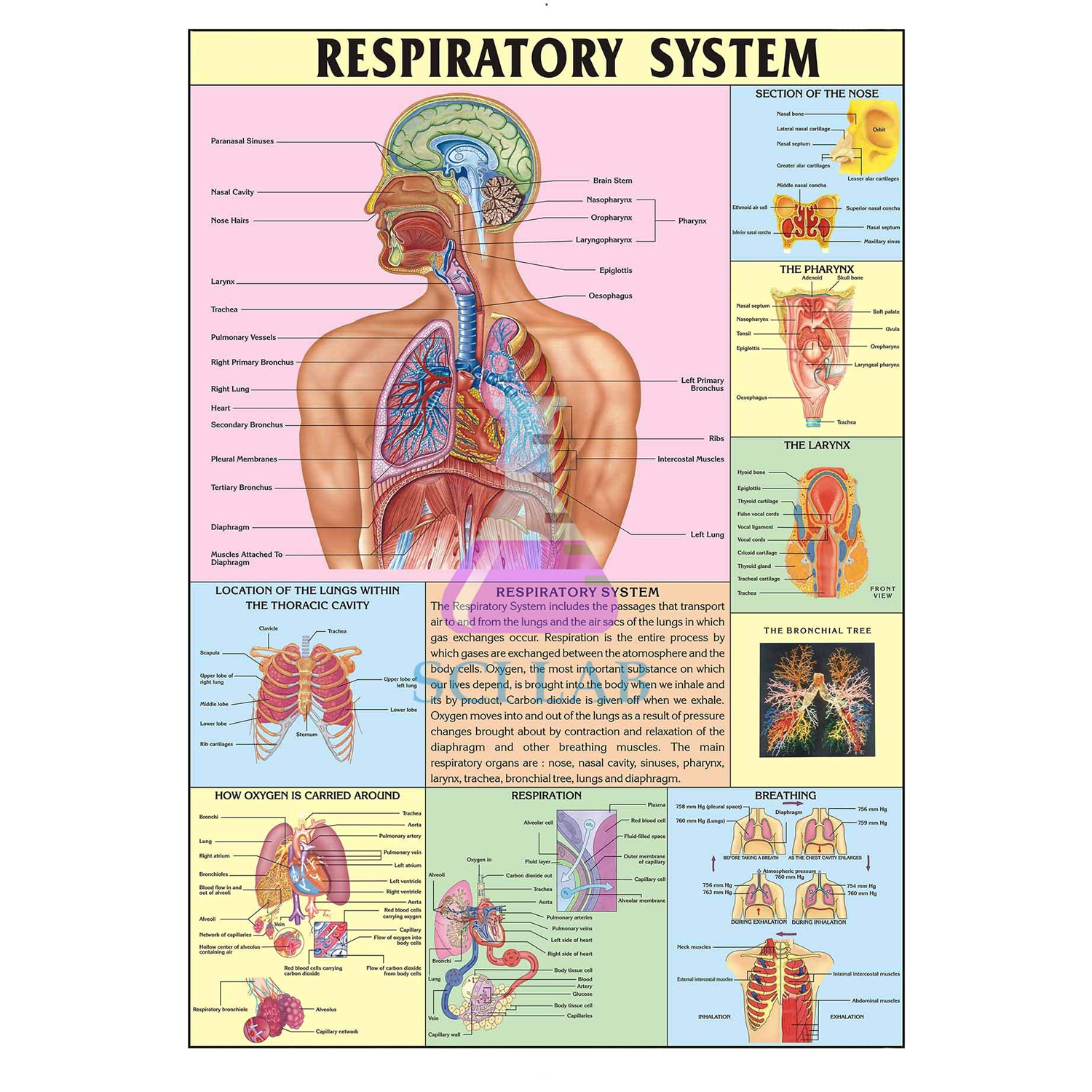
The Human Respiratory System Chart, Laminated, 70 x 100 cm is a wall chart for teaching the human breathing system. Its artwork shows the airways, the lungs, the alveoli and the diaphragm, with labels in English. Rods along the top and bottom edges and a top hanging cord keep it flat on a laboratory or classroom wall, as a large reference for breathing lessons.
Specifications of the Respiratory System Chart
| Specification | Value |
|---|---|
| Subject | Human respiratory system |
| Artwork | Labelled airways, lungs, alveoli and diaphragm |
| Label language | English |
| Chart size | 70 x 100 cm (700 x 1000 mm) |
| Finish | Laminated |
| Hanging fittings | Rods at the top and bottom, hanging cord at the top |
| Display type | Wall mounted |
| Use | Laboratory and classroom |
| Supplied by | Science Lab Supplies, Ambala, India |
Breathing Measurements Linked to the Chart
Students name each part of the airway on the chart, then take simple measurements on themselves and link each result back to the organ involved.
- Breathing movements (Class 7 to 10): pull down and push up the rubber sheet of the Lung Model Demo Kit, then find the diaphragm on the chart and explain why the balloons fill and empty.
- Breathing rate: count breaths per minute at rest and after two minutes of stepping, and explain the change with the chart.
- Peak flow: each student blows hard into the Peak Flow Meter, which has a 60 to 800 scale and a one-way valve, and the class compares readings.
- Carbon dioxide in breath: with the Kit for Experiments with Breathing, bubble exhaled air through lime water and watch it turn milky.
Precautions: students with asthma or a cold sit out the exercise and peak flow tasks, and the meter is cleaned between users. A frequent error is to show air reaching the lungs through the food pipe.
Frequently Asked Questions
How is the chart fixed to the wall?
It has a rod along the top and bottom edges and a hanging cord at the top, so one hook or nail holds it. The bottom rod keeps the sheet flat against the wall. Do not tape or pin through the laminate, as that lets moisture in at the edges.
Which language are the labels printed in?
The labels are printed in English. Where lessons are taught in another language, teachers can write the local terms beside the printed labels with a dry-wipe marker on the laminated surface and wipe them off afterwards.
Should a school order a 3D lung model as well as the chart?
It helps. The chart shows the whole system and its labels to the class at once, while a three-dimensional model lets students handle the lobes and airways and see their depth. Many lessons use the chart first and the model for revision.
Are breathing and respiration the same process?
No. Breathing is the movement of air into and out of the lungs. Respiration is the chemical process in every cell that releases energy from food, usually using oxygen and giving off carbon dioxide.
Why are the walls of the air sacs so thin?
Each alveolus has a wall only one cell thick, pressed against a capillary wall that is also one cell thick. The short distance lets oxygen and carbon dioxide diffuse across quickly.
Why does the right lung have three lobes and the left only two?
The heart sits slightly to the left in the chest. The left lung is smaller to make room for it and has a notch where the heart lies, so it is divided into two lobes, while the right lung has three.
Related Breathing System Teaching Aids
- Human Lung Model with Dissectible Lobe and Alveoli: PVC model with removable parts, 3 to 4 times magnified.
- Human Respiratory System Model: nasal cavity, bronchial tree, lungs and the position of the heart, with key card.
- Magnified Pulmonary Alveoli Model: alveolar sac and duct with capillary network, 26 x 15 x 35 cm.
- Human Lung Model in Bell Jar with Y-Tube: two balloons on a Y-tube act as lungs when the diaphragm is pulled down.
- Windpipe (Trachea) Model, Enlarged: rigid PVC model of the trachea and bronchi with coloured features, mounted on a base.
- Peak Expiratory Flow Meter, Piston Type, 60-900 L/min: cylinder-and-piston meter with a flow range of 60 to 900 L/min.
Human body charts like this one are listed in Charts & Portraits; lung models appear in Biology Lab Equipment.
Science Lab Supplies has an Importer-Exporter Code, which lets the respiratory chart be exported to Ethiopia, Tanzania, Uganda, the UAE, Saudi Arabia and Oman. Request a quotation through the contact page or by saving the chart to the enquiry cart.
Last updated: 19 November 2026
.png)





.jpg)