Voltmeter
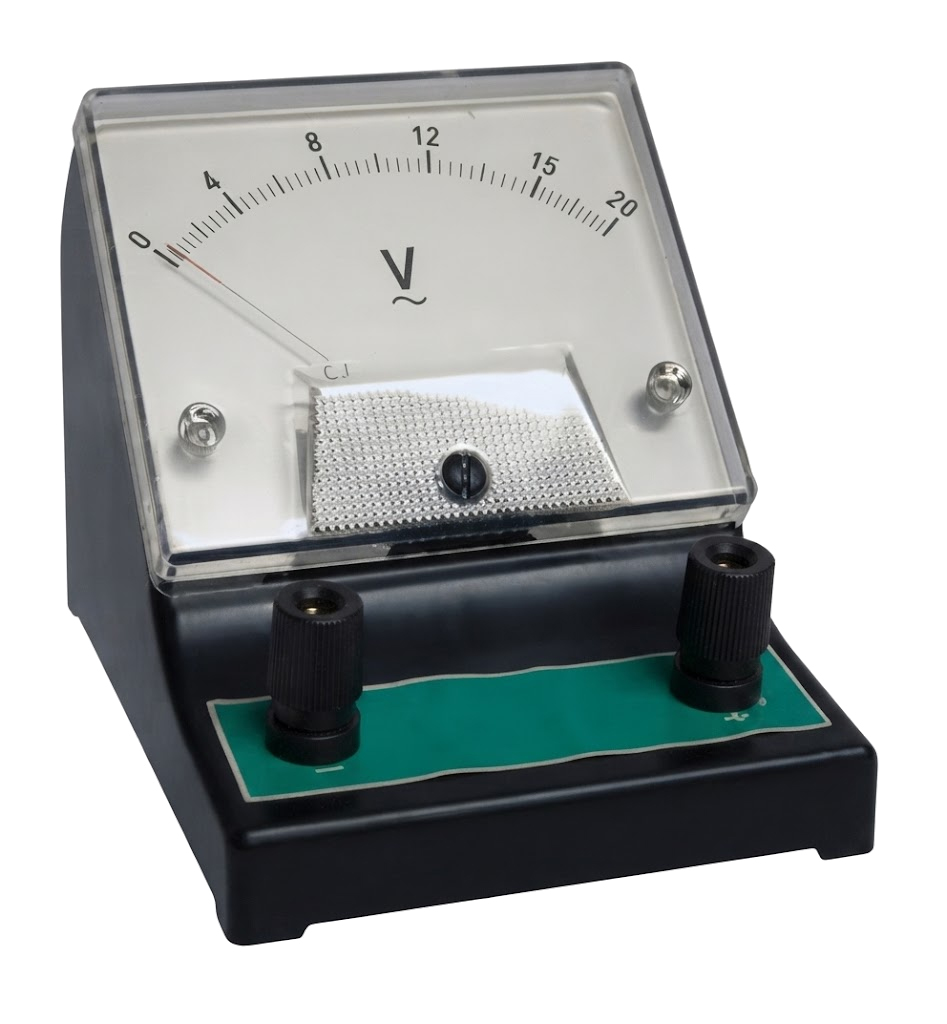
Product Code : SCL-PL-12372
Voltmeter (SKU SCL-PL-12372) is an analog moving-coil bench meter that measures the potential difference between two points in a DC circuit over a 0–20 V range. Physics students in schools and colleges use it for Ohm's law, cell and potential-drop experiments. Science Lab Supplies, a laboratory equipment manufacturer in India, makes this voltmeter at its Plot 448, HSIIDC Industrial Area unit in Saha, Ambala, and supplies schools, colleges, distributors and tender contractors without middlemen.
Specifications
This is a DC bench voltmeter with a moving-coil movement and an analog scale. It reads from 0 to 20 V with a stated resolution of 0.01 V, which covers the low-voltage cells and supplies found in school and college electricity practicals. It connects across, in parallel with, the component being measured.
| Parameter | Value |
|---|---|
| SKU | SCL-PL-12372 |
| Type | Analog moving-coil bench voltmeter |
| Range | DC 0–20 V |
| Resolution | 0.01 V |
| Measures | Potential difference between two points |
| Manufacturer | Science Lab Supplies, Saha, Ambala, Haryana |
| Country of origin | India |
Applications and Experiments for the Voltmeter
Almost every current-electricity practical needs a voltage reading, and a moving-coil meter lets students watch the pointer respond as they change the circuit. The 0–20 V range suits cells, battery packs and low-voltage supplies, placing this meter on the physics lab equipment list for Class 11 and 12.
- Class 10 science: verifying Ohm's law with a voltmeter and ammeter.
- Class 12 physics: V–I graphs, resistivity of a wire and the potential drop across resistors.
- Measuring the terminal voltage of cells and comparing it with the open-circuit value.
- B.Sc. and diploma labs: routine DC voltage measurement in circuit experiments.
Standard Scope of Supply
The Voltmeter is supplied as a single unit as described above: an analog moving-coil bench meter with a DC 0–20 V range. Connecting leads, power supplies and a matching ammeter are separate items, and any you need can be listed on the same quotation.
Packing, MOQ and Lead Time
You can ask Science Lab Supplies to quote one voltmeter or a batch for every student table. The quotation gives the packing, delivery time and price that apply to your quantity, and it can also carry ammeters, supplies or resistors for the same electricity practicals.
As a registered exporter with an Importer-Exporter Code, Science Lab Supplies is able to ship to buyers in Oman, the Philippines, Nepal, Bangladesh, Zambia and Rwanda. The business is registered under Udyam as a manufacturing enterprise (UDYAM-HR-01-0014546) and for GST (GSTIN 06ADEPJ0574F2ZU). The contact page and enquiry cart take enquiries, and the lab tender page covers institutional tenders.
Frequently Asked Questions
What range does this Voltmeter cover?
It measures DC potential difference from 0 to 20 V with a stated resolution of 0.01 V. Keep the circuit voltage within that range, and connect the meter across the component, never in series.
How should students connect the voltmeter?
Connect it in parallel with the resistor, lamp or cell being measured, observing polarity: positive terminal to the higher-potential side. A reversed connection makes the pointer try to move below zero.
Who makes this voltmeter?
Science Lab Supplies makes it in its own factory at Saha, Ambala, India. You are dealing with the manufacturer, not a trader, and the quotation is issued by the factory team.
Related Electrical Meters
Voltage readings are only meaningful alongside a current reading and a steady source, and some labs also want a digital or centre-zero meter. These four items complete a meter bench for school and college electricity practicals and can be quoted together with the voltmeter.
- Ammeter — analog 0–10 A meter for current.
- Digital Voltmeter — a digital-display alternative for voltage.
- Galvanometer 30-0-30 mA — centre-zero meter for small currents.
- AC/DC Laboratory Power Supply — stepped low-voltage source.
Browse the full Physics Lab range or all physics lab equipment.
Last updated: 25 September 2026