Air-Flow Generator for Air Track
Product Code : SCL-PL-12344
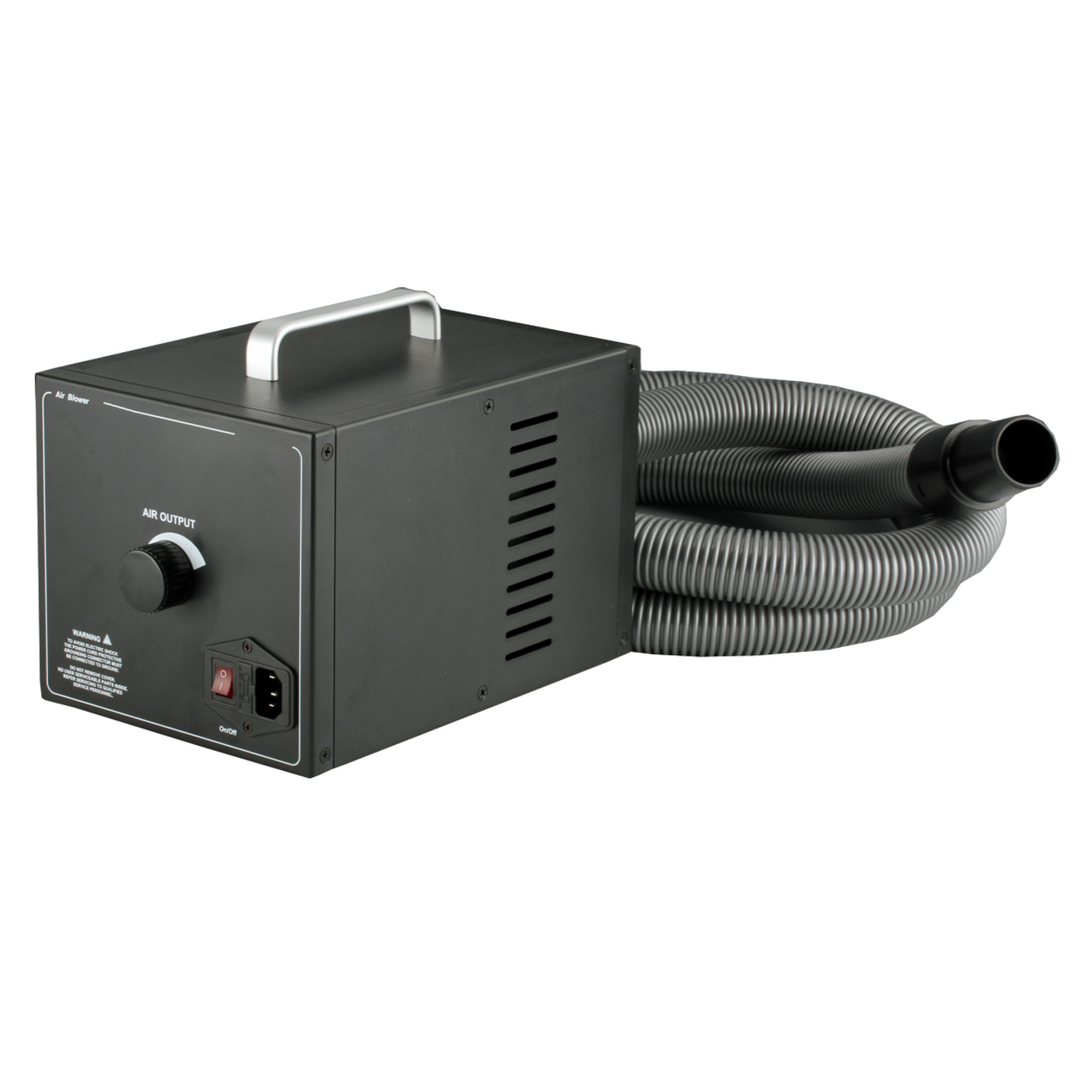
Air-Flow Generator for Air Track (SKU SCL-PL-12344) is a mains-powered blower that delivers a strong, steady stream of air through a 1.5 m hose. It feeds air tracks for motion experiments and provides the airflow for aerodynamics work, where students measure lift and drag on bodies of different shapes. Science Lab Supplies manufactures the generator in Saha, Ambala, India, at its HSIIDC Industrial Area works (Plot 448), for direct supply to schools, colleges, tender contractors and distributors.
Specifications
The unit runs on 230 V mains at 50 or 60 Hz and draws 350 W. Air leaves through a 1.5 m hose, long enough to reach the inlet of an air track or an aerodynamics test piece on the bench while the blower itself stands to one side.
| Parameter | Value |
|---|---|
| SKU | SCL-PL-12344 |
| Type | Blower / air-flow generator |
| Power supply | 230 V, 50/60 Hz |
| Power consumption | 350 W |
| Hose length | 1.5 m |
| Uses | Air track experiments; lift and drag (aerodynamics) experiments |
| Manufacturer | Science Lab Supplies, Saha, Ambala, Haryana |
| Country of origin | India |
Applications and Experiments for the Air-Flow Generator
On an air track, the blower lifts the gliders on a thin air film so collisions and accelerations can be studied almost without friction. As an airflow source for aerodynamics, it lets students compare the lift and drag forces on differently shaped bodies placed in the stream.
- Class 11 physics: supplying air to a linear air track for momentum and Newton's-law experiments.
- Aerodynamics demonstrations: lift and drag on bodies of different shapes.
- B.Sc. and diploma mechanics labs: low-friction motion and collision practicals.
The generator runs on mains voltage. Keep the cable and plug dry, switch off before connecting or moving the hose, and let students use it under supervision.
Standard Scope of Supply
The Air-Flow Generator for Air Track is supplied as a single blower unit with its 1.5 m hose, ready to connect to 230 V mains. The air track and any aerodynamics test bodies are separate items; anything optional that you add is listed on the quotation.
Packing, MOQ and Lead Time
Send an enquiry for one generator to pair with an existing track, or for a blower with each air track in a lab. The quotation sets out packing, delivery time and price for your number, with the tracks included if you ask.
With its Importer-Exporter Code, Science Lab Supplies, a registered exporter, can ship to buyers in Ghana, Ethiopia, Tanzania, Uganda, the UAE and Saudi Arabia. The business is registered under Udyam as a manufacturing enterprise (UDYAM-HR-01-0014546) and for GST (GSTIN 06ADEPJ0574F2ZU). Get in touch through the contact page, shortlist items in the enquiry cart, or open the lab tender page for tender needs.
Frequently Asked Questions
What power supply does the Air-Flow Generator need?
It runs on 230 V mains at 50 or 60 Hz and consumes 350 W.
Can it be used for anything besides an air track?
Yes. It also supplies airflow for aerodynamics experiments, where the lift and drag forces on bodies of different shapes are measured.
Is Science Lab Supplies the manufacturer or a trader?
The company is the manufacturer. It builds this blower at its plant in Saha, Ambala, India, so you get a factory quotation rather than a dealer's.
How long is the hose?
The hose is 1.5 m long, which lets the blower stand beside the bench while the air track or test body is connected.
Related Air Track and Motion Equipment
The generator is one part of a low-friction mechanics set-up. These four items from the same range cover the track itself, an alternative higher-power blower, timing for speed measurements, and a table for motion in two dimensions, and they can be quoted together.
- Air Track — 2 m anodized aluminium track with four gliders.
- Linear Air Track Blower — 220–240 V, 700 W alternative.
- Electronic Timer with Photogates — four optical sensors with data storage.
- Air-Cushion Table — 935 x 750 mm table for 2D motion.
Browse the full Physics Lab range or all physics lab equipment.
Last updated: 25 September 2026