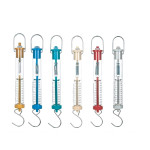
Tuning Fork Resonance Experiment Kit

Tuning Fork Resonance Experiment Kit

Product Code : SCL-PL-12130

The Tuning Fork Resonance Experiment Kit is a precision acoustic laboratory setup used for demonstrating sympathetic resonance, sound wave amplification, and beat frequencies in educational environments. Designed for physics educators, students, and laboratory technicians, this kit provides a tangible, high-clarity method to study mechanical wave behaviors and forced harmonic oscillations without digital dependency.

Product Description

The Tuning Fork Resonance Experiment Kit from Science Lab Supplies is engineered from acoustic-grade materials to guarantee highly accurate performance. The kit features two matching tuning forks calibrated precisely to a standardized frequency of 440 Hz ($A_4$). Each fork is mounted securely on its own individual, hollow resonance box, which functions as an acoustic amplifier to broadcast the sound waves clearly across large lecture halls.

The resonance boxes are constructed from selected seasoned pine wood, featuring a precise open-ended design optimized for the 440 Hz wavelength. When one tuning fork is struck, the mechanical vibrations travel through the air columns, triggering an immediate, identical vibration in the secondary adjacent fork. This fundamental setup serves as an indispensable teaching asset across elementary mechanics, wave theory, and classical physics lab equipment inventories worldwide.

Key Features

  • Acoustic-Grade Construction: The tuning forks are manufactured from premium aluminum alloy to ensure frequency stability and high resistance to oxidation.
  • Seasoned Wooden Sound Boxes: Features two hollow pine wood resonance boxes with precisely tuned volume chambers for maximum audio amplification.
  • Precision Matched Frequencies: Both forks are perfectly calibrated to 440 Hz, maintaining a standard tolerance of $\pm0.5\%$ at room temperature.
  • Detachable Base Assembly: The forks feature threaded steel stems that allow quick detachment from the wooden blocks for versatile handheld testing.
  • Pure Sine Tones: The balanced prong engineering suppresses sub-harmonic frequencies, emitting clean, continuous acoustic pitches.
  • Ergonomic Mallet Included: Supplied with a balanced rubber-headed striking hammer to activate vibrations safely without marring the metal alloy surface.

Technical Specifications

Specification

Detail

Product Name

Tuning Fork Resonance Experiment Kit

Brand

Science Lab Supplies

Fork Material

High-tensile, non-rusting aluminum alloy

Box Material

Seasoned pine wood with rubber isolation feet

Base Type

Open-ended acoustic wave sound chamber

Target Audience

Academic laboratories, science schools, STEM centers

What's Included in the Kit

  • 2 x Calibrated 440 Hz Aluminum Tuning Forks
  • 2 x Precision-Tuned Wooden Resonance Boxes
  • 1 x Rubber-Headed Striking Mallet
  • 1 x Adjustable Prong Mass Slider (for introducing frequency offsets)
  • 1 x Illustrated Experiment Guide with comprehensive data sheets

Applications / Uses

  • Demonstrating the phenomenon of sympathetic resonance between physically isolated acoustic mediums.
  • Studying sound wave amplification using open air columns inside structured acoustics apparatus modules.
  • Observing physical acoustic beats by attaching small slider weights to vary relative pitch outputs:
  • Serving as a high-engagement mechanical tracking unit inside interactive student science kits.
  • Calibrating external laboratory microphones and sensor arrays using a constant sound pressure baseline.

How to Use the Tuning Fork Resonance Experiment Kit

  1. Align the Resonance Boxes: Place both wooden boxes flat on a stable laboratory bench, positioning their open faces directly toward each other, roughly 10 cm to 15 cm apart.
  2. Verify Secure Seating: Ensure both 440 Hz forks are firmly screwed into the top threaded adapter posts of their respective wooden mounts.
  3. Strike the Source Fork: Strike one of the tuning forks firmly with the provided rubber-headed mallet to initiate the primary sound wave.
  4. Observe Sympathetic Motion: Let the first fork ring for 3 to 5 seconds, then damp its prongs completely with your fingers. Listen closely to hear the second, untouched fork singing audibly at the exact same frequency.
  5. Demonstrate Wave Beats: Attach the adjustable slider weight to one fork's prong. Strike both forks simultaneously to hear the rhythmic volume pulses generated by wave interference.

Handling Note: Never strike the aluminum prongs against hard metallic fixtures or concrete tables, as physical dents will permanently shift the calibrated frequency rating.

Care & Maintenance

  • Thread Inspection: Periodically check the mounting threads on the stems to ensure snug connectivity and prevent energy loss during vibrations.
  • Wipe Down Surface: Clean the metal components with a soft, dry microfiber cloth after every lab to eliminate skin oils and prevent finish tarnish.
  • Dry Cabinet Storage: Store all elements inside a climate-controlled, low-humidity cabinet among companion laboratory instruments to protect the wood from moisture absorption.

Why Choose Science Lab Supplies

Science Lab Supplies is an established manufacturer and global exporter of high-precision scientific instruments, educational models, and comprehensive vocational tools. Drawing on decades of intensive manufacturing experience, our specialized production lines follow strict mechanical tolerance benchmarks to guarantee long-term field durability. We cater to university departments, schools, and international school tenders globally, providing uniform product parameters, robust build qualities, and optimized logistical execution for scalable global deliveries.

Frequently Asked Questions

How does the Tuning Fork Resonance Experiment Kit show sympathetic resonance?

When you strike the first fork, it compresses the nearby air molecules at 440 Hz. These acoustic pressure waves travel across the gap and enter the open face of the secondary box, driving the matching fork to vibrate at its identical natural frequency.

Can I adjust the output pitch of the forks?

Yes, the kit features a small, adjustable prong mass slider that can be clamped onto a prong. Adding this localized mass slows the vibration speed, lowering that fork's frequency to demonstrate acoustic beats.

What is the purpose of the open-ended wooden boxes?

The wooden blocks act as quarter-wave resonant cavities that naturally amplify the sound wave pressure, producing an audible, uniform acoustic projection across the classroom.

Is the striking mallet safe for the aluminum forks?

Yes, the included mallet features a specialized soft-rubber head designed explicitly to transfer physical kinetic energy safely without scratching or denting the precision-machined alloy.

What should I do if the sympathetic vibration feels weak?

Ensure that the open ends of the resonance boxes face each other directly on a solid table, and verify that both forks are screwed down tightly into their brass mounting collar tracks.

Optimize your mechanical wave experiments by exploring our full range of durable products, or restock your educational department by viewing our complete laboratory instruments catalog page.

   
Supply of Tuning Fork Resonance Experiment Kit from to Finland, France, Tanzania, Thailand, Sri Lanka, Congo, Costa Rica, Ivory Coast, Croatia, Cuba, Cyprus, Czech Republic, Denmark, Djibouti, Dominica, Afghanistan, Albania, Algeria, Andorra, Angola, Antigua and Barbuda, Argentina, Armenia, Australia, Austria, Azerbaijan, Bahamas, Bahrain, Bangladesh, Barbados, United Arab Emirates (UAE, Dubai), United Kingdom (London), United States, Uruguay, Uzbekistan, Vanuatu, Belarus, Belgium, Belize, Benin, Bhutan, Bolivia, Bosnia and Herzegovina, Botswana, Brazil, Brunei, Bulgaria, Burkina Faso, Burma Myanmar, East Timor, Ecuador, Egypt, El Salvador, Equatorial Guinea, Eritrea, Estonia, Ethiopia (Addis Ababa), Fiji, Burundi, Cambodia, Cameroon, Canada, Cape Verde, Central African Republic, Chad, Chile, Colombia. Math Teaching Kit suppliers in Luxembourg, Macedonia, Madagascar, Malawi (Lilongwe), Malaysia (Kuala Lumpur), Maldives, Mali, Malta, Marshall Islands, Mauritania, Mexico, Micronesia, Moldova, Monaco, Mongolia, Montenegro, Morocco, Mozambique, Namibia, Comoros, Congo. Math Teaching Kit manufacturers in Dominican Republic, Gabon, Gambia, Georgia, Germany, Ghana, Greece, Grenada, Guatemala, Guinea, Guinea-Bissau, Guyana, Haiti, Honduras, Hungary, Iceland, Indonesia, Iran, Iraq, Niger, Nigeria (Abuja), Norway, Oman, Palau, Panama, Papua New Guinea, Paraguay, Peru, Philippines (Manila), Poland, Ireland, Israel, Italy, Jamaica, Japan, Jordan, Kazakhstan, India (Nairobi), Kiribati, Korea, Kuwait, Kyrgyzstan, Laos, Latvia, Lebanon, Lesotho, Liberia, Liechtenstein, Lithuania, Mauritius, Nauru, Nepal, Netherlands, New Zealand, Nicaragua, Portugal, Qatar, Romania, Russia, Rwanda (Kigali). Math Teaching Kit exportets to Saint Kitts and Nevis, Saint Lucia, Saint Vincent and the Grenadines, Samoa, San Marino, Sao Tome and Principe, Saudi Arabia, Senegal, Serbia, Seychelles, Sierra Leone, Singapore, Slovakia, Slovenia, Solomon Islands, Somalia, South Africa, South Sudan, Spain, Sudan, Suriname, Swaziland, Sweden, Switzerland, Syria, Tajikistan, Togo, Tonga, Trinidad and Tobago, Tunisia, Turkey, Turkmenistan, Tuvalu, Uganda (Kampala), Ukraine, Venezuela, Vietnam, Yemen , Zambia (Lusaka), Zimbabwe

Office Address

Works:Plot No. 448, HSIIDC. Industrial Area Saha, Haryana

[email protected]

+91-97290-66999

Follow Us