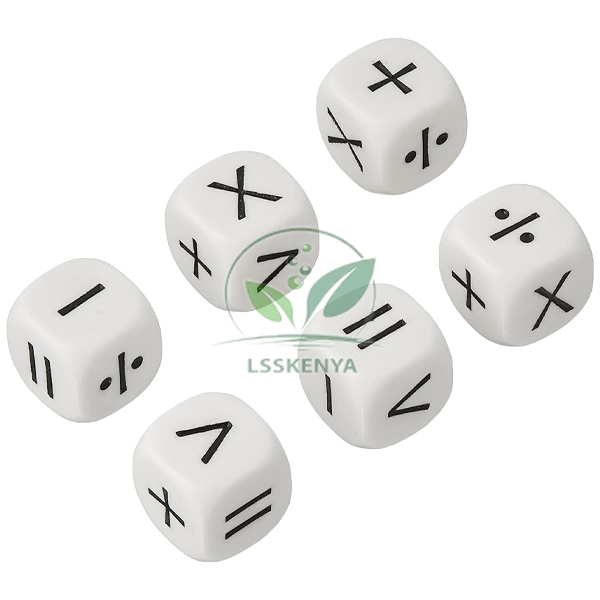
Math Symbol Dice
Product Code : LSK-ML-10110
Math Symbol Dice (SKU LSK-ML-10110) are a set of four probability dice whose faces carry colours, shapes and numbers. Because the faces vary by more than one attribute, pupils can ask different questions of the same roll: what colour, which shape, what number. They suit primary and middle-school maths for probability, sorting and game-based practice. The four-dice set is a Science Lab Supplies product, made at Plot 448, HSIIDC Industrial Area, Saha, Ambala, India, where the company also prepares quotes for schools, colleges, tender contractors and distributors.
Specifications
The four probability dice are described attribute by attribute in the table. In short, their faces are marked with a combination of colours, shapes and numbers, which gives several outcome categories to work with and lets pupils sort results by colour, by shape or by number from one set of rolls.
| Specification | Value |
|---|---|
| SKU | LSK-ML-10110 |
| Also known as | Probability dice |
| Dice per set | 4 |
| Face marking: colours | Yes |
| Face marking: shapes | Yes |
| Face marking: numbers | Yes |
| Manufacturer | Science Lab Supplies, Saha, Ambala, Haryana |
| Country of origin | India |
Applications and Experiments for the Math Symbol Dice
Pupils can roll the dice, record each outcome and count how often every colour, shape or number appears. Comparing those tallies with the expected chances introduces experimental and theoretical probability, while younger children can use the same dice for naming shapes, matching colours and counting.
- Early-years and Classes 1–2: recognising colours, shapes and numbers through dice games, with shape names checked against the labelled pieces of the Shape Tracer.
- Colour matching: placing a peg of the rolled colour on the Pegboard and Pegs to build a colour tally.
- Primary data handling: tallying outcomes and drawing pictographs.
- NCERT Class 10 Probability: comparing expected and observed frequencies, including combined events such as a given colour and number together.
Standard Scope of Supply
One set consists of four Math Symbol Dice with colours, shapes and numbers on their faces, as described above. Any optional accessories are listed on the quotation, and conventional dice or a probability kit can be quoted with them for a complete chance unit.
Packing, MOQ and Lead Time
Quotations are prepared for anything from one set of four dice to a set per group across several classes. Packing, delivery time and price appear on each one for the quantity asked, and a school ordering maths lab manipulatives can combine them in the same request.
With its Importer-Exporter Code as a registered exporter, Science Lab Supplies can ship to buyers in Zambia, Rwanda, South Africa, Qatar, Sri Lanka and Vietnam. A short note on the contact page with the number of groups is enough to price these dice; a full probability unit fits in the enquiry cart, and the lab tender page serves tender buyers.
Frequently Asked Questions
What is marked on the Math Symbol Dice?
Their faces show colours, shapes and numbers, so a single roll can be recorded in several ways for probability, sorting and matching activities across different age groups.
How many dice are in a set?
Each set contains four dice, enough for a small group to roll together or for four pupils to take turns while the rest of the group records the outcomes.
Who manufactures the Math Symbol Dice?
Making and marking these dice happens at the Science Lab Supplies factory in Saha, Ambala, India. Because the company produces them itself, your quotation arrives directly from the source with no agent in between.
How do they compare with ordinary dice?
The Dice in the same range are standard conventional dice. These probability dice carry colours and shapes as well as numbers, giving more outcome categories for classroom experiments.
Related Probability and Sorting Resources
Symbol dice are one of several tools that make chance and sorting concrete. The Maths Lab items below add conventional dice, coloured counters, shape blocks, dominoes, cards, a number card game and a full sampling kit, so a probability or number-games unit can be quoted as one set.
- Dice — standard conventional dice that also serve board games.
- Plastic Counters Colour — 100 counters split across four colours.
- Probability Kit — 6 sampling bottles, 3 with long tubes and 3 with short tubes, plus sampling beads.
- 2D Shape Pattern Blocks — blocks in six shapes and six colours for patterns and symmetry.
- Dominoes Colour — for number and colour group matching as well as fraction work.
- Playing Cards — a pack for recognising number patterns, matching and sorting.
- Game Numbers and Sums — deck includes a card of suggestions for additional activities and games.
Browse the full Maths Lab range or all school lab equipment.
Last updated: 22 October 2026

.png)
.jpg)