Interlock Equivalency Cubes
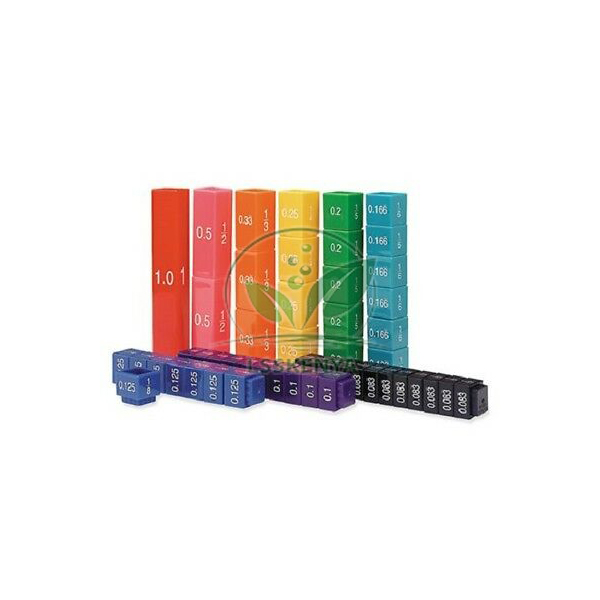
Product Code : LSK-ML-10107
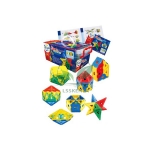
Interlock Equivalency Cubes (SKU LSK-ML-10107) are a set of 51 colour-coded cubes with fractions, decimals and percents clearly marked on each side. Pupils join and compare them to see that values such as a half, 0.5 and 50% are the same amount. The set is aimed at upper-primary and middle-school maths. Science Lab Supplies manufactures the cubes in India at its Plot 448 unit in the HSIIDC Industrial Area, Saha, Ambala, and deals directly with schools, colleges, tender contractors and distributors.
Specifications
The cubes are colour-coded and the sides are clearly marked with fractions, decimals and percents, so a pupil can find a fraction, locate its decimal and percentage forms and set them side by side. With 51 cubes in the set, a group has enough pieces to build and compare several equivalences at once.
| Parameter | Value |
|---|---|
| SKU | LSK-ML-10107 |
| Pieces | 51 cubes |
| Colours | Colour-coded, various colours |
| Markings | Fractions, decimals and percents on each side |
| Demonstrates | Equivalence of fractions, decimals and percents |
| Manufacturer | Science Lab Supplies, Saha, Ambala, Haryana |
| Country of origin | India |
Applications and Experiments for the Interlock Equivalency Cubes
The cubes give a visual representation of how fractions, decimals and percentages relate, a topic pupils often learn as three separate rules. Teachers use them for matching games, ordering values from least to greatest and checking conversions worked out on paper.
- NCERT Classes 6–7: fractions and decimals, including converting between the two.
- NCERT Classes 7–8: comparing quantities and expressing values as percentages.
- Ordering and comparing mixed sets of fractions, decimals and percents.
- Remedial and small-group work for pupils who find conversions abstract.
Standard Scope of Supply
Each set comprises 51 colour-coded cubes, every one marked on its sides with fractions, decimals and percents as described above. Any optional accessories are listed on the quotation, and fraction strips or circles can be quoted alongside for earlier fraction work.
Packing, MOQ and Lead Time
Ask us to quote a single set for a teacher or one set per group for a whole class. The quotation you receive details packing, delivery time and price for exactly that quantity, and other items for a maths lab kit for CBSE schools or other syllabuses can be listed with it.
Science Lab Supplies, a registered exporter with an Importer-Exporter Code, can ship to buyers in the Philippines, Nepal, Bangladesh, Zambia, Rwanda and South Africa. Start with the contact page for questions, use the enquiry cart for a multi-item quote, and see the lab tender page for tender supply.
Frequently Asked Questions
How many cubes are in the set?
The set contains 51 colour-coded cubes, each marked with fractions, decimals and percents on its sides.
What do the Interlock Equivalency Cubes teach?
They show the relationship between fractions, decimals and percents, giving pupils a visual way to see that different notations can describe the same value.
Is Science Lab Supplies the maker of these cubes?
Yes. They are manufactured at the Science Lab Supplies factory in Saha, Ambala, India, and each quotation comes from that factory directly.
Which classes are they suited to?
They fit upper-primary and middle-school maths, where fractions, decimals and percentages are taught and compared, and they also help older pupils who need a visual reminder.
Related Fraction and Equivalence Aids
Equivalence builds on a solid grasp of fractions as parts of a whole. These four Maths Lab items cover that groundwork with strips, circles and a fraction kit, plus plain linking cubes, and they can all be quoted with the equivalency cubes.
- Fraction Strips — colour-coded strips for equivalent fractions.
- Fraction Circles — halves to twelfths for comparing fractional parts.
- Fraction Kit — hands-on aid for parts of a whole and equivalent fractions.
- Interlocking Cubes — plain 1 cm linking cubes for number and measurement.
Browse the full Maths Lab range or all school lab equipment.
Last updated: 25 September 2026