Cuisenaire Rods
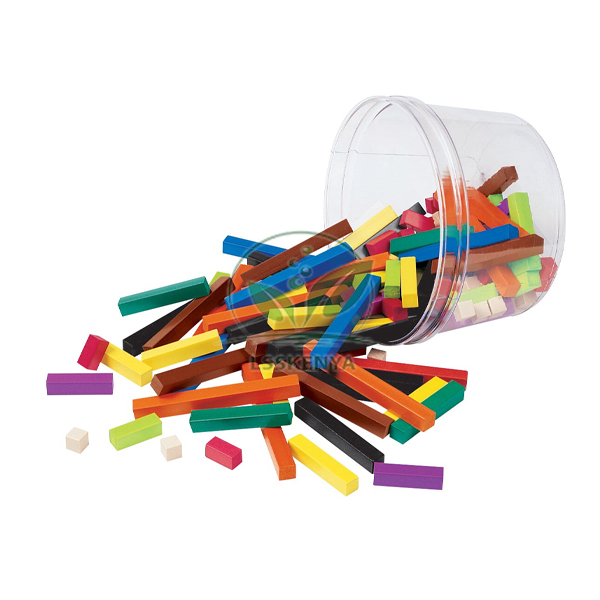
Product Code : LSK-ML-10128
Cuisenaire Rods (SKU LSK-ML-10128), supplied here as an introductory set, are rods of various lengths that can be given different number values or units of measure. They give students visual confirmation of hands-on investigations in mathematics, from addition through division to fractions, in primary and lower-secondary classes. Science Lab Supplies is the manufacturer: the introductory set is made at its works on Plot 448, HSIIDC Industrial Area, Saha, Ambala, India, and reaches schools, colleges, tender contractors and distributors without intermediaries.
Specifications
This is the introductory set of Cuisenaire Rods. The rods come in various lengths, and because any rod can stand for a chosen number or unit, the same pieces can model sums, differences, products, sharing and fractions. Named after the Belgian teacher Georges Cuisenaire, they are a well-established classroom manipulative.
| Parameter | Value |
|---|---|
| SKU | LSK-ML-10128 |
| Set type | Introductory set |
| Rods | Various lengths |
| Values | Can be assigned different numeric values or units of measure |
| Topics | Addition, subtraction, multiplication, division, fractions |
| Manufacturer | Science Lab Supplies, Saha, Ambala, Haryana |
| Country of origin | India |
Applications and Experiments for the Cuisenaire Rods
Pupils line rods up end to end to add, compare lengths to subtract, repeat a rod to multiply and split a length into equal rods to divide or find fractions. Seeing the answer as a physical length helps learners check their own reasoning, which is why the rods feature among maths lab manipulatives in many schools.
- Primary mathematics: number bonds and addition by joining rods.
- Multiplication and division as repeated lengths and equal sharing.
- NCERT Classes 3–6: fractions and equivalent fractions using rod lengths.
- Measurement: using a rod as a unit of length and comparing lengths.
Standard Scope of Supply
The Cuisenaire Rods are supplied as the introductory set described above, a collection of rods in various lengths. The specification does not list further contents, so any extra sets for group work or related manipulatives you ask for will be itemised on the quotation.
Packing, MOQ and Lead Time
Quotations can be issued for one introductory set or for a set per group across several classrooms. Each quotation sets out the packing, delivery time and price for that quantity, and you may add fraction strips, cubes or other maths lab items to it.
As a registered exporter holding an Importer-Exporter Code, Science Lab Supplies can ship to buyers in Oman, the Philippines, Nepal, Bangladesh, Zambia and Rwanda. The business is registered under Udyam as a manufacturing enterprise (UDYAM-HR-01-0014546) and for GST (GSTIN 06ADEPJ0574F2ZU). Ask for your quotation through the contact page or the enquiry cart; the lab tender page is there for tender-driven purchases.
Frequently Asked Questions
What are Cuisenaire Rods used for?
They are used for hands-on investigation of maths concepts, from addition to division to fractions, by giving rods of various lengths chosen number values or units of measure.
Is this a full or an introductory set?
This listing is the introductory set. If you need larger quantities for a whole class, state the number of sets and they will be quoted together.
Is Science Lab Supplies the manufacturer or a trader?
It is a manufacturer, not a stockist. The Cuisenaire Rods leave its Saha, Ambala factory in India, and quotations are issued from the same place.
Can the rods help with fractions?
Yes. When one rod is chosen as the whole, shorter rods that fit into it show halves, thirds and other fractions as visible lengths.
Related Number and Fraction Manipulatives
These four Maths Lab items model the same ideas as the rods with other materials: fraction strips for parts of a whole, centimetre cubes for counting and volume, linking cubes for building numbers, and number lines for showing lengths on a scale. They can share one quotation with the rods.
- Fraction Strips — colour-coded strips that break into parts of one whole.
- Base Ten Cubes — one-centimetre cubes for place value and measurement.
- Interlocking Cubes — linking centimetre cubes for numeration, area and length.
- Number Lines — five laminated 5 m lines, including tenths and hundredths.
Browse the full Maths Lab range or all school lab equipment.
Last updated: 25 September 2026