Interlocking Cubes
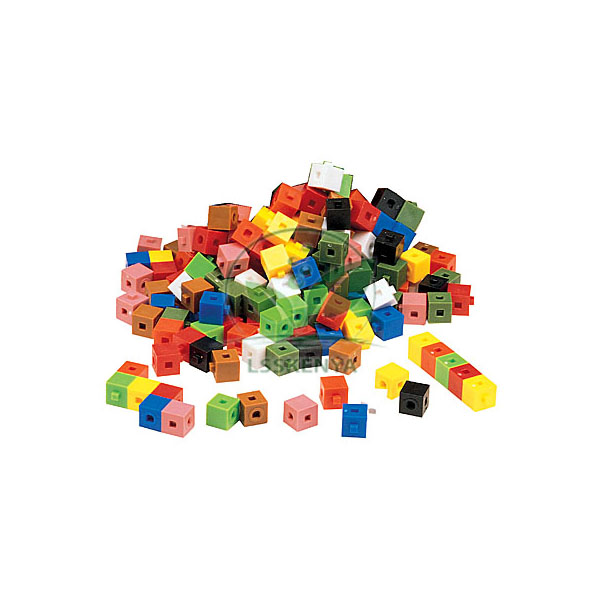
Product Code : LSK-ML-10108
Interlocking Cubes (SKU LSK-ML-10108), often called linking cubes, are 1 cm precision cubes that snap together into trains, walls and solid shapes. Because each cube has a volume of one cubic centimetre, the joined models can be counted, measured and compared, which makes them a flexible aid for place value, numeration, length, area and volume in primary and middle-school maths. Science Lab Supplies is a laboratory equipment manufacturer in India and produces these cubes at Plot 448, HSIIDC Industrial Area, Saha, Ambala, supplying schools, colleges, tender contractors and distributors from there.
Specifications
The defining feature is versatile interlocking: cubes join firmly enough to hold a model together yet come apart for the next task. Each measures one centimetre, so a train of cubes reads straight off as a length in centimetres and a built block gives its volume by counting.
| Parameter | Value |
|---|---|
| SKU | LSK-ML-10108 |
| Also known as | Linking cubes |
| Cube size | 1 cm (precision) |
| Volume per cube | 1 cm³ |
| Joining | Interlocking |
| Manufacturer | Science Lab Supplies, Saha, Ambala, Haryana |
| Country of origin | India |
Applications and Experiments for the Interlocking Cubes
Joined cubes hold their shape, so pupils can build a ten-train and keep it, stack layers to form a cuboid or lay a flat shape to count its area. Teachers use them wherever a number or measurement needs to become an object pupils can hold and check.
- Primary maths: making trains of ten to show tens and ones in place value.
- Numeration and number patterns with joined groups of cubes.
- Measuring length in centimetres and building shapes to count area.
- NCERT Classes 5–8: building cuboids to find volume and comparing solids of equal volume.
Standard Scope of Supply
Interlocking Cubes are supplied as 1 cm precision cubes that link together, as described above. The pack quantity is confirmed on the quotation; let us know how many groups will use them and we will quote a matching number of packs.
Packing, MOQ and Lead Time
We can quote a single pack for a teacher's demonstration or enough cubes for every group in a maths lab. Each quote gives packing, delivery time and price for that order size, and other manipulatives can be combined on it.
Science Lab Supplies holds an Importer-Exporter Code as a registered exporter and can ship to buyers in Nepal, Bangladesh, Zambia, Rwanda, South Africa and Qatar. The business is registered under Udyam as a manufacturing enterprise (UDYAM-HR-01-0014546) and for GST (GSTIN 06ADEPJ0574F2ZU). Use the enquiry cart to list items for a quote, write in via the contact page, or read about tender supply on the lab tender page.
Frequently Asked Questions
How big is each interlocking cube?
Each cube measures one centimetre and has a volume of one cubic centimetre, so models built from them can be measured directly.
How are these different from the Base Ten Cubes?
Both ranges are 1 cm cubes used for place value, numeration and measurement. These are specified as interlocking, so they join into trains and solid models that hold together.
Does Science Lab Supplies manufacture the cubes or buy them in?
Science Lab Supplies manufactures them in its own factory in Saha, Ambala, India. Buyers get prices and delivery terms straight from the production site.
Can they be used for volume lessons?
Yes. Pupils build cuboids from the cubes and count them to find the volume in cubic centimetres before moving on to the length x breadth x height formula.
Related Cubes and Manipulatives
Linking cubes sit at the centre of a manipulatives shelf. The four Maths Lab items below extend the same work into place value, fraction equivalence, tiled patterns and rod-based number work, and they can be quoted together with the Interlocking Cubes.
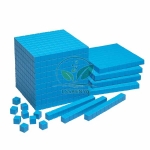
- Base Ten Cubes — 1 cm unit cubes for place value and measurement.
- Interlock Equivalency Cubes — 51 cubes marked with fractions, decimals and percents.
- Plastic Color Tiles — 1-inch tiles in four colours for patterns and models.
- Cuisenaire Rods — rods of various lengths for addition to fractions.
Browse the full Maths Lab range or all school lab equipment.
Last updated: 25 September 2026