
Apparatus for Demonstration of Electrolytic Processes
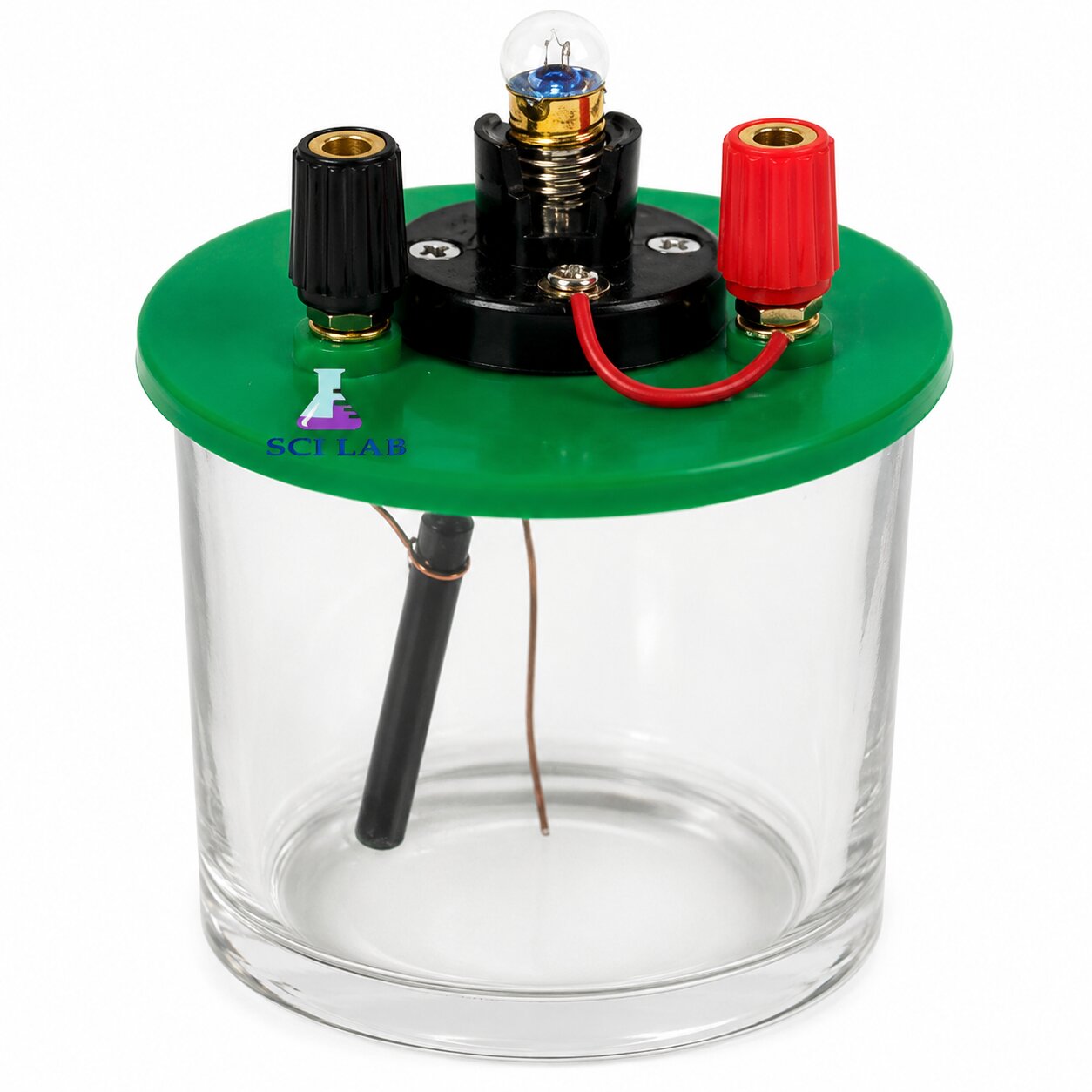
Product Code : SCL-CL-11456
Apparatus for Demonstration of Electrolytic Processes (SKU SCL-CL-11456) is a bench demonstration kit in which two electrodes dip into a solution in a beaker and a light bulb in the circuit shows whether current flows. With five electrode materials and two solutions, teachers can show conduction in electrolytes and deposits forming on electrodes. Science Lab Supplies supplies the kit from Ambala, India, serving schools, colleges, training institutes, distributors and tender contractors.
Specifications
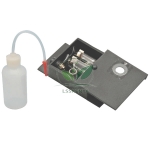
The kit is built on a base carrying one light bulb and two electrode supports. Carbon, copper, zinc, lead and brass electrodes can be clamped in pairs and lowered into a beaker holding either 10% sulfuric acid solution or copper sulfate solution, with three conducting wires completing the circuit.
| Parameter | Value |
|---|---|
| SKU | SCL-CL-11456 |
| Base | With 1 light bulb and 2 electrode supports |
| Electrodes | Carbon, copper, zinc, lead, brass |
| Solutions | 10% sulfuric acid; copper sulfate |
| Vessel | 1 chemical beaker |
| Wiring | 3 conducting wires |
| Supplied by | Science Lab Supplies, Ambala, India |
Applications and Experiments for the Electrolytic Processes Apparatus
The apparatus demonstrates that acid and salt solutions conduct electricity, that the bulb glows only when the circuit passes through an electrolyte, and that copper is deposited on the cathode during electrolysis of copper sulfate. Swapping electrode pairs lets classes compare metals.
- NCERT Class 8 science: chemical effects of electric current and electroplating.
- NCERT Class 10 science: electrolysis and the reactivity of metals.
- Class 12 chemistry: electrolytic conduction and products of electrolysis.
- Diploma and teacher-training labs: planning safe electrolysis demonstrations.
Sulfuric acid is corrosive and copper sulfate is harmful; lead electrodes are toxic to handle. Wear gloves and eye protection, wash hands after use, and keep the kit under teacher supervision.
Standard Scope of Supply
The kit contains the base with one light bulb, two electrode supports, carbon, copper, zinc, lead and brass electrodes, 10% sulfuric acid solution, copper sulfate solution, one chemical beaker and three conducting wires. Shelf life depends on the chemical, its grade and storage conditions; ask us for the expiry date of the batch you are quoted.
Packing, MOQ and Lead Time
Quotations are available for one kit or for a full set for every lab bench, and each one lists the packing, delivery time and price for the number requested. Refill solutions and spare electrodes can be priced on the same quotation.
Science Lab Supplies can ship to buyers in Sri Lanka, Vietnam, Malaysia, Peru, Egypt and Iraq as a registered exporter holding an Importer-Exporter Code. Science Lab Supplies is registered for GST (GSTIN 06ADEPJ0574F2ZU). Enquiries reach us via the contact page and the enquiry cart; tender details are on the lab tender page.
Frequently Asked Questions
What does the light bulb show?
The bulb is in series with the electrodes, so it glows only when current passes through the solution. It gives a clear signal that the liquid is an electrolyte.
Why are five electrode materials included?
Carbon, copper, zinc, lead and brass electrodes let teachers compare inert and reactive electrodes and show how the electrode material affects what happens at each pole.
Who supplies the Apparatus for Demonstration of Electrolytic Processes?
Science Lab Supplies supplies the kit from Ambala, India to schools, colleges and institutes, and quotes distributors and tender contractors for larger orders.
How should the solutions be stored?
Keep the sulfuric acid and copper sulfate solutions in closed, labelled bottles away from students' reach, as your laboratory's chemical storage rules require.
Related Electrolysis Apparatus
These four items from the Chemistry Lab range extend the electrolytic processes kit: a conductivity apparatus for comparing electrolytes, a U-tube cell for salt solutions, and extra electrode rods and connectors for building more circuits. All can go on the same enquiry.
- Apparatus for Electrical Conductivity of Electrolytes — comparing how well solutions conduct.
- Apparatus for the Electrolysis of Salts — U-tube cell with graphite electrode.
- Electrode Rod — additional rod electrodes.
- Electrode Connector — for connecting electrodes to wires.
Browse the full Chemistry Lab range or all school lab equipment.
Last updated: 25 September 2026

.jpg)
.jpg)
