Demonstration Hydraulic Press
Product Code : SCL-CL-11891
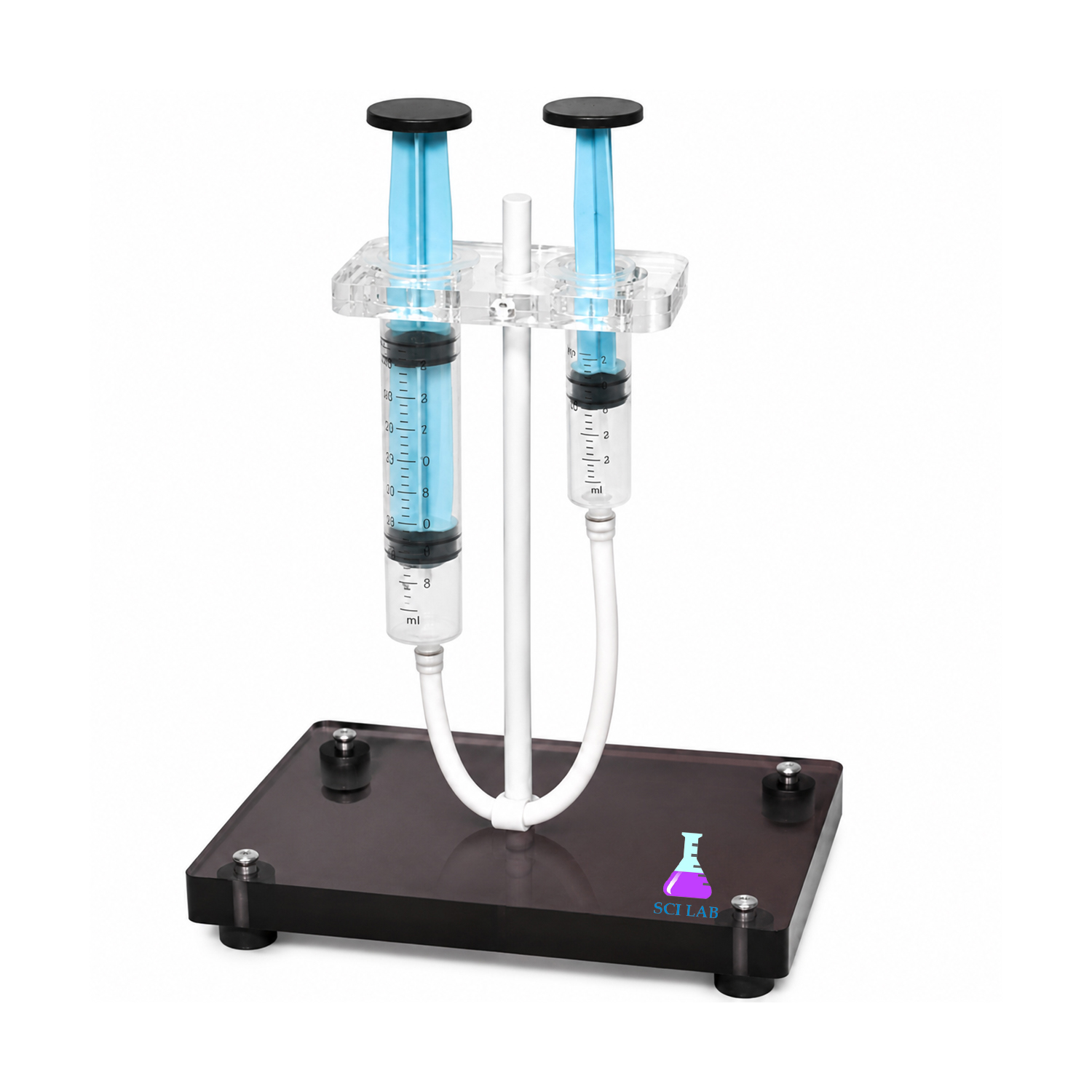
Demonstration Hydraulic Press (SKU SCL-CL-11891) is a teaching model of Pascal's law: two connected, fluid-filled cylinders with pistons of different sizes show how a small push on one piston produces a larger force on the other. It explains the hydraulic systems found in machines, vehicles and lifting equipment. Science Lab Supplies supplies the model from Ambala, India, and schools, colleges, tender contractors and distributors can order it directly.
Specifications
The model consists of two connected cylinders filled with fluid, each with a piston. Applying force to the smaller piston raises the pressure throughout the enclosed fluid, and because that pressure acts on the larger piston area, the larger piston moves with a greater force – a visible example of force multiplication.
| Parameter | Value |
|---|---|
| SKU | SCL-CL-11891 |
| Model no. | SCI/LSS-1549 |
| Construction | Two connected fluid-filled cylinders with small and large pistons |
| Principle | Pascal's law: pressure in a confined fluid is transmitted equally in all directions |
| Demonstrates | Hydraulic action and force multiplication |
| Supplied by | Science Lab Supplies, Ambala, India |
Applications and Experiments for the Demonstration Hydraulic Press
The hydraulic press model turns Pascal's law into something students can see and feel, then links it to car brakes, jacks and lifts. It is used for CBSE/NCERT Class 11 physics (mechanical properties of fluids), Class 8–9 pressure topics, and fluid power basics in ITI and diploma mechanical courses.
- Class 11 physics: Pascal's law and the hydraulic lift.
- Showing how a small input force lifts a heavier load on the larger piston.
- Relating piston areas to the force ratio in simple calculations.
- ITI and diploma courses: introducing hydraulic brakes and jacks.
Standard Scope of Supply
The press is supplied as a single demonstration unit made up of the two connected cylinders with their pistons, as described above. Any loads or masses used to show lifting are separate and can be listed on the quotation.
Packing, MOQ and Lead Time
Quotations can be prepared for one unit for the teacher's bench or for several units for a department. Each one states the packing, delivery time and price for the quantity, and other fluid-pressure apparatus can be added to the same quotation.
Because Science Lab Supplies holds an Importer-Exporter Code, it can ship to buyers in Bangladesh, Zambia, Rwanda, South Africa, Qatar and Sri Lanka. Message the team on the contact page, gather items in the enquiry cart, or read the lab tender page for tender quotations.
Frequently Asked Questions
What does the Demonstration Hydraulic Press show?
It shows Pascal's law: pressure applied to a confined fluid is transmitted equally, so a small force on the small piston produces a larger force on the large piston.
How is this model related to real machines?
The same principle works in hydraulic jacks, vehicle brakes and lifting equipment, where a small input force is multiplied to move heavy loads.
Who supplies the Demonstration Hydraulic Press?
Science Lab Supplies, a chemistry lab instruments supplier based in Ambala, India, supplies the model and can quote it together with other science and physics room items.
Can it be used by students or only by the teacher?
It is designed for classroom demonstration; students can take turns pressing the small piston under the teacher's guidance to feel the effect.
Related Fluid Pressure Equipment
Pascal's law sits within a wider unit on liquid pressure, buoyancy and pressure measurement. These four items continue that unit and share the bench with the hydraulic press, so schools often order them as one fluids set.
- Communicating Vessels — equal liquid levels in connected tubes.
- Archimedes Bucket — buoyancy and displaced fluid.
- U-Tube Manometer — measuring pressure differences with a liquid column.
- Manometer Cylinder with Piston Temperature Meter — piston-and-cylinder pressure work.
Browse the full Chemistry Lab range or all school lab equipment.
Last updated: 25 September 2026


50ml.jpg)