
Capacitors with Gradual Increase of Capacitance
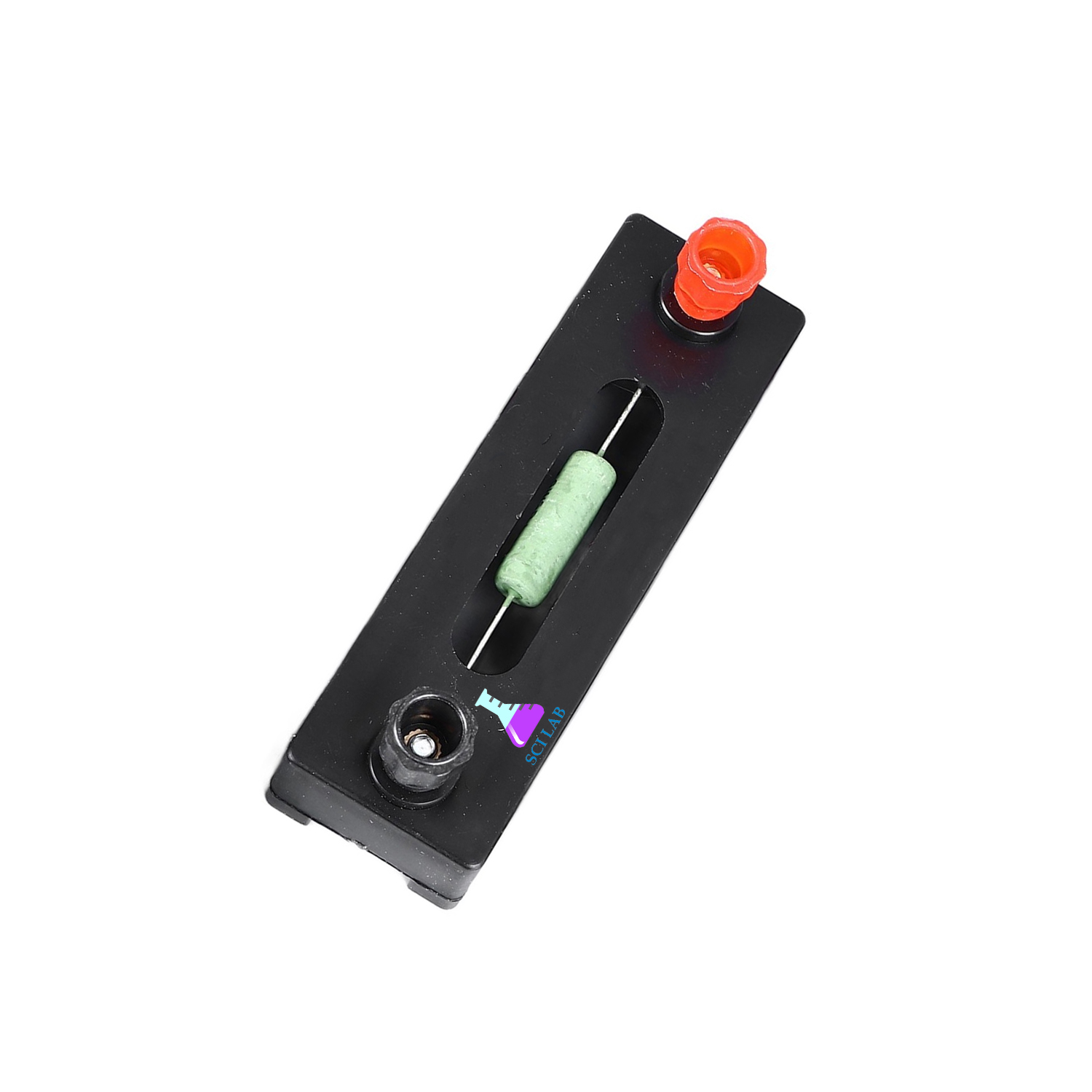
Product Code : SCL-CL-11864
Capacitors with Gradual Increase of Capacitance (SKU SCL-CL-11864) is a set of five capacitors on stands whose values rise in steps from 0.1 to 10000 mf, with a working voltage of 24 V. The capacitors connect with the corresponding cables and are used for physics experiments and demonstrations on how capacitance affects charging, storage and discharge. Schools, colleges, contractors and distributors can buy the set from Science Lab Supplies, which ships it from Ambala, India.
Specifications
Five capacitors make up the set, listed as 0.1 mf, 10 mf, 100 mf, 1000 mf and a minimum of 10000 mf. Every capacitor sits on its own stand, the working voltage is 24 V, and the terminals suit the matching connecting cables.
| Parameter | Value |
|---|---|
| SKU | SCL-CL-11864 |
| Number in set | 5, with stands |
| Values (as listed) | 0.1 mf, 10 mf, 100 mf, 1000 mf, 10000 mf minimum |
| Working voltage | 24 V |
| Connection | Compatible with corresponding cables |
| Supplied by | Science Lab Supplies, Ambala, India |
Applications and Experiments for the Capacitors with Gradual Increase of Capacitance
The graded values let students compare how long capacitors take to charge and discharge through the same resistor, and how the stored charge grows with capacitance. Mounted on stands, the capacitors are easy to see in a demonstration and to connect on a bench for senior school and college electricity work.
- NCERT Class 12 physics, capacitance: relating charge, voltage and capacitance.
- Charging and discharging through a resistor: comparing time constants for different capacitances.
- Series and parallel combinations of capacitors and their equivalent capacitance.
- Diploma, ITI and B.Sc. electronics labs: capacitance measurement with a digital tester.
Standard Scope of Supply
One set contains five capacitors of graded value, each on a stand, rated for a 24 V working voltage. Cables, resistors, a power supply and meters are separate items; any of them can be listed on the same quotation.
Packing, MOQ and Lead Time
A quotation can be for a single capacitor set or for sets across several physics laboratories. It states packing, delivery time and price for your quantity, and the matching resistor set, a DC supply or other school chemistry lab equipment in India can be included.
Science Lab Supplies holds an Importer-Exporter Code, so it can ship to buyers in the UAE, Saudi Arabia, Oman, the Philippines, Nepal and Bangladesh. Science Lab Supplies is registered for GST (GSTIN 06ADEPJ0574F2ZU). To enquire, use the contact page, the enquiry cart for multi-item lists, or the lab tender page for tender-based purchases.
Frequently Asked Questions
What values are in the capacitor set?
The specification lists five values, 0.1 mf, 10 mf, 100 mf, 1000 mf and a minimum of 10000 mf. For the exact unit marking and tolerance of each capacitor, ask through the contact page.
What voltage can the capacitors be used at?
The working voltage is 24 V. Keep the supply at or below this value and discharge the larger capacitors before handling their terminals.
Who supplies the Capacitors with Gradual Increase of Capacitance?
Science Lab Supplies supplies the set from Ambala, India, working as a school laboratory equipment supplier in India for single schools, colleges and contractors.
Can it be ordered together with the resistor set?
Yes. The capacitor and resistor sets are often quoted together for charging and discharging experiments, along with a DC supply and cables.
Related Electricity Lab Equipment
Capacitor experiments need a resistor to charge through, a steady source, a meter and leads. These four items complete an RC and capacitance bench alongside the set and can all be quoted together.
- Resistors with Gradual Increase of Resistance — five resistors from 1 Ω to 1 kΩ.
- Power Supply Unit/ Block for DC — regulated 0–9 V DC for charging.
- Tester Input Plugs — digital tester that also measures capacitance.
- Cables with Clips — 50 cm leads with clips.
Browse the full Chemistry Lab range or all school lab equipment.
Last updated: 25 September 2026


.jpg)

.jpg)