
Lake Food Web Chart
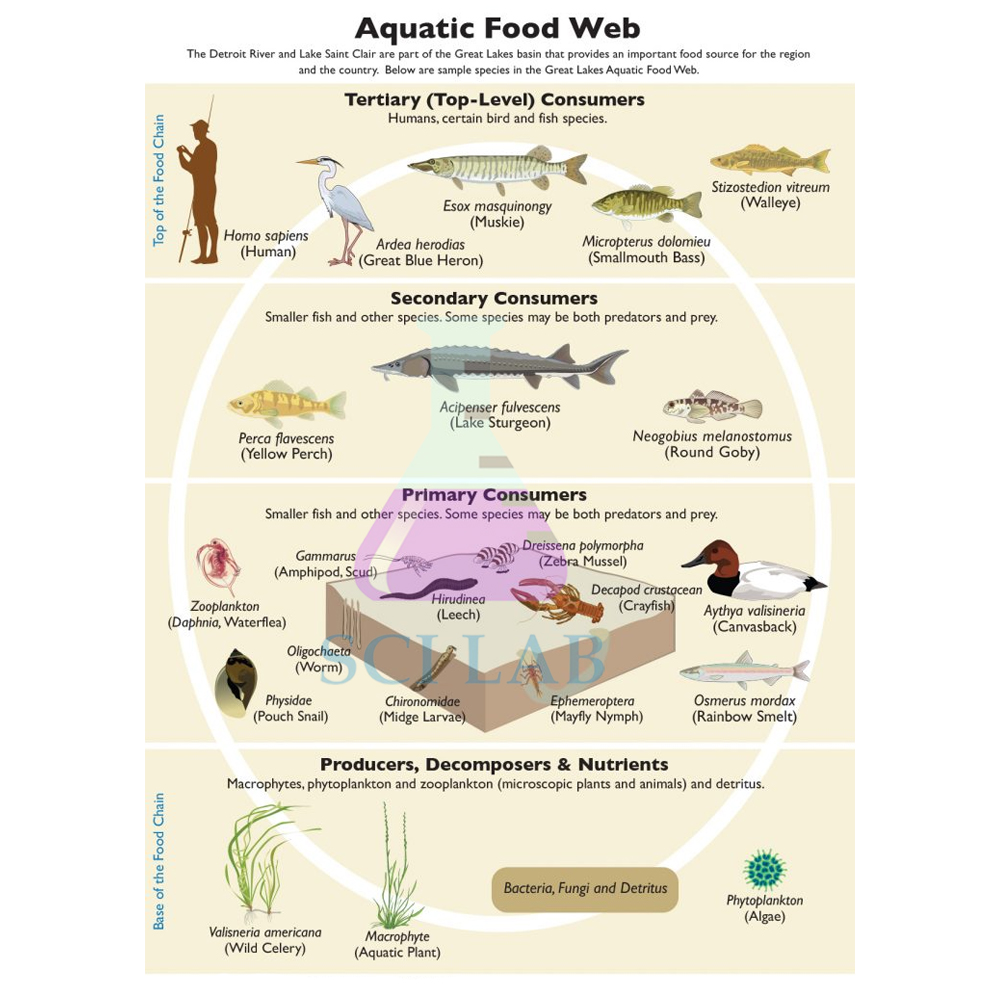
Product Code : SCL-BLE-11792
The Lake Food Web Chart is a laminated 70 x 100 cm wall chart of the feeding links in a freshwater lake. Its artwork draws them as a web, with arrows showing the direction in which food passes from one organism to the next, and its labels are in English. Top and bottom rods and a top cord hold it flat, so the whole web stays in view while students trace single chains.
Specifications of the Lake Food Web Chart
| Specification | Value |
|---|---|
| Subject | Food web in a lake |
| Artwork | Lake food web with directional arrows |
| Labels | English |
| Dimensions | 70 x 100 cm (700 x 1000 mm) |
| Finish | Laminated |
| Type | Wall mounted |
| Hanging fittings | Top and bottom rods, top hanging cord |
| Use | Laboratory and classroom |
| Supplied by | Science Lab Supplies, Ambala, India |
Lake Food Web Lessons and Microscope Work
The chart shows the whole web at once. Students pick out single chains, then look at some of the smallest lake organisms under the microscope.
- Chain picking (Class 7 to 10): follow the arrows to trace three chains on the chart that share one animal, and mark where they cross.
- Small predators: view the Hydra prepared slide and find the tentacles it uses to catch tiny water animals.
- Single-celled life: compare it with the Amoeba, Prepared Stained Microscope Slide, and place both organisms in the web.
- Remove a link: cross out the top predatory fish on a copy of the web and predict what happens to small fish, zooplankton and algae.
Common errors: reversing the arrows, forgetting the microscopic algae at the base, and drawing one long chain where the lake really has many linked ones.
Frequently Asked Questions
Does a lake food web chart also suit lessons on rivers and streams?
Partly. Still and running water share many animal groups, such as insect larvae, snails and fish, but rivers hold more animals adapted to the current, and lakes have open-water plankton. The chart matches pond and lake lessons most closely.
How many organisms should a lake food web chart show to be useful in class?
Enough for several chains to cross: two or three producers, a few grazers, small and large predators, and ideally a decomposer. With that spread, students can trace separate chains and see one animal eating at more than one level.
What forms the base of a lake food web?
Mostly microscopic algae floating in the water, with rooted and floating water plants near the shore. They capture sunlight and are grazed by zooplankton, so most of the energy in the lake enters through these tiny producers.
Why can farm or sewage runoff turn a lake green?
Runoff carries nutrients such as nitrates and phosphates that make algae grow very fast. When the bloom dies, bacteria breaking it down use up the dissolved oxygen, and fish can suffocate.
Is a lake food web controlled from the top or from the bottom?
Both. Light and nutrients set how much algae can grow. Predatory fish keep down the small fish that eat zooplankton, which leaves more zooplankton to graze the algae, so removing big fish can make the water murkier.
Related Freshwater and Fish Teaching Aids
- Lake Food Pyramid Chart: the lake's feeding levels, with the energy available falling at each step up.
- Marine Food Chain Chart: a single sea chain running from phytoplankton to zooplankton, fish and a predator.
- Fish Anatomy Educational Chart: external and internal fish structures, including fins, gills and scales.
- Fish Dissection: dissected fish in formalin, sealed in a 200 x 70 x 40 mm glass container.
- Water Cycle and Water Pollution Chart: water cycle stages together with the routes pollution follows.
The lake chart and its companion ecology charts are kept in Charts & Portraits, a branch of Educational Lab Equipment.
For lake food web charts bound for Nigeria, Kenya, Ghana, Ethiopia, Tanzania or Uganda, Science Lab Supplies exports under its Importer-Exporter Code. The enquiry cart and the contact page both lead to a quotation.
Last updated: 19 November 2026

.jpg)
.jpg)