Electrolytic Breakdown
Product Code : SCL-CL-11587
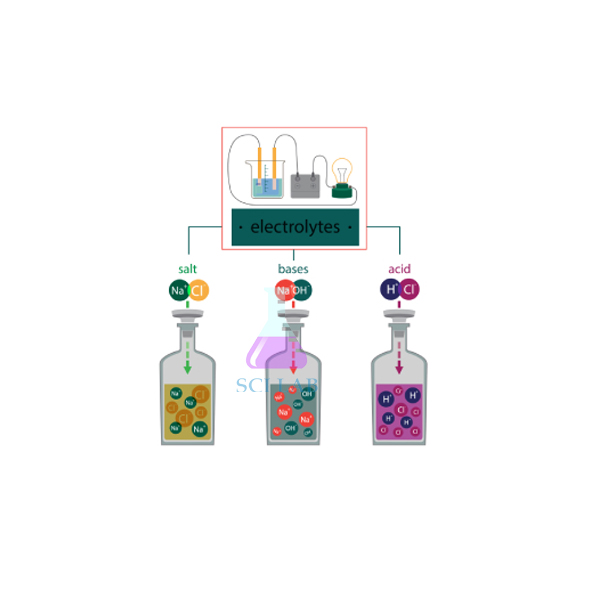
Electrolytic Breakdown is a 70 x 100 cm laminated wall chart for chemistry lessons on electrolysis: how electrolytes break down when a current passes through them. It is wall mounted in a classroom or laboratory next to the electrolysis bench.
Specifications of the Electrolysis Chart
| Specification | Value |
|---|---|
| Size | 70 x 100 cm |
| Mounting | Wall mounted |
| Finish | Laminated |
| Use | Classrooms and laboratory |
| Supplied by | Science Lab Supplies, Ambala, India |
Electrolysis Lessons with the Chart
Use the chart to name the electrodes and ions before switching on, then ask students to predict the products and check them in the experiment.
- Electrolysis of copper(II) chloride solution in the Apparatus for the Electrolysis of Salts: copper coats the cathode and chlorine forms at the anode.
- Water electrolysis in the Hofmann Voltameter: hydrogen and oxygen collect in a 2 to 1 volume ratio.
- Supply: run the cells from the Laboratory Power Supply, with a series resistor to keep the voltage low.
Common errors: swapping anode and cathode, and naming products as ions (chloride) instead of elements (chlorine).
Frequently Asked Questions
Why does solid salt not conduct electricity?
In the solid, the ions are held in fixed positions in the lattice and cannot move. When the salt melts or dissolves in water, the ions are free to move and carry charge.
Which ions go to each electrode?
Positive ions (cations) move to the negative electrode, the cathode, where they gain electrons. Negative ions (anions) move to the positive anode, where they lose electrons.
Why does sodium chloride solution not give sodium metal?
Water is present too. Hydrogen ions from water are discharged more easily than sodium ions, so hydrogen forms at the cathode. Molten sodium chloride, with no water, gives sodium.
Why are graphite or platinum electrodes used?
They are inert: they carry the current without reacting with the electrolyte or the products. A reactive metal anode such as copper can dissolve instead.
Related Electrochemistry Apparatus and Charts
- Apparatus for Demonstration of Electrolytic Processes: light bulb with carbon, copper, zinc, lead and brass electrodes.
- Apparatus for Electrical Conductivity of Electrolytes: four 250 ml cups and four bulbs in parallel.
- Apparatus for Demonstrating the Galvanic Element: zinc and copper plates with a galvanometer.
- Reduction Potential: 70 x 100 cm laminated wall chart.
- Power Supply Unit/ Block for DC: regulated 0 to 9 V, 2.5 A.
See the full Chemistry Lab list, or go up to School Lab Equipments.
Science Lab Supplies is able to export to schools and colleges in Qatar, Sri Lanka, Vietnam, Malaysia, Peru and Egypt under its Importer-Exporter Code. To get a quotation, reach us via the contact page or list the item in the enquiry cart.
Last updated: 14 November 2026