Ebonite Rod
Product Code : SCL-CL-11870
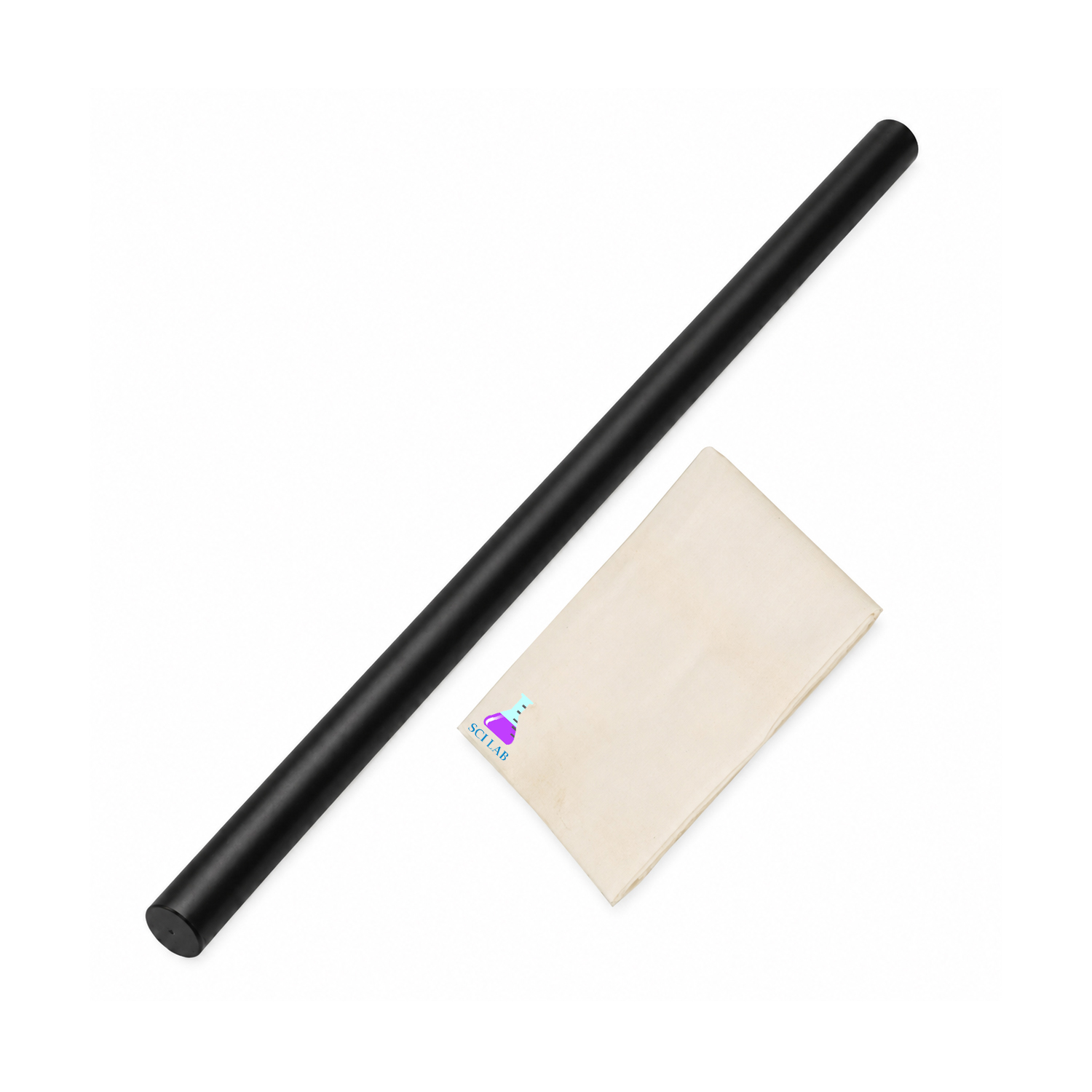
Ebonite Rod (SKU SCL-CL-11870) is a hard-rubber rod supplied with a matching piece of cloth for charging by friction, a basic tool for static electricity lessons. Rubbed with the cloth, it picks up a charge that can attract small objects or be detected with an electroscope. It suits middle-school science and Class 10–12 physics demonstrations and student practicals. Science Lab Supplies can send it from Ambala, India to schools, colleges, training institutes, distributors and tender contractors.
Specifications
The table records each fact about the ebonite rod and its rubbing cloth. In short, ebonite is vulcanised hard rubber, an insulator, so charge produced by rubbing stays on the rod instead of leaking away through the hand, and each rod comes with its own cloth for charging by friction and contact.
| Specification | Value |
|---|---|
| SKU | SCL-CL-11870 |
| Rod material | Ebonite (hard rubber) |
| Rubbing material | Corresponding piece of cloth |
| Charging method | Friction (rubbing with the cloth) |
| Concepts shown | Attraction, repulsion, induction and charging by contact |
| Works with | Electroscope, to detect charge |
| Use | Static electricity demonstrations and hands-on experiments |
| Supplied by | Science Lab Supplies, Ambala, India |
Applications and Experiments for the Ebonite Rod
The rod shows that rubbing two materials together separates charge, and that like charges repel while unlike charges attract. Paired with an electroscope it detects charge and demonstrates induction, topics found in NCERT Class 8 science and the electrostatics chapter of Class 12 physics, as well as in teacher-training sessions.
- Class 8 science: charging by rubbing and attracting small paper pieces.
- Class 10–12 physics: attraction and repulsion between charged rods, or charging the insulated spheres of the Apparatus for Distributing Electric Charges.
- Electroscope work: charging by contact and by induction, including the sheet electroscope in the Magnetic Kits set, which also holds a woollen rubbing cloth.
- B.Ed. and teacher-training sessions on demonstrating electrostatics.
Static experiments work more reliably in dry air; keep the rod and cloth clean and dry between lessons.
Standard Scope of Supply
Each Ebonite Rod is supplied with its corresponding piece of cloth, ready for charging by friction. An electroscope, a glass rod or suspended test objects are separate items, and any of them can be quoted on the same document so that a complete electrostatics bench arrives together.
Packing, MOQ and Lead Time
A quotation can be for a single rod for a teacher's desk or a set for every student group. Science Lab Supplies lists packing, delivery time and price for the quantity you name, and school chemistry lab equipment in India from the same list can be quoted together with it.
Under its Importer-Exporter Code, Science Lab Supplies is able to ship to buyers in Zambia, Rwanda, South Africa, Qatar, Sri Lanka and Vietnam. Rods can be added to the enquiry cart for pricing, any question about them can be raised on the contact page, and institutional purchasing is outlined on the lab tender page.
Frequently Asked Questions
What charge does an ebonite rod gain when rubbed?
In textbook demonstrations, rubbed ebonite gains electrons and becomes negatively charged, the opposite of a rubbed glass rod. Using both rods lets students show repulsion and attraction side by side.
Is a rubbing cloth included?
Yes. The rod comes with its corresponding piece of cloth, so it can be charged straight away and used with an electroscope or with small paper pieces on the bench.
Who supplies the Ebonite Rod?
Science Lab Supplies, working from Ambala, India, issues the quotation and dispatches the rod. Schools, colleges, training institutes, distributors and tender contractors can request single pieces or class quantities.
Why does the demonstration sometimes fail?
Moist air lets charge leak away quickly. Rub briskly, work in a dry room and keep the rod clean for clearer attraction and electroscope results during the lesson.
Related Electrostatics Apparatus
Static electricity lessons need a second charged material, a way to detect charge and objects to move. These items from the Chemistry Lab and Physics Lab ranges round out an electrostatics bench with the ebonite rod and can be quoted together on one enquiry.
- Glass Rod with Rubbing Material — glass rod and cloth; rubbing leaves the rod positively charged.
- Electrostatics Friction Rods Set — glass and ebonite rods of Ø12 × 200 mm with silk and synthetic-fur cloths.
- Electroscope — aluminium arrow on a plated blade inside a sheet metal case.
- Balls Styrofoam — 100 g pack of foam balls for electrostatic experiments.
- Demonstration Faraday Rage — cylindrical mesh body with a flat bottom plate for shielding demonstrations.
- Electrostatics Apparatus Set — 30 mm conducting spheres, a rod with paper strips, bells and chains.
- Van De Graaff Generator — motor-driven rubber belt charges a conducting sphere by friction.
Browse the full Chemistry Lab range, the Physics Lab range, or all school lab equipment.
Last updated: 9 October 2026
.jpg)