Laboratory Deioniser
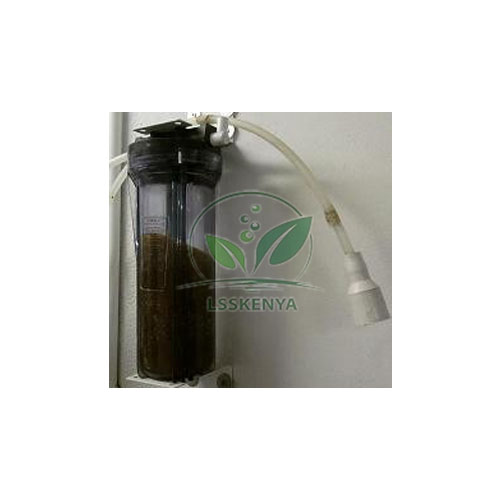
Product Code : LSK-CL-10054
The Laboratory Deioniser purifies tap water for laboratory use. Water flows through a cartridge of mixed bed resin that changes colour when it is used up. Typical output is up to 10 litres per hour, with conductivity of 0.06 to 10 µS/cm and dissolved solids below 0.5 ppm.
Specifications of the Laboratory Deioniser
| Specification | Value |
|---|---|
| Resin | Mixed bed, colour change resin to show cartridge exhaustion |
| Connections | Cartridge inlet and outlet accept flexible tubing |
| Feed | Operates directly from tap water |
| Output | Typical output and maximum flow rate 10 litres per hour |
| Water quality | Conductivity 0.06 to 10 µS/cm, pH 6.5 to 7.5, dissolved solids below 0.5 ppm |
| Included | Instructions |
| Supplied by | Science Lab Supplies, Ambala, India |
Using the Deioniser in the Lab
The inlet tube is pushed onto a tap and the outlet tube runs to a clean container. Water passes slowly through the resin, which swaps dissolved ions for hydrogen and hydroxide ions that combine to form water.
- Making up solutions: use deionised water for standard solutions, reagents and indicator, so tap-water ions do not upset results.
- Rinsing: fill a Wash Bottle for the final rinse of glassware, burettes and electrodes.
- Storage for the class: collect a day's supply in a Mariotte Bottle (Aspirator Bottle with Tap) for Distilled Water with a tap.
- Conductivity check: compare tap water and deionised water in a conductivity test to show what the resin removes.
Common errors: running the tap too fast, which shortens contact with the resin, and using water after the resin colour has changed.
Frequently Asked Questions
What is the difference between deionised and distilled water?
Deionised water is made by passing water through ion exchange resin, which removes charged mineral ions. Distilled water is boiled and condensed, which also leaves behind most uncharged impurities. For most school chemistry, deionised water is suitable.
What does a deioniser not remove?
Ion exchange removes only charged particles. Bacteria, fine particles and many uncharged organic substances can pass through. For work that needs water free of these, distilled water is the better choice.
How do I know when the cartridge needs replacing?
Watch the colour change resin. As the resin is used up, the colour change moves along the cartridge. When it reaches the outlet end, replace the cartridge before the water quality falls.
Why do cartridges run out faster in some regions?
Each cartridge holds a fixed amount of resin, and every ion it removes uses up part of that capacity. Hard tap water carries more dissolved salts, so the resin is spent after fewer litres than in a soft-water area. Labs on hard water should plan for more spare cartridges.
Why is conductivity, not pH, used to judge deionised water?
Pure water holds almost no ions, so a pH probe gives a slow, drifting reading in it, while conductivity responds directly to any ions left. A low, steady conductivity reading, within the 0.06 to 10 µS/cm the unit gives, is the usual check of deionised water.
What is needed to connect the deioniser in the lab?
A cold tap with steady mains pressure, flexible tubing from the tap to the cartridge inlet, and a second tube from the outlet to a clean container. Open the tap gently, since too fast a flow cuts the contact time with the resin.
Related Water Purification Items
- Distiller for Distilled Water: 1 to 2 litres per hour on single-phase 220 V.
- Liebig Condenser, 450 mm, 14/29 Joint: 450 mm glass condenser with 14/29 joint.
- Plastic Wash Bottle 250ml: round wash bottle with screw closure and riser tube.
- Bench Digital Ph Meter: reads pH 0.00 to 14.00 with temperature compensation.
- Apparatus for Electrical Conductivity of Electrolytes: four 250 ml cups with electrodes and bulbs in parallel.
Water purification and rinsing items appear in the Chemistry Lab range, under School Lab Equipments.
Science Lab Supplies holds an Importer-Exporter Code and can ship to laboratories in Nigeria, Kenya, Ghana, Ethiopia, Tanzania and Uganda. Quotation requests for the deioniser are taken on the contact page and through the enquiry cart.
Last updated: 15 November 2026