
Conical Flask (Erlenmeyer) with Stopper, 25-500 ml
Product Code : SCL-CL-11898
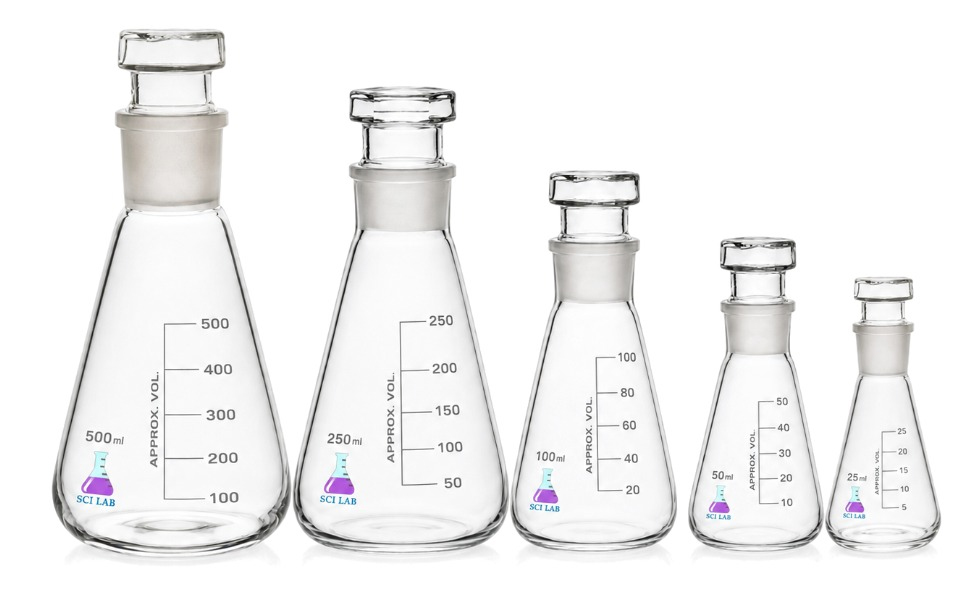
The Conical Flask (Erlenmeyer) with Stopper is a glass flask with a conical body and a ground glass fixed stopper. It comes in 25, 50, 100, 250 and 500 ml sizes, with a reinforced beaded rim, printed approximate graduations and a marking area for labels.
Specifications of the Conical Flask
| Specification | Value |
|---|---|
| Material | Glass |
| Capacities | 25 ml, 50 ml, 100 ml, 250 ml, 500 ml |
| Closure | Ground glass fixed stopper |
| Rim | Reinforced beaded rim for strength and safer pouring |
| Markings | Printed approximate graduations and a marking area |
| Supplied by | Science Lab Supplies, Ambala, India |
Swirling, Mixing and Titration with the Conical Flask
The sloping walls keep liquid inside while the flask is swirled by hand, and the narrow neck takes the stopper. In most bench titrations it is the vessel that receives the titrant.
- Acid-base titration: put a measured portion of alkali and a few drops of indicator in the flask, add acid from a Burette for Acids and swirl after each addition.
- Dissolving a solid: add a weighed solid to water, stir with a 200 x 4 mm Glass Stirring Rod or swirl until it dissolves, then stopper the flask to keep the solution.
- Warming a solution: take the stopper out and heat gently on a Wire Gauze over a burner, then let the flask cool before closing it.
Common errors: taking an exact volume from the printed marks, and heating the flask with the stopper in place.
Frequently Asked Questions
Can a solution be kept in the stoppered flask for a few days?
Yes, for short periods. The ground glass stopper slows evaporation and keeps dust out, so a solution made in one lesson can be used in the next. For longer storage, move it to a labelled reagent bottle.
Is the flask a good choice for growing crystals?
Not really. Crystals need the solvent to evaporate slowly from a wide surface, and the narrow neck holds the vapour in. A shallow crystallising dish or evaporating basin works better and makes the crystals easier to lift out.
What is the marking area on the flask for?
It is a space on the glass for writing with a pencil or glass marker. Note the contents, concentration and your initials there, so flasks standing side by side on the bench are not mixed up.
When should I use a volumetric flask instead?
Use the conical flask for mixing, swirling, reactions and titrations. Use a volumetric flask when a solution must be made up to one exact volume, such as a standard solution.
Related Flasks and Titration Glassware
- Flat-Bottomed Flasks 100ml: glass flask with a flat bottom and long mouth, 100 ml.
- Filter Flask (Buchner Flask) with Side Arm, 250 ml: 250 ml Erlenmeyer flask with a side arm for vacuum filtration.
- Graduated Pipettes: graduated clear glass pipette, 5 ml.
- Pipette Filler Bulb: creates suction for pipettes up to 25 ml.
- Burette Clamp: one-piece acetal clamp that holds a 50 ml burette on a 12 mm rod.
Browse the Chemistry Lab range or the full School Lab Equipments section.
Conical flasks can be packed for export to Malaysia, Peru, Egypt, Iraq, Nigeria and Kenya; Science Lab Supplies has the Importer-Exporter Code this needs. A quotation for the flasks can be requested on the contact page or by listing the sizes in the enquiry cart.
Last updated: 15 November 2026



.jpg)
.jpg)