
Compression Ignitor (Pneumatic)
Product Code : LSK-CL-10052
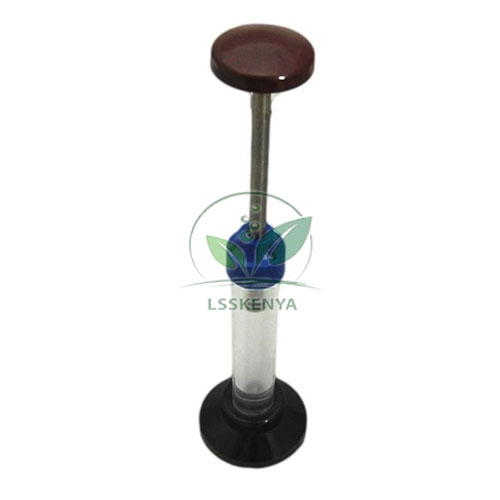
The Compression Ignitor (Pneumatic), also called a fire syringe or fire piston, shows that a gas heats up when it is compressed quickly. A plunger drives a piston down a heavy-walled combustion tube, and a wisp of cotton at the bottom ignites in a flash.
Specifications of the Compression Ignitor
| Specification | Value |
|---|---|
| Combustion tube | Heavy-walled tube with a piston and plunger |
| Outer cylinder | Transparent plastic, gives an unobstructed view of the action inside the tube |
| Demonstration | Generation of heat by a gas under rapid compression |
| Ignition material | Cotton placed at the bottom of the tube |
| Supplied by | Science Lab Supplies, Ambala, India |
Demonstrating Compression Heating with the Fire Syringe
A small, loose tuft of cotton is placed at the bottom of the tube and the piston is fitted. With the room darkened, the plunger is driven down in one sharp stroke and the flash is seen through the clear outer cylinder.
- Adiabatic compression (Class 11 physics and thermodynamics): the work done on the air raises its temperature because there is no time for heat to escape.
- Particle model: link the result to a Kinetic Theory Model, where faster spheres stand for hotter gas.
- Slow versus fast: push the plunger slowly first and show that nothing happens, then compare with Boyle's law work on the Boyle's Law Apparatus, where slow compression keeps the temperature steady.
- Diesel engines: use the demonstration to explain how a diesel engine ignites its fuel without a spark.
Precaution: point the unit away from people, use only a small piece of cotton, and let the tube cool and clear before the next run.
Frequently Asked Questions
Why does the cotton catch fire without a flame?
Pushing the piston does work on the air and raises its internal energy. Because the stroke is very fast, the heat cannot escape, so the air becomes hot enough to ignite the cotton.
Why must the plunger be pushed so quickly?
A slow push gives the heat time to flow into the tube walls, so the air never gets hot enough. Only a single, sharp, full stroke gives a near-adiabatic compression.
What should I check if the cotton does not ignite?
Use a smaller, fluffier piece of cotton, make sure the stroke is hard and full, and let fresh air into the tube between attempts. Burnt residue and stale air both make ignition harder.
Which syllabus topics can a school teach with the compression ignitor?
It supports lessons on the first law of thermodynamics, adiabatic compression, the link between work done on a gas and its temperature, and the diesel engine, which ignites its fuel by compression alone. It is usually shown as a teacher demonstration in upper secondary physics.
What is used up in each demonstration?
A small tuft of dry cotton wool is placed at the bottom of the tube for each firing, so a stock of cotton is the main item used up. Clear out burnt fibres before the next run, wear eye protection, and dim the room so the flash is easy to see.
Related Gas Law and Heat Apparatus
- Charles's Law Apparatus, U-Tube: glass U-tube with a beaker reservoir for volume against temperature of a fixed mass of gas.
- Hand Vacuum Pump with Pressure Gauge: 15 ml per stroke with a gauge in cm and inches of mercury.
- Calorimeter: 100 ml vessel with rubber stopper and metal stirrer.
- Thermometer (with no Mercury): glass thermometer reading -10 to 120 °C.
Browse the Heat range or the Physics Lab Equipment range.
Science Lab Supplies holds an Importer-Exporter Code and can ship to schools in Egypt, Iraq, Nigeria, Kenya, Ghana and Ethiopia. The compression ignitor can be added to the enquiry cart, or a quotation asked for on the contact page.
Last updated: 15 November 2026

