Apparatus for Preparing Hydrocarbon Gases
Product Code : SCL-CL-11453
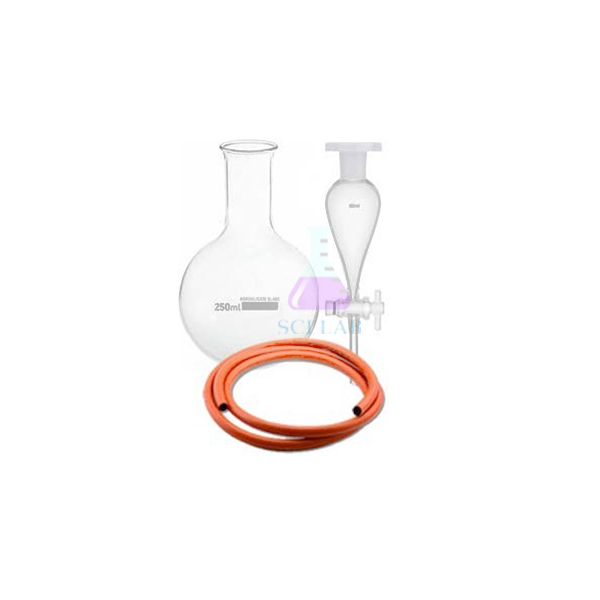
This apparatus is a glass set for preparing hydrocarbon gases such as ethyne and ethene in school practicals. It combines a 250 ml round-bottom flask, a 60 ml separating funnel for adding liquid a little at a time, and a gas delivery tube.
Specifications of the Hydrocarbon Gas Apparatus
| Specification | Value |
|---|---|
| Flask | Round-bottom, spherical, 250 ml |
| Separating funnel | 60 ml |
| Delivery | Gas delivery tube |
| Supplied by | Science Lab Supplies, Ambala, India |
Preparing Hydrocarbon Gases in the Lab
Clamp the flask on a Retort Stand with Boss Head and Clamp. The separating funnel feeds liquid onto the reagent in the flask, and its tap sets how fast gas forms. The delivery tube leads the gas to a trough, where it is collected over water.
- Ethyne: drip water from the funnel onto calcium carbide in the flask; no heating is needed.
- Ethene: heat ethanol with excess concentrated sulfuric acid using a Flask Heating Mantle, and pass the gas through sodium hydroxide solution to remove sulfur dioxide.
- Test for unsaturation: bubble the gas into bromine water and watch the orange colour disappear.
Safety: these gases are flammable. Keep flames away from the outlet, take the delivery tube out of the water before heating stops, and work in a fume cupboard.
Frequently Asked Questions
What is suck-back and how is it avoided?
When a heated flask cools, the gas inside contracts and can pull water from the trough back into the hot glass, which may crack. Take the delivery tube out of the water before you stop heating.
How do you show that the gas is unsaturated?
Bubble it through bromine water. Ethene and ethyne remove the orange colour quickly because bromine adds across the double or triple bond. Methane, which is saturated, does not react this way in the dark.
Why are hydrocarbon gases collected over water?
Ethene, ethyne and methane dissolve very little in water, so they push water out of an inverted container. You can see how much gas has formed and air is kept out.
Why use a separating funnel instead of an open funnel?
The tap lets you add liquid a little at a time. That controls the rate of a fast reaction, such as water on calcium carbide, and stops gas escaping back through the funnel.
Can ethene be made without concentrated acid?
Yes. Ethanol vapour passed over a heated catalyst such as porous pot or aluminium oxide loses water and gives ethene. That method uses a boiling tube and is often preferred in schools.
Related Flasks and Gas Glassware
- Round Bottom Flask, Long Neck, 250 ml: glass round-bottom flask of 250 ml with a long neck, heat resistant.
- Separating Funnel, Spherical, 125 ml: spherical 125 ml funnel with a tap and frosted stopper.
- Thistle Funnel: 30 cm stem for adding liquid low down in a narrow-necked flask.
- Simple Gas Preparation Kit: plastic tank with lid, five 150 x 24 mm test tubes, a thistle funnel and a delivery tube.
- Alcohol Lamp: 150 ml glass lamp with a PVC cap.
For more flasks and gas sets, open the Chemistry Lab page; all school ranges sit under School Lab Equipments.
Holding an Importer-Exporter Code, Science Lab Supplies can arrange export to Rwanda, South Africa, Qatar, Sri Lanka, Vietnam and Malaysia. Send a quotation request using the contact page, or place the item in the enquiry cart.
Last updated: 14 November 2026
.jpg)