
Air-Bearing Rotational System
Product Code : SCL-PL-12393
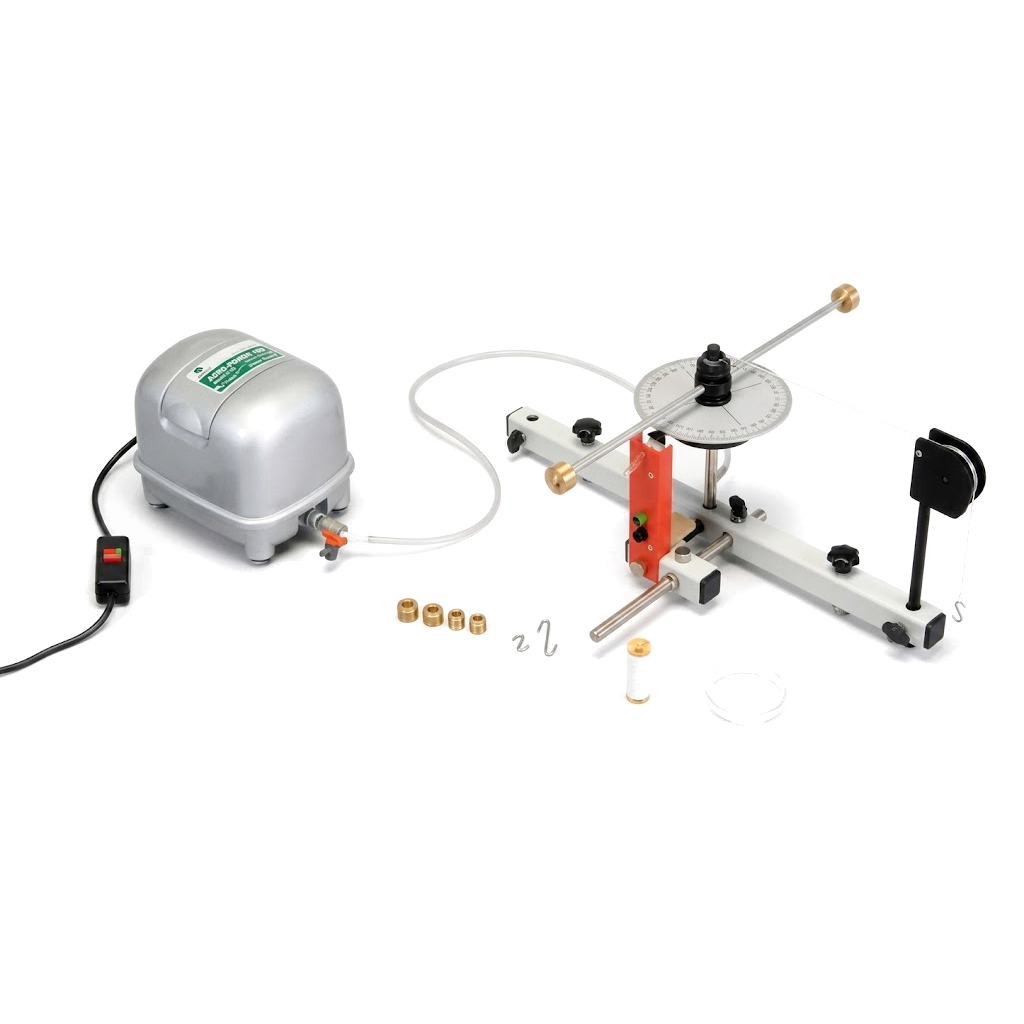
Air-Bearing Rotational System (SKU SCL-PL-12393) floats a rotating disk on a cushion of air so rotational motion can be studied with very little friction. A hanging mass on a thread applies a small torque through a multi-step pulley, and students measure the resulting angular motion. Science Lab Supplies manufactures the system at its Plot 448 factory, HSIIDC Industrial Area, Saha, Ambala, India, for colleges, schools, tender contractors and distributors.
Specifications
A mains-powered blower feeds the air bearing through a silicone tube with bypass valve, and the disk with crossbar turns against a 0–360° scale in 1° divisions. Torques from 0.05 to 0.60 mN·m are applied with S-hooks and a mass set.
| Parameter | Value |
|---|---|
| SKU | SCL-PL-12393 |
| Bearing | Air bearing fed by mains-powered blower/compressor |
| Air line | Silicone tube with bypass valve |
| Rotor | Rotating disk with crossbar, moment of inertia 0.16 g·m² |
| Angular scale | 0–360°, 1° divisions |
| Torque range | 0.05–0.60 mN·m |
| Drive | Multi-step pulley, pulley, cotton-thread spool, release mechanism |
| Masses | S-hooks 1.00 g and 2.00 g; 2 × 12.5 g, 2 × 25 g, 2 × 50 g |
| Support | Rods and clamps with levelling screws; levelling washer |
| Manufacturer | Science Lab Supplies, Saha, Ambala, Haryana |
| Country of origin | India |
Applications and Experiments for the Air-Bearing Rotational System
The system is used to verify the rotational form of Newton's second law: torque equals moment of inertia times angular acceleration. Changing the hanging mass or pulley step alters the torque, making it useful mechanics lab equipment in India for B.Sc. courses and Class 11 rotational motion.
- Class 11 physics: torque and angular acceleration.
- B.Sc. and B.Tech mechanics: moment of inertia of the disk from torque and angular acceleration.
- Comparing pulley steps at a constant hanging mass.
Level the base, then open the bypass valve gradually so the disk floats evenly.
Standard Scope of Supply
The system comprises the air bearing, disk with crossbar, multi-step pulley, pulley, release mechanism, S-hooks, the six-piece mass set of 12.5 g, 25 g and 50 g pieces, mains-powered air blower, silicone tube with bypass valve, support rods and clamps with levelling screws, levelling washer and cotton-thread spool.
Packing, MOQ and Lead Time
Request a price for one system for a demonstration bench or several for a university mechanics laboratory; the quotation gives packing, delivery time and price for that quantity. Timers, extra masses and other physics lab equipment in India from the range may be quoted alongside it.
Science Lab Supplies holds an Importer-Exporter Code and is able to ship to buyers in Saudi Arabia, Oman, the Philippines, Nepal, Bangladesh and Zambia. Reach us through the contact page, list your items in the enquiry cart, or consult the lab tender page for tender purchases.
Frequently Asked Questions
What torque range does the system provide?
The applied torque ranges from 0.05 to 0.60 mN·m, set by the choice of S-hook and masses and by the step of the multi-step pulley on which the thread is wound.
Why use an air bearing for rotational experiments?
The air cushion supports the disk with very little friction, so the small torques from the hanging masses produce clear angular acceleration that students can measure and compare with theory.
Is Science Lab Supplies the manufacturer or a trader?
Science Lab Supplies is the manufacturer of the rotational system. It is produced in the company’s own factory at Saha, Ambala, India, and colleges receive quotations directly from that factory.
What power does the system need?
The air blower or compressor that feeds the bearing is mains-powered. State your local mains supply when you enquire so the quotation can confirm a matching blower.
Related Dynamics Apparatus
The four items below extend low-friction dynamics beyond rotation. An Atwood machine studies linear acceleration over a pulley, an air track gives practically frictionless linear motion, an air-cushion table records motion in two dimensions and a mass set adds loads.
- Atwood Machine — friction-minimised pulley with cord and masses.
- Air Track — 2 m anodized aluminium track with gliders.
- Air-Cushion Table — 935 × 750 mm table with inkjet pucks.
- Mass Set with Hangers — steel masses from 10 g to 1000 g.
Browse the full Physics Lab range or all physics lab equipment.
Last updated: 25 September 2026



.png)
