
Pulley, Inline Triple
Product Code : LSK-PL-10368
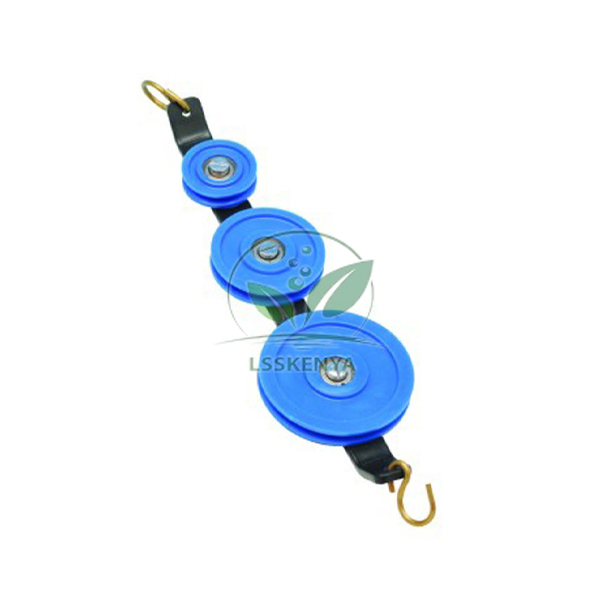
Pulley, Inline Triple (SKU LSK-PL-10368) is a three-wheel pulley block carrying 25, 38 and 50 mm pulleys on ball bearings in an open-sided frame with a hook at each end. With three wheels in one block, students can rig pulley systems with more supporting strands and larger mechanical advantage than a single or double block allows. It suits machines practicals in school and college mechanics. Science Lab Supplies is the manufacturer, working from Plot 448, HSIIDC Industrial Area, Saha, Ambala, India, and it sells the block directly to schools, colleges, tender contractors and distributors.
Specifications
Three pulleys of 25, 38 and 50 mm diameter sit in line on ball bearings inside an open-sided frame, with a hook at each end for hanging the block or attaching a load. The open side lets string be placed over each wheel without threading.
| Parameter | Value |
|---|---|
| SKU | LSK-PL-10368 |
| Number of pulleys | 3, in line |
| Pulley diameters | 25 mm, 38 mm and 50 mm |
| Bearings | Ball bearings |
| Frame | Open-sided, with hooks at each end |
| Manufacturer | Science Lab Supplies, Saha, Ambala, Haryana |
| Country of origin | India |
Applications and Experiments for the Inline Triple Pulley
Used as the moving or fixed block of a block and tackle, the triple pulley lets students build systems with up to six supporting string segments when paired with a second triple block. They can then compare measured and ideal mechanical advantage, a core part of machines lessons in ICSE Class 10 physics.
- ICSE Class 10 physics (machines): velocity ratio equal to the number of supporting strands, and efficiency.
- Comparing single, double and triple pulley systems for the same load.
- Engineering-foundation and college mechanics: effect of friction and pulley weight on efficiency.
Standard Scope of Supply
Each Pulley, Inline Triple is supplied as one block: the open-sided frame with hooks at both ends, carrying 25, 38 and 50 mm pulleys on ball bearings. String, masses and a support are not listed and can be added to the quotation.
Packing, MOQ and Lead Time
Whether you need one triple block or a matched pair for each practical group, the quotation will set out packing, delivery time and price for that number. Fixed pulleys, an Atwood machine or mass sets can join the same quotation.
Science Lab Supplies can ship to buyers in the UAE, Saudi Arabia, Oman, the Philippines, Nepal and Bangladesh as a registered exporter holding an Importer-Exporter Code. The business is registered under Udyam as a manufacturing enterprise (UDYAM-HR-01-0014546) and for GST (GSTIN 06ADEPJ0574F2ZU). Send questions via the contact page, shortlist items in the enquiry cart, or consult the lab tender page.
Frequently Asked Questions
What are the three pulley sizes?
The block holds pulleys of 25, 38 and 50 mm diameter, each running on ball bearings in one open-sided frame.
How is it different from the inline double pulley?
The Pulley, Inline Double carries two pulleys of 38 and 50 mm. The triple adds a 25 mm wheel, so a system built with it can have more supporting strands.
Does the string need threading through the frame?
No. The open-sided frame allows quick and easy stringing, because the string is laid over each pulley rather than threaded.
Is the triple pulley made by Science Lab Supplies or bought in?
Science Lab Supplies makes it in its own factory in Saha, Ambala, India. It is the manufacturer, not a trader, and the factory itself prepares the quotation.
Related Mechanics Apparatus
A triple block is used with a second pulley and a set of masses, and pulley dynamics extends to an Atwood arrangement. These four items from the same physics range extend pulley work and can be quoted together with the triple block.
- Pulley, Inline Double — 38 and 50 mm pulleys in an open-sided frame.
- Fixed Pulley — cast metal pulley with deep V-groove and top and bottom hooks.
- Atwood Machine — low-friction pulley with rod, clamp, cord and slotted masses.
- Mass Set with Hangers — steel masses from 10 g to 1000 g.
Browse the full Physics Lab range or all physics lab equipment.
Last updated: 25 September 2026



.png)