Plotting Compass
Product Code : LSK-PL-10305
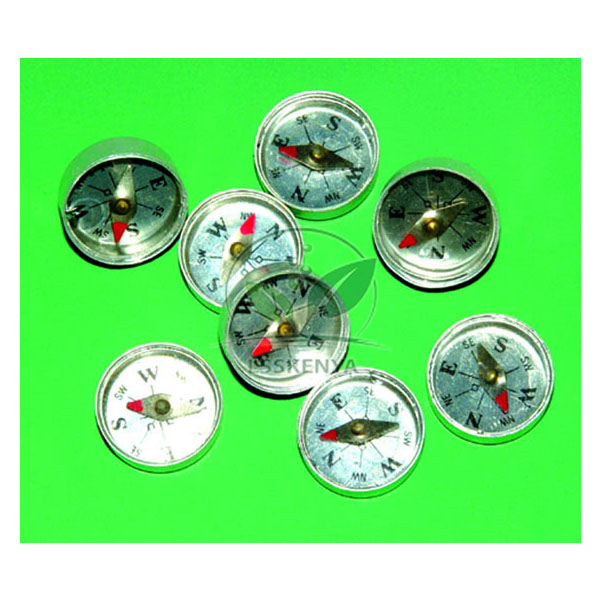
Plotting Compass (SKU LSK-PL-10305) is a small 16 mm compass in an aluminium case, glass faced on one side, used to trace the direction of magnetic field lines point by point around magnets and current-carrying conductors. It is a routine item in school and college magnetism practicals. Science Lab Supplies produces it at its manufacturing facility on Plot 448, HSIIDC Industrial Area, Saha, Ambala, India, and supplies it straight to schools, colleges, tender contractors and distributors.
Specifications
The compass has a 16 mm aluminium case with a glass face on one side, so the needle is visible from above while the case sits flat on paper. The dial is marked with the cardinal and ordinal points, which also makes it usable for simple direction-finding activities.
| Parameter | Value |
|---|---|
| SKU | LSK-PL-10305 |
| Diameter | 16 mm |
| Case | Aluminium |
| Face | Glass on one side |
| Dial | Cardinal and ordinal points marked |
| Manufacturer | Science Lab Supplies, Saha, Ambala, Haryana |
| Country of origin | India |
Applications and Experiments for the Plotting Compass
Placed on paper beside a magnet, the compass needle lines up with the local field. Students mark the ends of the needle, move the compass forward and repeat, building up field lines dot by dot. The small size gives fine resolution, which is why it is standard school physics lab equipment in India.
- NCERT Class 6 science: magnets, poles and finding directions.
- Class 10 science: field lines of a bar magnet and around a straight wire or coil.
- Class 12 physics: mapping fields and locating neutral points.
- B.Sc. magnetism practicals: plotting field patterns of magnet pairs.
Keep the compass away from strong magnets when stored, as this can weaken or reverse the needle's magnetism.
Standard Scope of Supply
Each Plotting Compass is supplied as a single unit: the 16 mm aluminium case with its glass face and marked dial. Magnets, drawing paper and the coil or wire for current-field work are separate, and compasses can be quoted in any number for class sets.
Packing, MOQ and Lead Time
Plotting compasses can be quoted singly or in class numbers, for example one or more per student pair. Give us the quantity and we will quote packing, delivery time and price for it; bar magnets and field-demonstration apparatus can join the same quotation for a complete magnetism bench.
Being a registered exporter with an Importer-Exporter Code, Science Lab Supplies can ship to buyers in the Philippines, Nepal, Bangladesh, Zambia, Rwanda and South Africa. Our sales desk answers through the contact page; you can also save items in the enquiry cart or consult the lab tender page.
Frequently Asked Questions
What is a plotting compass used for?
It is used to plot magnetic field lines. Moving the small compass step by step around a magnet or a current-carrying conductor and marking the needle's direction traces the shape of the field.
What size is the Plotting Compass?
It is 16 mm in diameter, in an aluminium case with a glass face on one side and a dial marked with the cardinal and ordinal points.
Is Science Lab Supplies the manufacturer or a trader?
A manufacturer. Science Lab Supplies makes these compasses at its own Saha, Ambala factory in India, and the factory itself handles your quotation.
Can it be used as an ordinary compass?
Yes. Because the dial carries the cardinal and ordinal points, it can also show directions in simple orientation activities, though its main purpose is field plotting.
Related Magnetism Apparatus
Field plotting needs a field to plot. These four items give bar magnets to trace around, a magnetic needle and a pocket compass for other direction and pole activities, and a round coil for mapping the field of a current, completing a magnetism practical set.
- Bar Magnets — magnets for field-line plotting.
- Magnetic Needle — showing magnetic direction.
- Pocket Compass — a compass for direction-finding.
- Magnetic Field Demo, Round Coil — the field around a current loop.
Browse the full Physics Lab range or all physics lab equipment.
Last updated: 25 September 2026