Digital Voltmeter
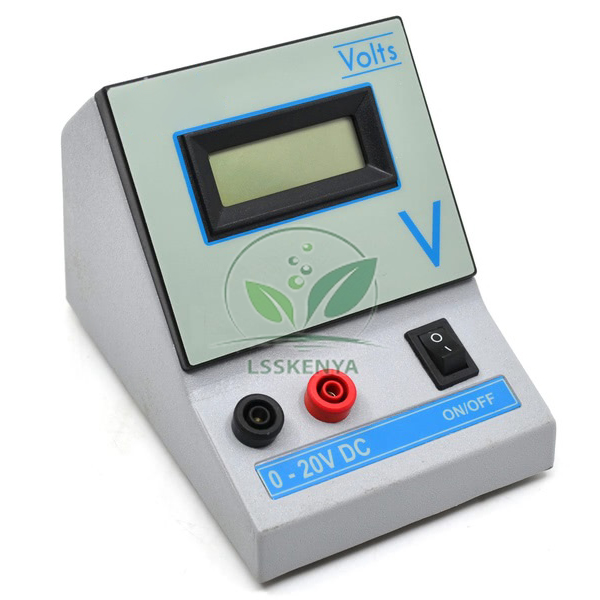
Product Code : LSK-PL-10323
Digital Voltmeter (SKU LSK-PL-10323) is a battery-powered DC voltmeter with a large LCD screen that reads potential difference from 0 to 20 V. Its light, portable design suits Ohm's law, cell and circuit practicals in school physics from Class 10 upward and in college electricity labs. Science Lab Supplies supplies this meter from Ambala, India, quoting it to schools, colleges, training institutes, tender contractors and distributors.
Specifications
The meter covers a single 0–20 V DC range and shows the reading on a large LCD. It runs on a 9 V battery, which is included and already fitted, so it is ready for use on arrival. The case measures 11.5 cm high, 12.5 cm long and 10 cm wide.
| Parameter | Value |
|---|---|
| SKU | LSK-PL-10323 |
| Range | 0–20 V DC |
| Display | Large LCD |
| Accuracy | +1 digit |
| Power | 9 V battery, included and pre-installed |
| Dimensions | 11.5 cm high x 12.5 cm long x 10 cm wide |
| Function | Measures the potential difference between two points |
| Supplied by | Science Lab Supplies, Ambala, India |
Applications and Experiments for the Digital Voltmeter
The voltmeter is connected in parallel across a component to read the potential difference between two points of a DC circuit. Low-voltage school circuits sit comfortably inside its 0–20 V range, and the digital display removes the parallax and scale-reading errors of a pointer meter.
- Class 10 electricity: verifying Ohm's law by plotting V against I for a resistor.
- Class 12 current electricity: measuring the terminal voltage of a cell under different loads.
- Comparing potential differences across resistors in series and parallel circuits.
- Checking the output of low-voltage DC supplies and battery packs before a practical.
Standard Scope of Supply
Each Digital Voltmeter is supplied as a single unit with its 9 V battery included and pre-installed. Connecting leads are not listed in the specification; if you need them, add suitable leads to the same enquiry and the quotation will show them as a separate line item.
Packing, MOQ and Lead Time
Ask for one voltmeter or a set for every workstation in the electricity lab; the quotation you receive gives the packing, delivery time and price for that exact quantity. Ammeters, leads and other physics lab equipment in India can be added to the same quotation so a whole circuits bench is priced at once.
Holding an Importer-Exporter Code as a registered exporter, Science Lab Supplies is able to ship to buyers in Uganda, the UAE, Saudi Arabia, Oman, the Philippines and Nepal. Send your requirement via the contact page or the enquiry cart; tender buyers can also use the lab tender page.
Frequently Asked Questions
What voltage range does the Digital Voltmeter cover?
It reads 0–20 V DC. That range covers the cells, battery packs and low-voltage supplies used in most school and college circuit experiments.
Does the voltmeter need a mains supply?
No. It operates on a 9 V battery, which is included and pre-installed, so the meter can be used on any bench without a mains connection.
Who supplies the Digital Voltmeter?
Science Lab Supplies, based in Ambala, India, supplies this voltmeter and prepares the quotation, packing and dispatch for your order.
Can it measure AC voltage or current?
The specification lists a DC voltage range only. For current, pair it with an ammeter, or use a multimeter where several quantities are needed.
Related Electrical Measuring Instruments
These four items complete a circuits bench around the digital voltmeter: an analogue alternative on the same range, a multimeter for current and resistance, an ammeter for the current side of Ohm's law, and plug leads to connect everything, all available on one quotation.
- Voltmeter — analogue moving-coil bench voltmeter, 0–20 V DC.
- Digital Multimeter — voltage, current and resistance with diode and continuity tests.
- Ammeter — analogue 0–10 A meter for measuring circuit current.
- Connecting Leads with 4 mm Safety Plugs — pack of 10 leads with 4 mm plugs at both ends.
See the complete Physics Lab range or browse all physics lab equipment.
Last updated: 25 September 2026