Newton’s Colour Disc
Product Code : LSK-PL-10337
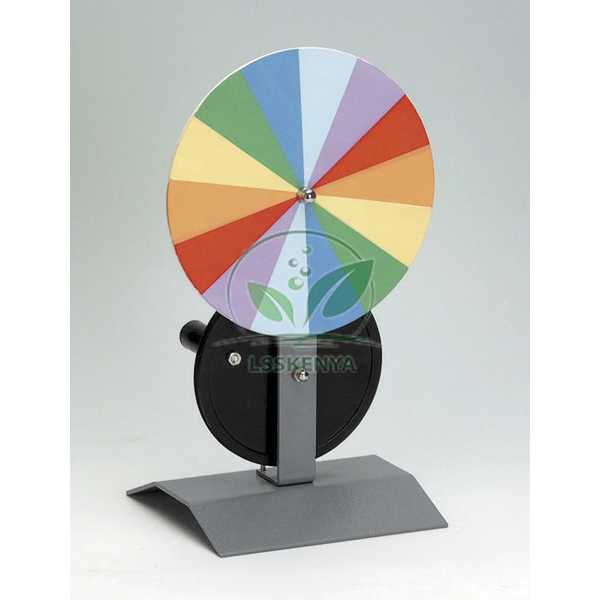
Newton’s Colour Disc (SKU LSK-PL-10337) is a hand-driven demonstration that white light can be made from all the spectral colours. A 180 mm multi-coloured disc on a metal stand is spun by a belt from a hand wheel until the colours blend. Science teachers use it in middle-school and secondary lessons on light and colour. Science Lab Supplies manufactures the disc in its Saha, Ambala factory (Plot 448, HSIIDC Industrial Area) and sells direct to schools, colleges, tender contractors and distributors.
Specifications
The unit is a 180 mm diameter disc coloured in the spectral colours and carried on a metal stand. A hand-driven wheel turns the disc through a belt, so the demonstrator can raise the speed steadily until the separate colours can no longer be told apart.
| Parameter | Value |
|---|---|
| SKU | LSK-PL-10337 |
| Disc diameter | 180 mm |
| Disc | Multi-coloured, spectral colours |
| Drive | Belt from a hand-driven wheel |
| Mounting | Metal stand |
| Manufacturer | Science Lab Supplies, Saha, Ambala, Haryana |
| Country of origin | India |
Applications and Experiments for the Newton’s Colour Disc
The colour disc shows the reverse of dispersion: a prism splits white light into colours, and the spinning disc recombines them in the eye. It supports lessons on light and colour from middle school upwards and sits well with prisms and ray boxes in school physics lab equipment in India.
- Middle-school science: white light is made up of several colours.
- NCERT Class 10 science, the human eye and the colourful world: linking dispersion by a prism to recombination.
- Science exhibitions and teacher-training demonstrations on persistence of vision.
Standard Scope of Supply
Each unit is supplied as described above: the 180 mm multi-coloured disc mounted on its metal stand, with the belt and hand-driven wheel that spin it. Any optional items you want alongside it, such as prisms or filters, are listed separately on the quotation.
Packing, MOQ and Lead Time
Quotations can be raised for one colour disc or for enough units to equip every science room in a school group. Each quote sets out the packing, delivery time and price for the quantity you name, and other light-and-colour items can be added to the same document.
Holding an Importer-Exporter Code as a registered exporter, Science Lab Supplies is able to ship to buyers in Peru, Egypt, Iraq, Nigeria, Kenya and Ghana. To start an order, write through the contact page, collect items in the enquiry cart, or check the lab tender page for institutional purchases.
Frequently Asked Questions
What does Newton’s Colour Disc demonstrate?
It shows that white light is a mixture of the spectral colours. When the multi-coloured disc spins fast, the colours merge and the disc looks pale, the reverse of splitting light with a prism.
How is the disc turned?
By hand. A belt links the disc to a hand-driven wheel on the metal stand, so the demonstrator controls the speed directly during the lesson.
Why does the spinning disc look greyish rather than pure white?
The coloured sectors reflect mixtures of wavelengths rather than pure spectral colours, so the blend is a light tint. Students can still see clearly that the colours combine.
Does Science Lab Supplies make this disc itself?
Yes. It is a manufacturer, not a trading house: the colour disc is built in its own factory at Saha, Ambala, and every quotation is issued by the factory itself.
Related Light and Colour Equipment
These four items from the same Physics Lab range extend a light-and-colour lesson: two further colour discs for comparison, filters for colour mixing and absorption, and a ray box for reflection and refraction work. All can go on one quotation with the hand-driven disc.
- Newton's Disc — motor-driven version with a removable 150 mm PVC disc.
- Optical Device for Color Demonstration, Color Disk — 200 mm disc with LED lighting.
- Color Filter Set — six primary and secondary colour filters.
- Raybox with Accessories — single or multiple rays with slit masks and lens.
Browse the full Physics Lab range or all physics lab equipment.
Last updated: 25 September 2026