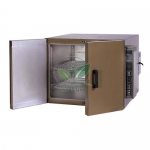
Soil Volume Change Meter

Product Code : LSK-SM-10657
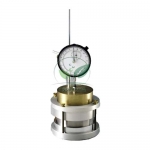
Soil Volume Change Meter (SKU LSK-SM-10657), often called the PVC (potential volume change) meter, gives a quick rating of how much an expansive soil is likely to swell. A small compacted specimen is confined in a ring and wetted, and the pressure it develops is read on a proving ring. Geotechnical and highway labs in engineering colleges, polytechnics and TVET institutes use it to screen clays. Science Lab Supplies supplies the meter from Ambala, India to institutes, colleges, tender contractors and distributors.
Specifications
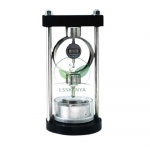
A 70 mm (2-3/4 in) specimen ring sits in a mould assembly with porous stones and a loading cap, and loading pistons pass the swell to a 4.5 kN (1,000 lb) proving ring with dial indicator. A compaction hammer prepares the specimen, and charts convert the reading to lb/sq ft and then to a PVC rating.
| Parameter | Value |
|---|---|
| SKU | LSK-SM-10657 |
| Specimen ring | 70 mm (2-3/4 in) diameter |
| Sample size | 10 teaspoons of soil |
| Water required | 140 g (5 oz) |
| Mould assembly | Porous stones and loading cap |
| Proving ring | 4.5 kN (1,000 lb), dial indicator |
| Other components | Loading pistons, compaction hammer |
| Charts | Convert readings to lb/sq ft, then to PVC rating |
| Supplied by | Science Lab Supplies, Ambala, India |
Applications and Experiments for the Soil Volume Change Meter
The meter identifies expansive clays before they are used under floors, pavements or light foundations. Because each test needs only a small sample and 140 g of water, a class can compare several soils in one session in degree, diploma and TVET geotechnical and highway practicals.
- B.E./B.Tech civil engineering: identifying expansive soils and their swell potential.
- Diploma civil engineering: comparing the swell of different clays for foundation work.
- TVET civil and road construction modules: screening subgrade and fill materials.
Standard Scope of Supply
The meter is supplied with its mould assembly with porous stones and loading cap, the 70 mm specimen ring, loading pistons, compaction hammer, the 4.5 kN proving ring with dial indicator, and the conversion charts. Soil preparation items such as mixing dishes can be added to the quotation.
Packing, MOQ and Lead Time
Quotations cover a single meter or several for group work, with packing, delivery time and price stated for the quantity. Shrinkage, consolidation and swell test equipment can be combined on the same quotation for a complete expansive-soil practical.
Science Lab Supplies is a registered exporter with an Importer-Exporter Code, able to ship to buyers in the Philippines, Nepal, Bangladesh, Zambia, Rwanda and South Africa. Ask questions on the contact page, list items in the enquiry cart, or see the lab tender page for public tenders.
Frequently Asked Questions
What does PVC mean on the Soil Volume Change Meter?
Potential volume change: a rating of how strongly a soil tends to swell when wetted. The charts convert the proving ring reading to lb/sq ft and then to the PVC rating.
How much soil and water does a test need?
About 10 teaspoons of soil and 140 g (5 oz) of water, compacted in the 70 mm specimen ring with the hammer provided.
What is the proving ring capacity?
4.5 kN (1,000 lb), read on a dial indicator. It records the pressure the confined specimen exerts as it takes up water.
Who supplies the Soil Volume Change Meter?
From Ambala, India, Science Lab Supplies supplies the meter as part of its vocational training equipment for soil labs, quoting it with any related items.
Related Expansive Soil Testing Equipment
A PVC rating is normally checked against other swell, shrinkage and consistency tests on the same clay. These four items from the Soil Mechanics range complete an expansive-soil study and can be quoted with the meter.
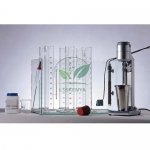
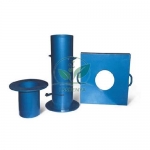
- Expansion Index Test Apparatus — expansion index of compacted soil.
- Shrinkage Limit Set — shrinkage limit and ratio of the same clay.
- Consolidation Apparatus — compression and settlement under load.
- Hand Operated Casagrande Equipment — liquid limit for plasticity.
Browse the full Soil Mechanics range or all TVET lab equipment.
Last updated: 25 September 2026