Plastic Limit Set
Product Code : LSK-SM-10665
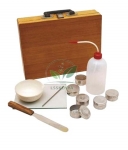
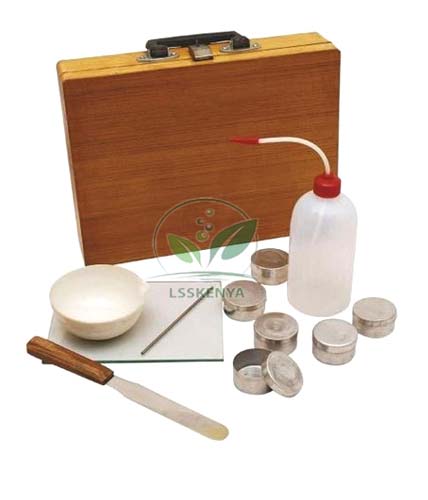
Plastic Limit Set (SKU LSK-SM-10665) is a kit of hand tools for the classic plastic limit test, in which moist soil is rolled on a glass plate into a 3 mm thread until it begins to crumble. It covers mixing, rolling, comparison and moisture sampling for soil mechanics classes in engineering colleges, polytechnics and TVET centres. Science Lab Supplies delivers the set from Ambala, India to institutes, tender contractors and distributors.
Specifications
The set pairs a frosted glass plate for rolling with a 3 mm reference rod for judging thread diameter. A porcelain basin and flexible spatula are provided for mixing, with six moisture containers for sampling and a 500 ml wash bottle for adding water in small steps.
| Parameter | Value |
|---|---|
| SKU | LSK-SM-10665 |
| Reference rod | Brass or stainless steel, 3 mm dia x 150 mm long |
| Rolling plate | Glass, 20 x 15 cm, ground ends, one side frosted |
| Mixing basin | Porcelain, 150 mm dia |
| Spatula | Flexible |
| Moisture containers | Set of 6 |
| Wash bottle | Plastic, 500 ml |
| Supplied by | Science Lab Supplies, Ambala, India |
Applications and Experiments for the Plastic Limit Set
The plastic limit is the water content at which a soil just begins to crumble when rolled into a 3 mm thread. This set provides what is needed to reach that point and sample the thread, so the result can be paired with the liquid limit to give the plasticity index.
- B.Tech / B.E. civil engineering: Atterberg limits and plasticity index for soil classification.
- Diploma civil engineering: identifying clays and silts by their plastic behaviour.
- TVET building and road construction modules: assessing clay soils for fill and embankments.
Standard Scope of Supply
The set comprises one 3 mm x 150 mm rod in brass or stainless steel, one flexible spatula, six moisture containers, one 20 x 15 cm glass plate with ground ends and one frosted side, one 150 mm porcelain basin and one 500 ml plastic wash bottle. A balance and a drying oven are separate items.
Packing, MOQ and Lead Time
Plastic limit sets are often ordered by the bench, so a quotation can cover a single kit or a whole class and states the packing, delivery time and price for that number. Liquid limit devices and an oven may be added, which suits institutes buying vocational training equipment in one lot.
Registered as an exporter with an Importer-Exporter Code, Science Lab Supplies can ship to buyers in Vietnam, Malaysia, Peru, Egypt, Iraq and Nigeria. Send your list through the contact page or the enquiry cart, and use the lab tender page for tender enquiries.
Frequently Asked Questions
What is the 3 mm rod for?
It is a reference for thread thickness. When the rolled soil thread reaches the rod's 3 mm diameter and just begins to crumble, the soil is at its plastic limit.
Why is the glass plate frosted on one side?
The frosted face gives a slightly rough rolling surface, so the thread rolls rather than slides. The ground ends remove sharp edges from the 20 x 15 cm plate.
Who supplies the Plastic Limit Set?
Science Lab Supplies ships the set from Ambala, India to engineering colleges, polytechnics and training centres, as well as to trade buyers such as contractors and distributors.
How does it compare with the Plastic Limit Roller?
This set follows the hand-rolling method with a glass plate and reference rod, while the roller forms the thread between two plates with 3.2 mm rails. Many labs teach both.
Related Soil Consistency Test Equipment
To finish the consistency tests that start with this kit, labs usually add a mechanical roller for comparison, a liquid limit device for the plasticity index and an oven for drying moisture samples. All four come from the Soil Mechanics range and fit on one quotation.
- Plastic Limit Roller — mechanical alternative with 3.2 mm rails.
- Hand Operated Casagrande Equipment — liquid limit for the plasticity index.
- Cone Penetrometer — cone-method liquid limit for low-plasticity soils.
- Laboratory Bench Oven — dries the moisture containers.
Browse the full Soil Mechanics range or all TVET lab equipment.
Last updated: 25 September 2026