Spoon-Spatula
Product Code : SCL-CL-11569
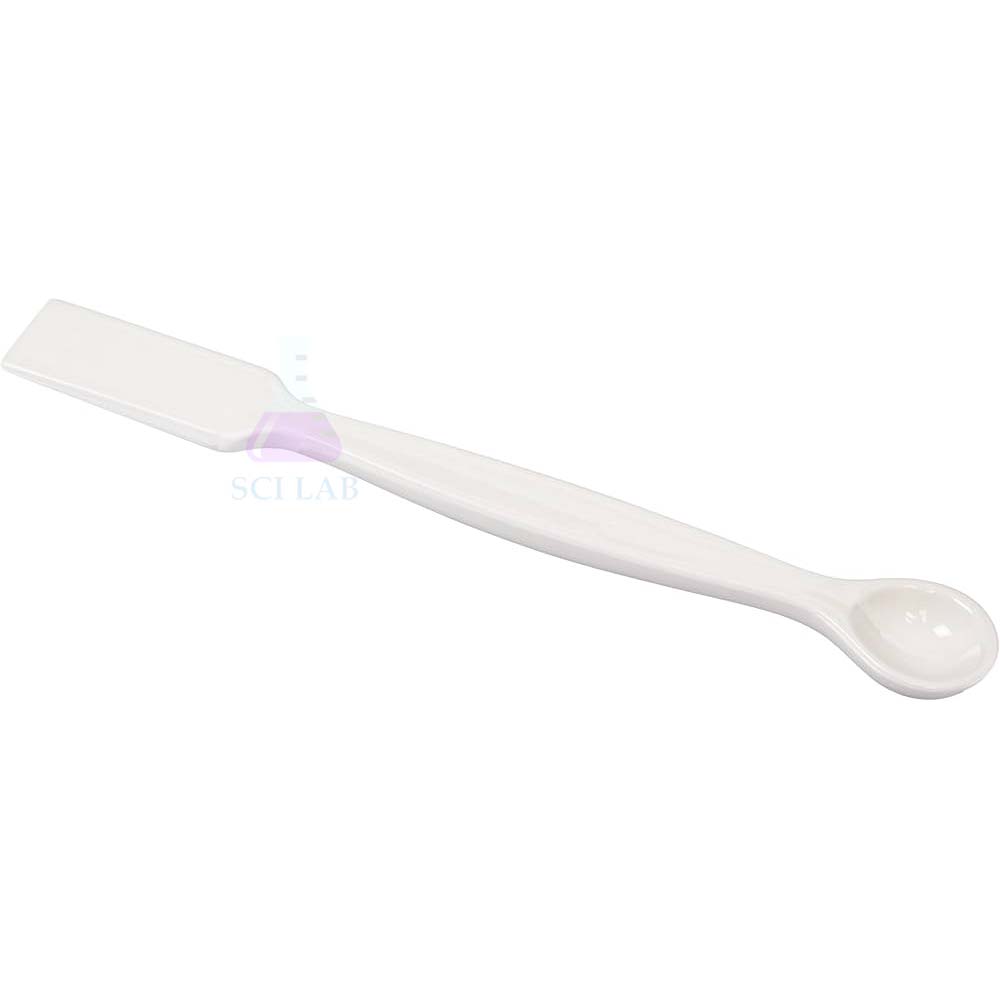
Spoon-Spatula (SKU SCL-CL-11569) is a 115 mm white porcelain tool with a small spoon at one end and a flat spatula at the other, used to scoop, transfer and level small amounts of powders and crystals. Because porcelain does not react with most reagents, it suits chemistry, biology and pharmacy benches in schools and colleges. It reaches schools, colleges, training institutes, tender contractors and distributors from Science Lab Supplies in Ambala, India.
Specifications
The spoon-spatula is made entirely of white, chemical-resistant porcelain and measures 115 mm in length. A non-metallic tool avoids contaminating samples with metal and is useful with reagents that would corrode a steel spatula.
| Parameter | Value |
|---|---|
| SKU | SCL-CL-11569 |
| Material | Porcelain, chemical resistant |
| Length | 115 mm |
| Colour | White |
| Use | Laboratory |
| Supplied by | Science Lab Supplies, Ambala, India |
Applications and Experiments for the Spoon-Spatula
Almost every practical that uses a solid reagent starts with a spatula. The porcelain spoon-spatula measures out small portions for tests, moves crystals from a filter paper and scrapes residues from dishes, and it is a basic piece of school chemistry lab equipment in India for students at every level.
- Class 6–10 science: taking small amounts of salts and powders for simple chemical tests.
- Class 11–12 chemistry: transferring salts for qualitative analysis and weighing.
- B.Sc. and pharmacy labs: handling reactive or corrosive solids where a metal spatula is unsuitable.
Porcelain is hard but brittle, so store the spatulas in a rack or drawer tray rather than loose, and wash and dry them between reagents.
Standard Scope of Supply
The Spoon-Spatula is supplied as a single 115 mm porcelain tool as described above. Metal spatulas, spoons and storage trays are separate items; any optional accessories are listed on the quotation.
Packing, MOQ and Lead Time
These spatulas are usually ordered in class quantities, though a single piece can be quoted too. The quotation confirms packing, delivery time and price for your number, and mortars, spoons or other chemistry lab instruments can be quoted together with them.
Science Lab Supplies has an Importer-Exporter Code as a registered exporter and can ship to buyers in Peru, Egypt, Iraq, Nigeria, Kenya and Ghana. The contact page takes questions, the enquiry cart takes item lists, and the lab tender page takes tender requirements.
Frequently Asked Questions
Why choose a porcelain spatula over a metal one?
Porcelain resists most chemicals and does not add metal contamination, so it is preferred for reactive or corrosive solids and for samples that must stay metal-free.
How long is it?
The spoon-spatula is 115 mm long, a comfortable size for bench work with reagent bottles, weighing boats and small dishes.
Who supplies the Spoon-Spatula?
Science Lab Supplies supplies it from Ambala, India, and handles quotations for schools, colleges, distributors and tender contractors.
Can it be heated?
Porcelain tolerates heat, but sudden temperature changes can crack it. Let it warm and cool gradually and do not plunge a hot spatula into water.
Related Spatulas and Spoons
Different reagents and quantities call for different tools. The items below add metal spatulas, spoons for measuring out substances, and a mortar for grinding solids before they are transferred, so a bench can carry a full set of handling tools.
- Spatula — another spatula for general bench use.
- Laboratory Spoons — spoons for measuring out solids.
- Spoon for Substances — for taking portions of reagents.
- Porcelain Mortar and Pestle — 80 mm mortar for grinding solids first.
Browse the full Chemistry Lab range or all school lab equipment.
Last updated: 25 September 2026
.jpg)