Glass Rod with Rubbing Material
Product Code : SCL-CL-11871
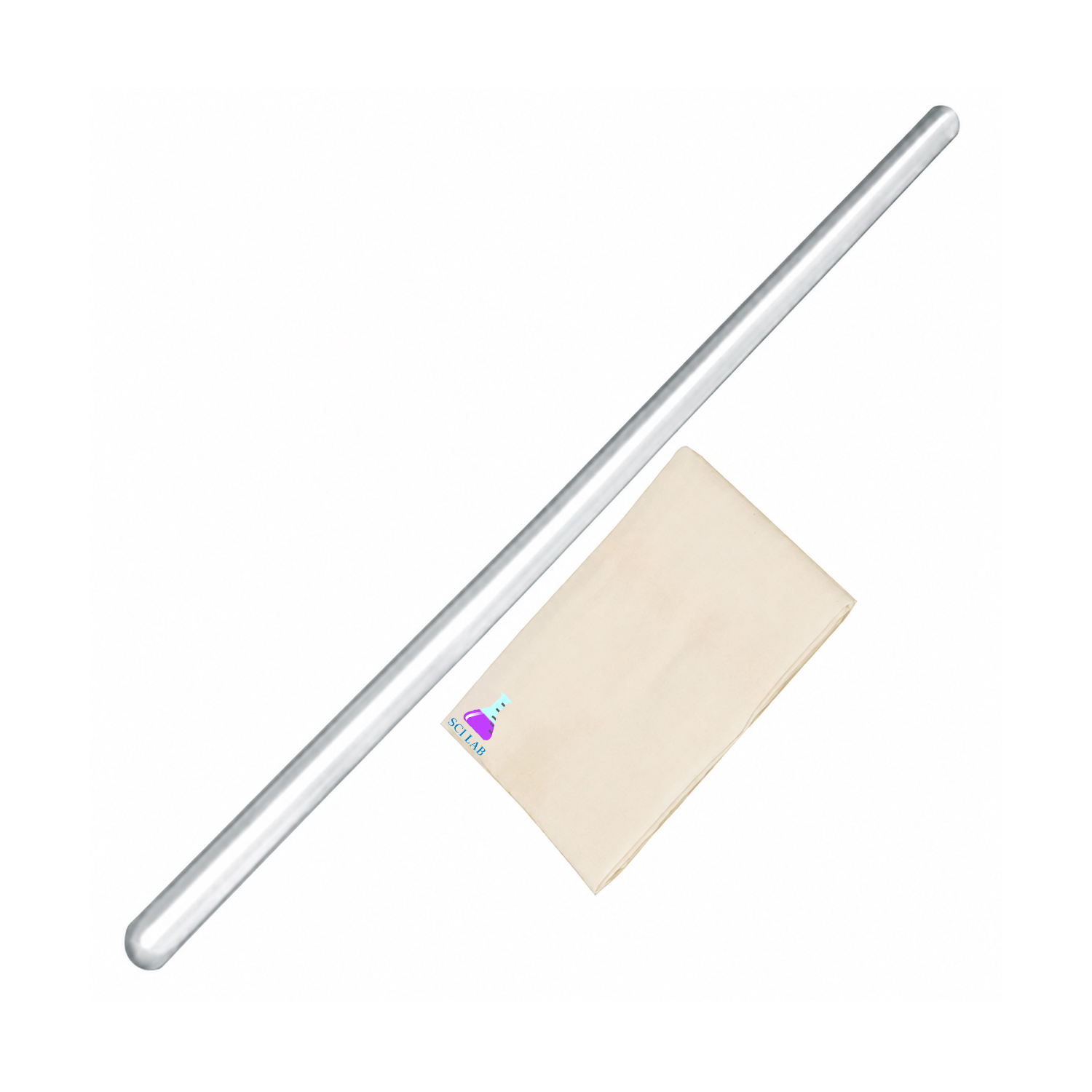
Glass Rod with Rubbing Material (SKU SCL-CL-11871) is a glass rod paired with a matching piece of cloth for producing static electricity by friction. When the two are rubbed together, electrons move from the glass to the cloth, leaving the rod positively charged. Science teachers use the pair in Class 8 lessons and Class 10–12 physics demonstrations. Buyers such as schools, colleges, training institutes, distributors and tender contractors receive it from Science Lab Supplies in Ambala, India.
Specifications
The set is simply the glass rod and its corresponding cloth. Rubbing transfers electrons from glass to cloth, so the rod ends up positive and the cloth negative, and the charged rod can then attract small neutral objects such as paper bits, dust or other lightweight materials.
| Parameter | Value |
|---|---|
| SKU | SCL-CL-11871 |
| Model no. | SCI/LSS-1457 |
| Contents | Glass rod with corresponding piece of cloth |
| Charge after rubbing | Rod positive, cloth negative |
| Demonstrates | Static electricity by friction and electrostatic attraction |
| Supplied by | Science Lab Supplies, Ambala, India |
Applications and Experiments for the Glass Rod with Rubbing Material
This pair gives students a positive charge to work with, so it complements a negatively charged rod in attraction and repulsion tests. It covers static electricity in NCERT Class 8 science, electric charges and fields in Class 12 physics, and hands-on demonstrations in school laboratories and teacher training.
- Class 8 science: attracting bits of paper with a rubbed rod.
- Class 12 physics: two kinds of charge and the rule that like charges repel.
- Electroscope practicals: charging the instrument positively.
Standard Scope of Supply
Each set is supplied as the glass rod with its corresponding piece of cloth, ready for rubbing. Test objects, an electroscope and a second rod of another material are not part of the set, and any optional items you request are listed separately on the quotation.
Packing, MOQ and Lead Time
Ask for one set for demonstration use or several for group work; every quotation spells out the packing, delivery time and price for that quantity. As a laboratory glassware supplier in India, Science Lab Supplies can add other glass items from your list to the same quotation.
Science Lab Supplies has an Importer-Exporter Code and can ship to buyers in Rwanda, South Africa, Qatar, Sri Lanka, Vietnam and Malaysia. Your enquiry can come through the enquiry cart or the contact page, while the lab tender page explains tender quotations.
Frequently Asked Questions
Why does the glass rod become positively charged?
Rubbing moves electrons from the glass onto the cloth. The glass is left short of electrons, so it carries a positive charge, while the cloth gains them and becomes negative.
What can the charged rod attract?
Small neutral objects such as paper bits, dust particles or other lightweight materials, which is the usual first demonstration of electrostatic attraction.
Who supplies the Glass Rod with Rubbing Material?
Science Lab Supplies supplies this set from Ambala, India. Schools, colleges, training institutes, distributors and tender contractors can request a quotation for any quantity.
How should the glass rod be handled?
Hold it by one end, keep it dry and store it where it cannot roll off the bench. Replace any chipped rod, since broken glass edges are sharp.
Related Static Electricity Apparatus
A positively charged glass rod is most useful alongside a rod that charges negatively, an instrument that detects charge and light objects to push around. These four items build that set for a school electrostatics lesson and fit on the same quotation.
- Ebonite Rod — hard-rubber rod with cloth for the opposite charge.
- Electroscope — shows when the rod is charged.
- Balls Styrofoam — foam spheres for attraction and repulsion.
- Demonstration Faraday Rage — demonstrates electrostatic shielding.
Browse the full Chemistry Lab range or all school lab equipment.
Last updated: 25 September 2026

.jpg)
.jpg)
.jpg)